
The End of One-Size-Fits-All Recommendations
You’ve seen the old version of personalization. “Customers who bought this also bought that.” A carousel of products algorithmically guessed from your last purchase. A homepage that looks the same for everyone with minor variations based on browsing history.
That traditional model is being replaced, and it’s changing fast.
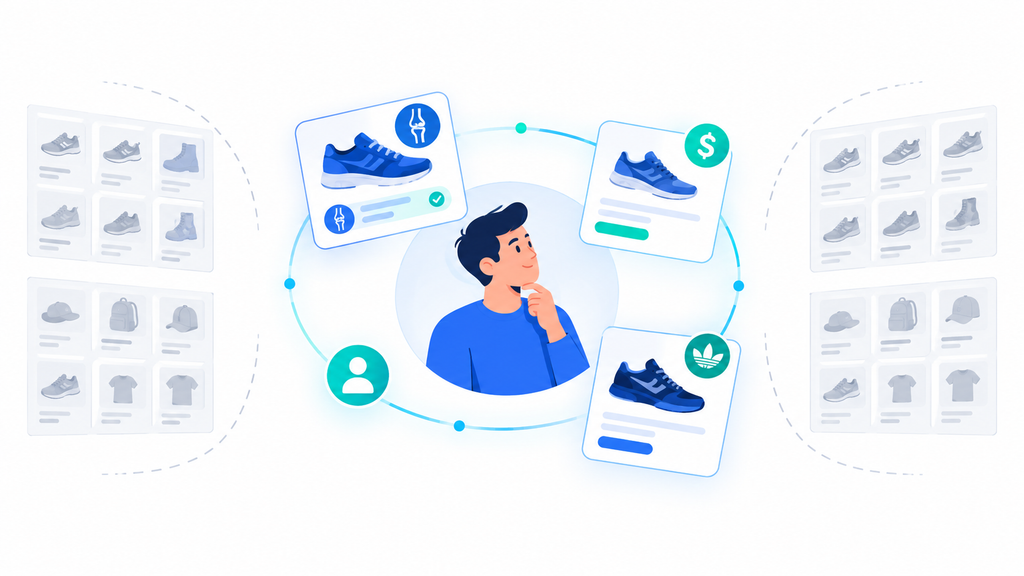
Agentic product personalization is something different in kind, not just in degree. Instead of an algorithm showing you products it thinks you might like, an AI agent reasons through your actual goals, constraints, and personal context to deliver experiences that feel genuinely tailored to you. Not tailored to your demographic. To you specifically.
The numbers show this shift is already happening. During Cyber Week, AI agent-influenced sales reached $67 billion, with AI agents influencing 20% of all purchases. By 2030, nearly 50% of online shoppers are expected to use AI agents, accounting for roughly 25% of their spending. This will add an estimated $115 billion to the US e-commerce sector.
For website owners, SaaS products, and e-commerce brands, understanding how agentic personalization works and how to prepare for it is no longer optional.
This is why I’ve come out with this comprehensive agentic product personalization.
What Is Agentic Product Personalization?
Traditional personalization is passive. It watches what you click, then shows more of the same. It’s reactive, based on past behavior, and still requires you to do most of the searching and filtering yourself.
On the other side, the agentic personalization is active. An AI agent takes your goal, even if that goal is abstract, complex, or real-world-specific. In this active process, AI works on behalf of its users to find a solution that fits the user’s specific situation.
Here’s the practical difference:
- Traditional Product Personalization: “You bought running shoes. Here are more running shoes.”
- Agentic Product Personalization: “You want to run your first 10K in three months, you’re recovering from a knee injury, your budget is $300, and you prefer minimalist brands. Here’s a complete training kit, shoes, support accessories, and a 12-week plan.”
The shift is from showing products to solving problems. At its core, agentic product personalization has four building blocks:
- Goal-oriented reasoning. Agents understand what you’re trying to accomplish, not just what you searched for. They can handle complex, multi-variable goals; here’s an example: “outfit an entire graduation party under $800” or “find camping gear suited to wet Pacific Northwest conditions” and evaluate thousands of products against those constraints simultaneously.
- Personal intelligence. Agents can securely connect to a user’s existing apps, like email, calendar, photos, and purchase history, to understand their life context without the user having to re-explain it every time.
- Conversational discovery. Agents engage in real dialogue, not just keyword matching. A customer can describe a product in their own words, ask follow-up questions, and get increasingly precise recommendations. And, a good shop specialist would work exactly like this.
- Transaction personalization. The personalization extends into the checkout itself. Agents find hidden savings, apply loyalty points and payment perks automatically, and can handle item-level customization through structured attributes.
How Personal Intelligence Works
Personal intelligence is what separates a smart search from a genuinely personal experience in the agentic commerce.
When a user connects their browsing assistant, like Gemini in Chrome, to their Google apps, the agent gains access to real context. It can reference Gmail to understand a user’s interests and recent plans. It can check Google Photos to understand their aesthetic preferences. It can even look at a calendar to understand timing and constraints.
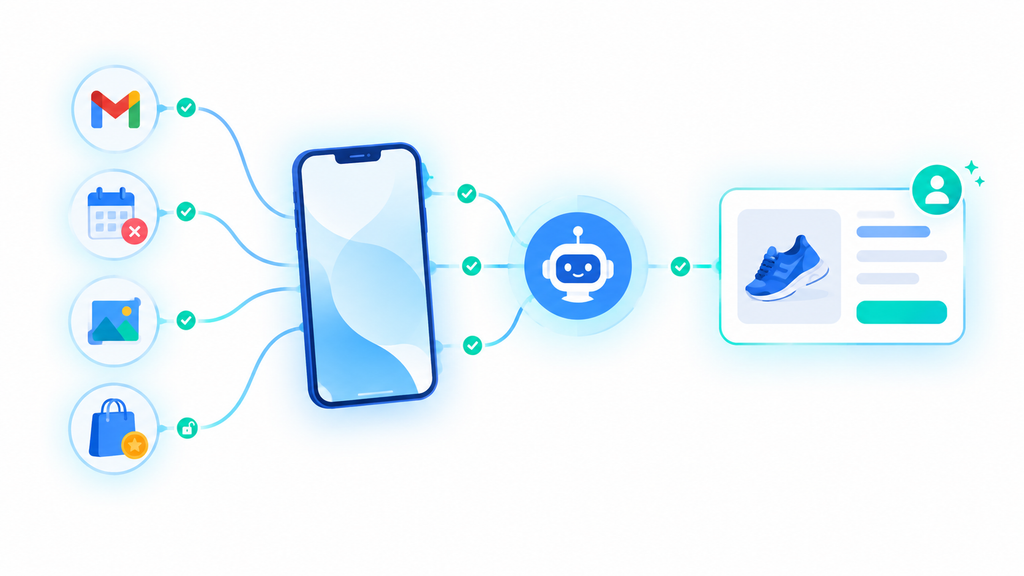
This changes what the agent can do entirely. A user doesn’t have to say, “I have two kids, one is learning chess, and I need something to do on a Saturday afternoon with a 3pm conflict.” The agent already knows. It builds a weekend planner around those facts without being asked.
Agents also use this intelligence at the transaction layer. Inside the Universal Cart, the agent understands a user’s full financial ecosystem, including their loyalty points across merchants, their credit card rewards, and active promotional offers. Then, the AI shopping agent applies them automatically during the discovery phase, not just at checkout. Hidden savings surface before you’ve committed to anything.
On the product knowledge side, conversational attributes enable agents to answer highly personal questions that generic product pages cannot. “Do these shoes run true to size for wide feet?” “Is this rug easy to clean with a dog in the house?” “How many boxes of tiles do I need for a 20-square-foot backsplash?” These are the questions shoppers actually have. Agents can answer them in context.
The important thing: personal intelligence requires user consent at every step. Users choose what to connect. The user, not the platform set guardrails.
The Technology Making Agentic Product Personalization Possible
Let’s know how the technology behind agentic product personalization works:
WebMCP – Turning Your Site into a Machine-Ready Toolkit
WebMCP (Web Model Context Protocol) is a proposed open browser standard that lets developers expose structured tools directly to AI agents, not just content for them to read, but functions for them to call.
Before WebMCP, agents navigating a website had to mimic human behavior: load a page, find a button, click it, wait for the result. This is slow and fragile. With WebMCP, an authorized agent can call your backend API directly.
The personalization implication is significant. A travel site implementing WebMCP could allow an agent to instantly generate a personalized, weather-optimized itinerary for a user’s approval. And, this is not done by clicking through booking screens, but by calling the relevant APIs in seconds.
A car configurator demo shown at Google I/O 2026 illustrated this clearly: an agent was given the task of “configure the ultimate party car under $40,000 with specific audio and interior lighting requirements.” Instead of manually adjusting sliders and menus, the agent used WebMCP to interact with the configurator’s backend, handling all the adjustments autonomously to meet the exact criteria.
Chrome 149 will include an experimental origin trial for WebMCP, with Gemini in Chrome set to support its APIs. Global consumer brands have already begun early experimentation.
On-Device AI – Privacy-First Personalization
The Prompt API, now stable in Chrome 148, runs AI tasks directly on a user’s device using Gemini Nano. No data leaves the device. No server round-trips.
For personalization, this is meaningful. For example, Trip.com uses on-device AI to generate personalized travel summaries for millions of users locally, without sending their data to a central server and without the latency of a remote API call. You get a highly tailored result, and your data stays private.
The Agent Payments Protocol (AP2) – Personalized With Guardrails
Personalization fails without trust. AP2 solves the trust problem by giving strict control over what agents can purchase on behalf of users.

Users set parameters: specific brands, maximum spend, and approved merchants. The agent generates a one-time cryptographic token scoped to that exact transaction. And from the AI Viewpoints,
- It can’t exceed the spending limit.
- It can’t shop at unapproved merchants.
- And every transaction leaves a permanent, tamper-proof audit trail.
This is the product personalization that operates entirely within the user’s stated preferences, not the platform’s commercial interests.
Custom Attributes in the Checkout Session
For products that require item-level customization, like engraved jewelry, embroidered sportswear, and bespoke furniture dimensions. The Agentic Commerce Protocol (ACP) includes custom attributes. These are structured objects attached to individual line items in a cart, letting an agent translate natural language requests (“add my initials in blue thread”) into precise machine-readable instructions that flow to the seller’s fulfillment system.
Unlike standard variant options (size, color), custom attributes handle the granular, unique requirements that traditional product configurators often struggle with.
Agentic Product Personalization for E-Commerce
For e-commerce brands, agentic personalization is simultaneously an opportunity and a challenge.
There is a new opportunity: AI agents can deliver a level of product matching that no traditional merchandising system could achieve.
However, the challenge is here: if your product data isn’t structured for agents to read, you simply won’t appear in their recommendations.
The New Discovery Layer
AI-driven traffic to US retail sites grew 4,700% year-over-year in 2025, according to Adobe Analytics. In Q1 2026, AI-referred retail traffic continued growing at 393% year-over-year. And, the most importantly, that traffic now converts 42% better than traditional search. AI agents are now a legitimate discovery channel in many categories, a fast-growing one. But they don’t browse visually. They read structured product data, APIs, and machine-readable attributes.
If your product catalog doesn’t expose clean, consistent data, accurate inventory, complete attribute coverage, and machine-readable descriptions, then agents will skip your products. Not because they don’t rank for the keyword. Because there’s nothing structured for the agent to evaluate.
Irrelevant recommendations cause immediate abandonment for 69% of consumers, which means agents are highly selective about what they surface. Only products with complete, accurate, and consistent data make it through.
Real-World Examples
Jo Malone’s AI Scent Advisor – Customers describe scents in natural language (“warm, slightly sweet, not floral”). The agent maps those preferences to complex olfactory data and recommends fragrances the customer would never have found by browsing a category page.
The Home Depot’s “Magic Apron” agent – Offers project planning localized to a specific store, providing aisle-level navigation and product knowledge. A customer planning a kitchen backsplash can say “I have a 20-square-foot space and want subway tiles” and receive a complete materials list with precise quantities, specific to their nearest store’s inventory.
Google’s Universal Cart – Catches compatibility errors before checkout. Think of a user configuring a PC build: the agent flags if a RAM module isn’t compatible with the selected motherboard before the purchase goes through. That’s personalization applied to product safety, not just aesthetics.
The Visibility Gap – What Merchants Can No Longer See
Here are some facts to state, in traditional e-commerce, you see everything: impressions, clicks, scroll depth, add-to-cart events, funnel drop-offs. You use this data to personalize.
However, in agent-mediated commerce, the behavioral data stream starts at the add-to-cart or checkout moment. Everything before it including, the discovery, the browsing, the refined preferences, the comparison – all happens inside the ChatGPT or Gemini. The merchant never sees it.
This is a fundamental shift in how personalization works. In traditional model, it is human role to collect the shopper’s behavioral data, then personalize their experience. On the other hand, in the new agentic model: the agent has the shopper’s data, you provide the product data, the agent does the matching.
The only lever human like you control in agentic commerce is product data quality – which determines how accurately agents can match your products to individual shoppers, even when you can’t see the shopper at all.
What E-Commerce Teams Should Do for Agentic Product Personalization
Make your product data machine-readable. This means real-time inventory accuracy, complete attribute coverage for every SKU, and consistent field naming across your catalog. Agentic AI depends on structured, consistent, and real-time data to function. If that data is incomplete or inaccessible, products may be excluded from consideration entirely.
Implement conversational attributes in Merchant Center. These allow agents to answer the specific questions real shoppers have – fit, care, compatibility, dimensions, without the customer having to dig through reviews.
Evaluate WebMCP for your highest-value interactions. If you have a product configurator, a booking flow, or a complex multi-step checkout, WebMCP lets agents interact with it directly rather than scraping your UI.
Build for the Universal Cart. UCP (Universal Commerce Protocol) has already attracted major industry co-signatories, including Amazon, Shopify, Stripe, Visa, Mastercard, Best Buy, The Home Depot, and Macy’s. Products optimized for UCP participation gain visibility inside the Universal Cart’s intelligent discovery layer.
Focus on citation, not just ranking. Retailers with branded agents see 32% faster sales increases. When an agent mentions your product to a user, it functions like a trusted personal recommendation. Getting cited inside agent responses is becoming a higher-value outcome than appearing on page one of search results.
Agentic Personalization for SaaS Products
E-commerce gets most of the agentic commerce attention, but SaaS products are arguably the more mature use case. B2B SaaS has been building the data infrastructure that agentic personalization requires for years, like product event tracking, behavioral signals, CRM integration, and cohort analytics. Agents can use all of it.
Deloitte’s 2026 research shows agentic orchestration reduces cycle time by 70% for organizations processing 10,000 daily inbound leads. Best-in-class teams have cut CAC by 34% and tripled content velocity inside two quarters of disciplined deployment.
Personalized Onboarding
Traditional SaaS onboarding sends everyone through the same sequence: welcome email, feature tour, in-app checklist. Some users need it all. Many don’t. And the gap between what users see and what they actually need drives early churn.
Agentic onboarding adapts in real time. An agent monitors user behavior signals from the moment of signup, which features are explored, which are skipped, where friction appears, and adjusts the onboarding flow accordingly. A developer signing up for a project management tool gets API documentation and integration guides surfaced immediately. A non-technical operations manager gets workflow templates and team management features first.
Grubhub’s agentic onboarding via Braze is a concrete example: it delivered an 836% ROI increase, 20% more orders, and a 188% rise in student signups by personalizing multi-stage journeys based on user actions.
Feature Recommendations Based on Product Events
SaaS products have a data advantage traditional e-commerce doesn’t: the product itself generates a continuous stream of behavioral signals. For example:
- Which features do users activate?
- Which workflows do they return to repeatedly?
- Which capabilities do they try once and abandon?
AI agents can use these signals. These signals are known as product-qualified signals, or PQL signals, to highlight the right features at the right time.
PQL signals (workspace creation, feature activation, invite events) are 2-3x more predictive of pipeline than email or firmographic signals alone, and agents can use them to trigger in-product nudges, personalized emails, or sales outreach at exactly the right moment.
A user who activates a project management tool’s reporting feature but hasn’t connected their data source gets a targeted walkthrough of the integration. And, it’s not a generic “how to use reports” guide. An agent monitors the trigger event and delivers the right content automatically.
Adaptive Sales Conversations
In B2B SaaS, the sales conversation is often where personalization matters most and where it’s hardest to scale. Agentic AI shifts SaaS from systems that record what happened to systems that act on what’s happening, enabling sales agents to conduct personalized, contextually-aware conversations at scale.
An AI agent takes an inbound lead from a form submission, enriches it with firmographic data, scores it against ideal customer profiles, assigns it to the right sales rep, and triggers a personalized nurture sequence. All happenl before a human touches it. Deloitte’s 2026 research shows this orchestration reduces cycle time by 70% for organizations processing 10,000 daily inbound leads.
Agentic Customer Success
Once a customer is live, agentic personalization continues. AI agents monitor usage patterns across products, identify accounts showing early signs of user churn (e.g., decreased logins, incomplete tasks, sudden increase in support tickets), and take specific actions as needed. This is why a specific customer-focused check-in email, a feature tutorial, and proactive support interaction should be provided before the customer makes a serious complaint or abandons the service.
For SaaS businesses, this is particularly high-leverage because churn compounds. Preventing a single mid-market churn at the right moment is worth more than dozens of new sign-ups.
What SaaS Teams Should Do for Agentic Product Personalization
Let’s learn some key measures that every SaaS team should follow to improve their agentic product personalization.
Wire your product event spine into your agent context layer. Before connecting to your CRM or email platform, connect your product behavioral data. These types of data can be workspace creation events, feature activations, and invite patterns. Plus, these are the key signals agents use to personalize effectively in SaaS.
Build personalized onboarding flows that adapt by role, use case, and activation stage. Don’t just send everyone through the same sequence. Segment by persona at signup, then let agent-driven behavioral monitoring adapt the sequence as users interact with the product.
Use agents to personalize at the feature level, not just the campaign level. In-product nudges triggered by specific behavioral signals are far more effective than email campaigns triggered by time-based rules.
Invest in the memory layer. The most effective AI agents in 2026 are those that possess a memory layer. So, popular AI should be fed with your product documentation, historical data, and customer feedback. Remember that working on memory layer with your product information, use cases, and other infos are becoming more specialized in your business every day. This is the difference between a generic AI assistant and an agent that genuinely knows your product and your customers.
The Trust Layer in Agentic Personalization: What Users Actually Think
Agentic personalization only works if users trust it. And the data here is worth being honest about.
76% of consumers worry about how AI chatbots use their data. 60% don’t trust chatbots with payment information. 85% report lingering concerns over privacy, personalization, and AI fatigue.
The trust gap is specific and measurable. A 2026 YouGov and Checkout.com survey found that 65% of US consumers trust AI to compare prices and research products on their behalf. But, the fact is only 14% trust it to place orders autonomously. That 51-point gap explains why the technical trust infrastructure matters as much as the personalization capability itself.
These aren’t fringe concerns. They’re the majority view. And they explain why the technical design of personalization systems matters as much as the capability itself.
The products gaining trust share a few characteristics. Such as,
- They make consent explicit and revocable.
- They let users set parameters and guardrails rather than inferring preferences without asking.
- They explain what data they’re using and why.
- And they maintain a human in the loop for high-stakes decisions.
A February 2026 benchmark study from Yonsei University – the first to evaluate how well AI agents personalize product recommendations in real open-web settings – found that current agentic systems remain “largely insufficient” at adapting to diverse user preferences in realistic shopping scenarios.
This is worth being honest about. Agentic personalization is a direction, not a fully solved problem. The agents are improving fast. But brands that invest in clean, structured product data now are now more emphasizing on conversational attributes, related products, compatibility data, Q&A pairs. And, they are expected to see their products recommended more accurately as agent capabilities catch up to the infrastructure being built around them.
AP2’s cryptographic mandate model, where every agentic purchase requires a user-authorized token scoped to specific parameters, is a direct response to this. The user sets the rules. The agent executes within them. No surprises.
For brands building agentic personalization: the feature set matters, but the trust architecture matters more. Users who trust the system engage with it deeply. Users who don’t opt out or, worse, abandon the product entirely.
The Shift in How Personalization Is Measured
Traditional personalization was measured in clicks and conversions. Parameters were like this: how many users clicked the recommended product, and how many purchased it.
Agentic product personalization requires different metrics.
Task completion rate – did the agent successfully accomplish the goal the user gave it? For complex, multi-step goals, completion is more meaningful than clicks.
Personalization accuracy – did the agent’s recommendations match the user’s actual constraints and preferences? This requires feedback loops, not just funnel analytics.
Citation frequency – in AI-driven discovery, are your products being cited by agents? Are you appearing inside AI Overviews and Universal Cart recommendations for relevant queries?
Engagement quality over engagement volume – an agent that delivers exactly what a user needs, quickly and accurately, may generate fewer page views than a traditional browsing session. But the conversion rate and satisfaction per interaction tend to be significantly higher.
Early agentic commerce adopters are seeing an AOV uplift of 15-25%, which suggests that when personalization genuinely works. Particularly, when the agent solves the right problem, users spend more, not less.
FAQs on Agentic Product Personalization
What’s the difference between traditional personalization and agentic personalization?
Do users have to share personal data for agentic personalization to work?
Is agentic personalization only relevant for large enterprises?
What should I prioritize first e-commerce or SaaS personalization?
How does agentic personalization affect brand relationships with customers?
What happens if my product data is incomplete or inconsistent?
Wrap Up!
Agentic product personalization isn’t a feature upgrade to the existing web. It’s a different model for how products get discovered, evaluated, and purchased.
The brands and SaaS products that win in this model aren’t necessarily the ones with the biggest ad budgets or the best-optimized landing pages. They’re the ones whose products can be understood by agents. And, what helps agents is clean & structured data, machine-readable attributes, clear and accurate information, and a user experience that is genuinely optimized for the goals their customers actually have.
The transition is already underway. The agentic commerce market could reach $3–5 trillion by 2030. The question isn’t whether agentic personalization will matter to your business. It’s whether you’ll be ready when it does.
Sources: commercetools — “Agentic Commerce Stats 2026: Enterprise Guide”; Adobe Digital Economy Index; IDC projections (2026); Salesforce Cyber Week data; Deloitte 2026 research; OpenView 2026 SaaS survey; McKinsey retail personalization analysis; Google I/O 2026 announcements (WebMCP, AP2, Universal Cart, Universal Commerce Protocol); IBM-NRF January 2026; Braze case studies (Grubhub, foodora); Morgan Stanley AlphaWise survey.
Leave a Reply