
Your Website Just Got a New Kind of Visitor!
Something fundamental shifted at Google I/O 2026. Not just in terms of product announcements – but in terms of who, or what, is visiting your website.
For decades, web design and SEO revolved around two audiences: human users and search crawlers. You built intuitive navigation for humans, and clean markup for Googlebot.
That was the game so far.
But the keynotes delivered at Shoreline Amphitheatre this week made one thing unmistakably clear: a third visitor has arrived.
And it doesn’t browse. It acts. As Google CEO Sundar Pichai stated plainly at the event:
“The big shift is our move towards agents, from AI that simply assists you to agents that help you get stuff done, under your direction and faster.”
AI agents – powered by Gemini and increasingly running autonomously inside Chrome – are now navigating the web on behalf of users. They’re filling out forms, completing purchases, researching products, and auditing content.
And here’s the uncomfortable truth for most website owners: your site probably wasn’t built for them.
This isn’t a distant future scenario. AI Mode in Google Search has already crossed one billion monthly users, with queries doubling every quarter since launch. Brands cited inside AI responses earn 35% more organic clicks than non-cited competitors. The age of passive browsing is being replaced by delegated action.
This post breaks down everything announced at Google I/O 2026 that directly affects your website. And, I’ll cover everything from new browser standards and SEO shifts to agentic commerce protocols. And, also guide you with exactly what to do about it.

The Evolution of Search — From SEO to AEO (Answer Engine Optimization)
Let’s be direct: SEO isn’t dead, but its center of gravity has moved.
Google itself published a guide in the lead-up to I/O that made waves in the marketing community. It confirmed that AEO (Answer Engine Optimization) and GEO (Generative Engine Optimization) are not new disciplines separate from SEO. Rather, they’re SEO applied to an AI-native search environment. Google’s own documentation states you should prioritize foundational SEO over “AEO/GEO hacks,” and that “plenty of content thrives in Google Search (including generative AI experiences) without any overt SEO at all.”
But there’s a nuance that professionals noticed immediately: optimizing for AI agents navigating your site is a different conversation from optimizing for AI answers in search results. The former is about your site’s architecture and interactivity. The latter is about your content quality. Both matter. Let’s start with the architectural layer.
The Accessibility Tree Is the New Sitemap
Chrome Developer Advocate Una Kravets delivered one of the most practical quotes of the entire conference:
“Because most agents navigate the web using the accessibility tree, every ARIA role or label that you optimize doesn’t just help a human. It makes your site more actionable for an agent, too.”
This is the single most important sentence for web developers to internalize. AI agents don’t “read” your page the way a human does. They travel through the accessibility tree, the same structured representation of your page that screen readers use. Every unlabeled button, every decorative-image-without-alt-text, every form field missing a proper <label> is effectively a wall that blocks an agent from doing its job.
Practical actions to take now:
- Audit every interactive element for proper ARIA roles (button, navigation, main, form, search)
- Ensure all form fields have explicit <label> elements – not just placeholder text
- Add descriptive aria-label attributes to icon-only buttons
- Use semantic HTML elements (<nav>, <main>, <article>) instead of generic <div> soup
This is no longer just a compliance checkbox. It’s competitive infrastructure.
Say Hello to llms.txt — But Read the Fine Print
Much of the pre-I/O conversation in communities like Reddit’s r/digital_marketing centered on llms.txt – a proposed standard that acts like robots.txt but for AI models, giving them a clear, readable map of your site’s content. The AEO community had been treating it as a must-have.
Google’s official position, however, is more measured. Its AI optimization guide explicitly states:
“You don’t need to create new machine-readable files, AI text files, markup, or Markdown to appear in generative AI search.”
For Google Search specifically, llms.txt has no ranking impact – confirmed by Google’s John Mueller.
That said, there’s a real-world nuance: major platforms including Vercel, Stripe, Shopify, GitHub, Anthropic, and OpenAI all publish llms.txtfiles. The file may not help with Google Search rankings, but it provides directional guidance for other AI agents and LLM-powered tools that do use it. Think of it as good digital hygiene. Especially if your site has documentation, APIs, or content that developers or AI agents might reference.
The practical takeaway: don’t skip accessibility work to spend time on llms.txt. Do both but prioritize in the right order.
Lighthouse’s New “Agentic Browsing” Audit
One of the more consequential practical additions from the Chrome team was a new Lighthouse audit category specifically for agentic readiness. It validates declarative metadata on your forms and interactive elements, checking whether they’re genuinely “actionable” for AI agents, not just visually present, but semantically machine-readable.
This is significant because Lighthouse is the industry’s go-to performance and quality benchmark. Adding agentic browsing as a scored category means it will rapidly become a standard item in developer checklists and CI/CD pipelines.
New APIs and Browser Standards — Building for Agents
Beyond the SEO layer, I/O 2026 introduced several new browser-level capabilities that fundamentally change how agents interact with web pages.
WebMCP — The Biggest Shift You Haven’t Heard Of
Chrome’s Matthias Rohmer put it plainly: “With WebMCP, we can now make this web page agent-ready in minutes. This proposed browser standard lets you tell agents how and where to interact with your site.”
WebMCP (Web Model Context Protocol) is a proposed open web standard that allows developers to expose structured JavaScript functions and HTML forms directly to browser-based AI agents. This is a categorical shift from how agents currently work.
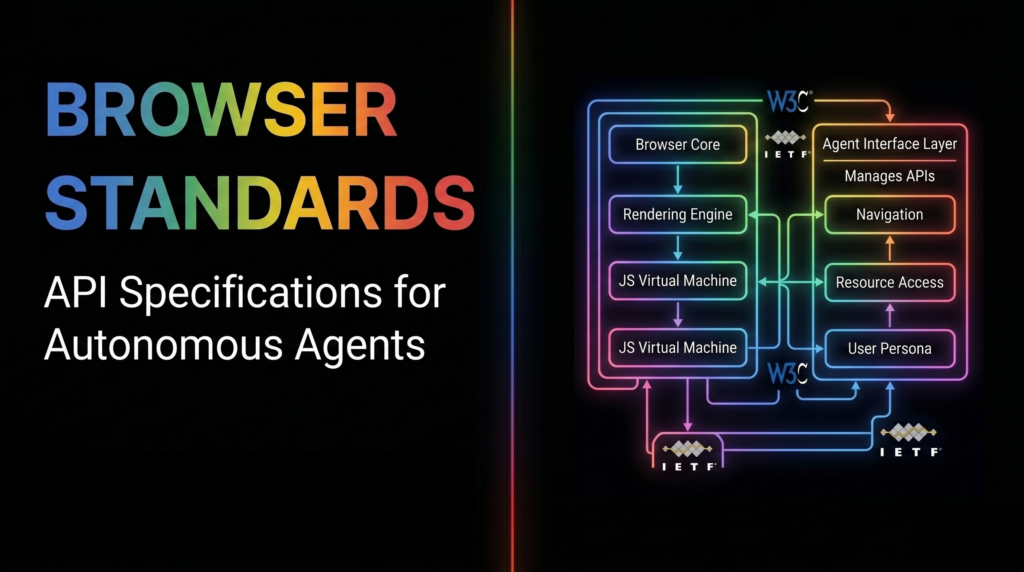
In these days, agents mostly scrape visual data, they take a screenshot, interpret it, and try to click things. It’s slow, fragile, and error-prone. WebMCP allows an agent to instead call clean, declared functions: query a travel API, submit a financial form, check inventory. No screenshot interpretation required. Machine precision, every time.
The experimental WebMCP origin trial launches in Chrome 149, with Gemini in Chrome support arriving shortly after. Early adopters, global consumer brands that have been experimenting in the trial have already reported more reliable and faster agent interactions.
What this means for your site: if you have any tool, form, or transaction flow that you want agents to use on behalf of users, you will want to implement WebMCP. The register tool method lets you expose specific functions with clear descriptions and parameters. Think of it as writing an API contract, but one that browsers and agents natively understand.
HTML-in-Canvas — Ending an 18-Year Accessibility Blind Spot
Thomas Nattestad, Product Manager at Chrome, described this one beautifully:
“The HTML in Canvas API is the bridge that gives you the best of both worlds by letting you paint DOM elements into a Canvas or WebGPU texture… Now, you no longer have to choose between visually complex and stunning or interactable and accessible.”
This has been a genuine pain point for a long time. Canvas, WebGL, and WebGPU experiences: 3D product viewers, immersive landing pages, data visualizations, interactive maps, have always been invisible to search crawlers and screen readers. They’re rendered as pixels, with no semantic content for anyone (human or agent) to interpret.
The HTML-in-Canvas API, now available in origin trial, solves this by rendering native DOM content directly into Canvas/WebGL/WebGPU contexts. The visual output is unchanged, users still see the immersive 3D experience. But under the hood, the accessibility tree and search crawlers now have real content to work with.
If your site uses any canvas-based experiences for product showcases or interactive content, this is worth watching closely.
The Prompt API — On-Device Intelligence Goes Stable
The Prompt API reached stability in Chrome 148, and the implications are significant. Powered by Gemini Nano and a lightweight Gemma 197M model, it allows web apps to run AI tasks, summarization, translation, classification, multimodal analysis – directly on the user’s device, without any server calls.
The key benefits: no API costs, no latency from server round-trips, and — critically — no data leaving the user’s device. For privacy-sensitive use cases, this is transformative. Trip.com has already used it to scale personalized travel summaries to millions of users locally, with zero token bills.
For developers: if you have AI-powered features that process user-provided content (text, images, documents), evaluate whether they could run on-device via the Prompt API. It’s faster, cheaper, and more private.
Modern CSS That Reduces JavaScript Bloat
Paul Kinlan, Lead of Chrome Developer Relations, articulated the user-centric vision:
“Our goal is to help you build sites that just scroll better, transition between views better, enable people to interact with their devices in a more physical and intuitive way.”
Several CSS improvements announced at I/O directly support this goal. Scroll-driven animations, which were previously JavaScript-intensive, can now be expressed in pure CSS, significantly reducing main-thread load. The long-awaited appearance: base-select property finally enables native <select> dropdowns to be fully styled. And, that is the feature designers have wanted for years and that previously required heavy JavaScript workarounds.
These might seem like quality-of-life improvements, but less JavaScript means faster load times, better Core Web Vitals scores, and, increasingly relevant, more predictable behavior for agents navigating your page.
The New Developer Workflow — Vibe Coding and Agent-Assisted Building
The changes at I/O 2026 weren’t just about what sites do for users. They were also about how developers build those sites in the first place.
Varun Mohan, Director of Engineering at Google DeepMind, set the tone: “It’s truly an amazing time to be a builder. We’ve moved beyond AI tools that help us write, to agents that help us act.”
Stitch and the “Vibe Design” Revolution
Stitch, Google’s AI design tool, introduces what the team is calling “vibe design” – the ability to describe a UI in natural language and CSS vocabulary, and receive production-ready Tailwind CSS and HTML in return. You might say “create a non-uniform editorial grid with floating pull quotes and muted earth tones” and get working code back.
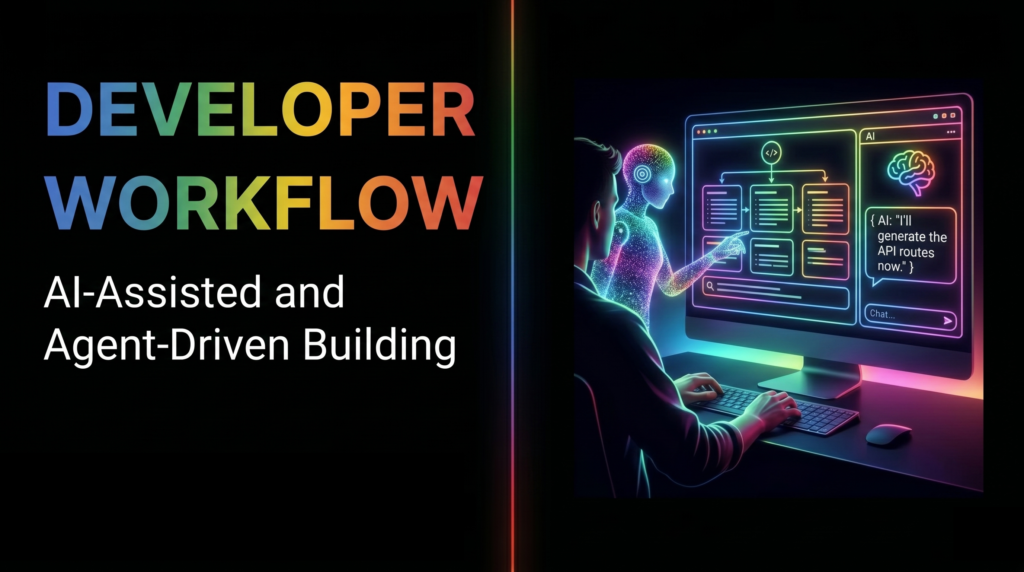
Dion Almaer from the Stitch team framed this shift well: “Your CSS knowledge isn’t just for implementation anymore. It’s your design vocabulary. Every feature you learn… gives you a new word in that vocabulary.”
This democratizes high-quality frontend work significantly. Designers who understand CSS concepts but don’t hand-write it can now direct the output precisely. For teams building or redesigning websites in 2026, Stitch is worth evaluating as part of the design-to-code pipeline.
Google Antigravity 2.0 — Multi-Agent Development
Antigravity 2.0 launched as a standalone desktop application that takes “vibe coding” to the orchestration level. Rather than a single AI assistant helping write code, Antigravity coordinates multiple specialized agents simultaneously: one handling marketing copy, one generating architecture diagrams, one writing and testing code, one creating visual assets.
A demo at I/O showed the platform researching a 1993 video game and generating a complete custom clone from scratch, with agents working in parallel across different workstreams. For web agencies or in-house teams building complex sites, this represents a meaningful acceleration in how ambitious projects get delivered.
Chrome DevTools for Agents — Autonomous Quality Assurance
One of the more quietly impactful announcements: Chrome DevTools now exposes an MCP server, allowing AI coding agents to autonomously inspect a live page, access console logs, run Lighthouse audits, and fix runtime issues, without a human in the loop.
Real-world impact: LY Corporation has used this capability to reduce manual performance auditing by up to 98%. That’s not a small efficiency gain. It’s a fundamentally different quality assurance model.
Anshul Ramachandran from Google put the broader vision simply: “We aren’t just making it easier to build agents. We’re making it easier to build with agents.”
Una Kravets added a practical grounding note: “Baseline is a definitive industry standard that gives you visibility into web feature availability across the major browsers… Modern Web Guidance [provides] AI agents with a blueprint for modern web features.” This means your agent-assisted development work is now anchored to a vetted, cross-browser-compatible feature set, reducing the risk of building on APIs that aren’t widely supported.
Agentic Commerce — The E-Commerce Shift Nobody’s Ready For
If the above sections were about how agents navigate your site, this section is about how agents transact on your site. And for e-commerce brands, this is the part of I/O 2026 that deserves the most urgent attention.
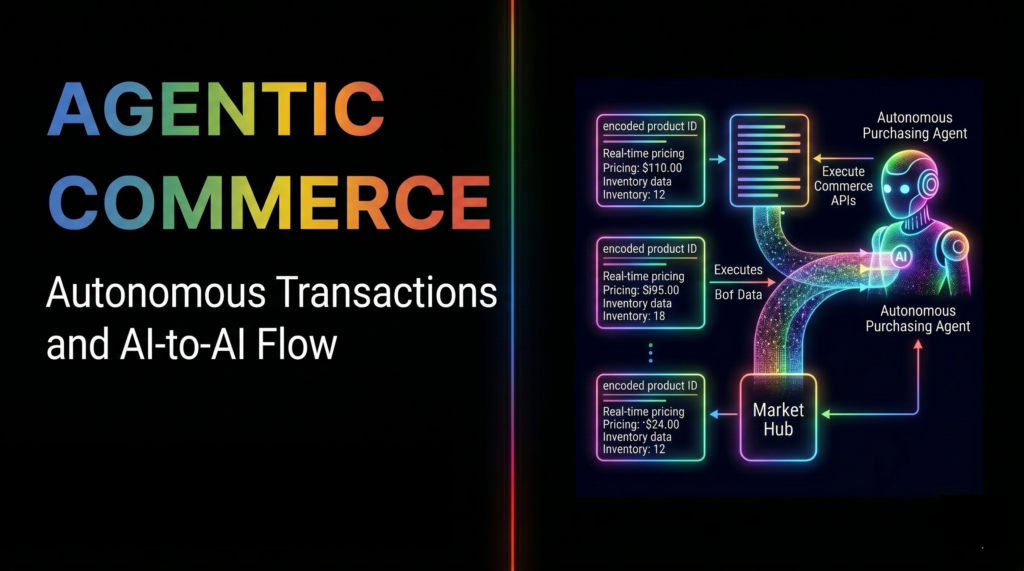
Vidhya Srinivasan, VP/GM of Ads and Commerce at Google, framed it with a memorable analogy: “UCP does for agentic commerce what HTTP did for the web: It gives agents and systems a common language. It makes everything from product research to checkout to shipment tracking totally seamless.”
That’s not marketing hyperbole. It’s a precise technical description of what’s being built.
Universal Commerce Protocol (UCP) — The Common Language for Agent Shopping
UCP is an open-source standard that gives AI agents a shared protocol for every stage of a commercial transaction: product discovery, inventory validation, comparison, checkout, and post-purchase tracking. It was co-developed with Shopify and has already attracted Amazon, Meta, Microsoft, Salesforce, and Stripe to the UCP Tech Council.
The key insight from the Reddit discussions and early analysis: UCP levels the playing field. Previously, only the largest retailers could afford to build custom integrations for every emerging AI platform. UCP means a small boutique on Shopify can compete for visibility within Google Gemini alongside a global giant like Target – as long as their product data is clean and machine-readable.
But implementing UCP is not trivial. It requires machine-readable product data, real-time inventory accuracy, and consistent field naming. Teams working with UCP have noted that any service returning inconsistent field names, stale cache data, or free-text descriptions will fail silently during agent negotiation. This is a first-class engineering requirement, not a documentation exercise.
Practical steps for e-commerce teams:
- Audit your product data for consistency and accuracy
- Ensure your product catalog exposes structured data (price, availability, variants, shipping times) in a machine-readable format
- Review Google’s agent-friendly website guidance and the UCP spec
- Consider this a high-priority engineering initiative, not an optional future upgrade
Agent Payments Protocol (AP2) — Secure Transactions with Guardrails
UCP handles the what-and-where of a transaction. AP2 handles the how-safely-and-verifiably.
When a user authorizes an agent to shop on their behalf, they set parameters like specific products, a maximum spend limit, approved merchants. AP2 then creates a cryptographic, tamper-proof “digital mandate” that binds the transaction to those exact parameters. A One-Time Execution Token (OTET) is generated for the specific transaction. The agent never has direct access to the user’s payment credentials.
As Google’s own description notes: “AP2 creates a transparent, verifiable link between you, the merchant, and the payment processor and uses privacy-preserving technology to keep your data safe. Tamper-proof digital mandates ensure the agent is always acting on your behalf, giving you a permanent digital paper trail.”
For merchants, this has two implications. First, it reduces fraud risk, as the token is scoped to a specific SKU, merchant, and spending cap. Second, it creates shared transaction records that simplify returns and disputes, since both merchant and customer are looking at the same verified record.
For security teams: AP2’s token model introduces new considerations around key management, token lifecycle, and replay-attack prevention that existing payment security frameworks don’t fully address. This needs dedicated attention.
The Universal Cart — Cross-Merchant AI Shopping
The Universal Cart – launching inside Google Search and the Gemini app this summer – is the consumer-facing layer built on top of UCP and AP2. It’s a Gemini-powered shopping cart that works across different merchants seamlessly, automatically surfaces hidden coupons and price comparisons, and catches compatibility errors (imagine it flagging that a RAM module isn’t compatible with a selected motherboard before checkout).
For e-commerce brands, the Universal Cart is both an opportunity and a challenge. If your product data is clean and UCP-compliant, your products become discoverable through this agent-driven shopping experience. If your data is messy or your site doesn’t support the protocol, you simply won’t appear in this new purchasing channel.
What the Web Development Community Is Actually Saying
No honest analysis of I/O 2026 would be complete without acknowledging the mixed reactions from practitioners on the ground. Reddit communities in r/digital_marketing and r/google reflected a spectrum of responses – from genuine excitement to measured skepticism.
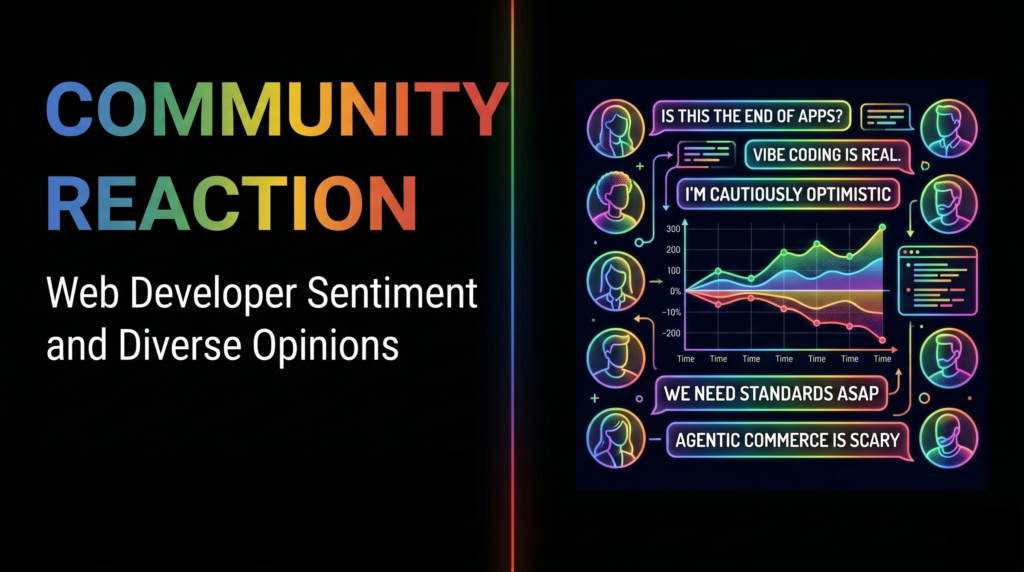
A common thread in the discussions: the pace of change is outrunning many teams’ capacity to adapt. Small business owners and solo developers noted that implementing WebMCP, auditing the accessibility tree, and maintaining UCP-compliant product data requires significant resources that not every team has. One commenter summarized the sentiment: “Every year Google announces the future. Every year it takes 3-5 years to actually matter.”
There’s validity to that concern. But there’s a counter-argument too: the teams that implemented structured data and mobile optimization early – before those things were urgently necessary – are the ones who navigated Google’s subsequent shifts most smoothly. Agent-readiness today is the structured data of 2026.
Another thread of discussion centered on trust and control. The idea of AI agents making purchases on behalf of users, with autonomous access to payment systems, unsettles many users and developers. Google’s design of AP2 with explicit user-set guardrails, tamper-proof mandates, and spending caps is clearly a response to this concern – but building user confidence in agentic commerce will take time.
One astute observation from the r/google thread:
the announcements at I/O reveal a Google that is simultaneously trying to be the infrastructure layer and the consumer interface for agentic commerce.
Universal Cart, AP2, UCP – Google is positioning itself at the center of every agentic transaction. For brands that have worked hard to build direct customer relationships, this raises real questions about attribution, data ownership, and long-term channel dependency.
These are legitimate strategic questions, not just technical ones. And they deserve a place in your planning alongside the implementation work.
How to Prepare Your Website for Agent-Readiness
Based on everything announced at Google I/O 2026, here’s a prioritized action plan for website owners and development teams.
Accessibility Audit (Free, High Impact) Run an accessibility audit on your site using browser DevTools or a tool like Axe. Identify and fix missing ARIA labels, unlabeled form fields, and non-semantic HTML. This is the single highest-leverage action you can take right now, and it helps human users and AI agents equally.
Lighthouse “Agentic Browsing” Audit Once the new Lighthouse category is stable, run it on your key landing pages and product pages. Treat the score as a new baseline metric alongside Core Web Vitals.
WebMCP Evaluation Identify which tools, forms, or workflows on your site would benefit most from agent automation. Evaluate the WebMCP spec and plan implementation for your highest-value interactions, contact forms, product configurators, checkout flows.
UCP and AP2 Assessment (E-Commerce Audit your product data for machine-readability and accuracy. Engage your engineering team on UCP compatibility requirements. Start with your top-performing product categories.
Content That Only You Can Write Across all AI surfaces, AI Mode, AI Overviews, agent recommendations, the consistent signal is that unique, authoritative, first-party content wins. No amount of technical optimization replaces genuine expertise. Build content that reflects your real knowledge and experience.
Conclusion: Survival in the Agentic Era
The web platform evolves in cycles. Responsive design, Core Web Vitals, structured data. Each of these felt like optional enhancements until they weren’t. The agentic era is following the same pattern, but at a faster pace.
Chrome Developer Relations lead Paul Kinlan captured the scale of what’s shifting:
“The web is transforming from a medium where users browse and then take action to one where it also has agents to let people delegate their work for them.”
That’s not a marginal change. It’s a redefinition of what a website is for.
The good news: most of the immediate actions are foundational improvements that make your site better for everyone and faster, and more accessible, more semantically clear. You’re not building for agents instead of humans. You’re building for both, in a way that makes your site genuinely excellent.
Start with your accessibility tree. Create a strategy for structured product data. Watch the WebMCP origin trial. And understand that the brands best positioned for the agentic era will be the ones who treated these shifts seriously, not tomorrow, it has to be today.
Sources: Chrome for Developers blog (Google I/O 2026), Google Developers Blog, SD Times, Efficiently Connected, Google Shopping announcements, Search Engine Journal, Coalition Technologies, Launchcodex, and speaker quotes from the Google I/O 2026 keynotes.
Leave a Reply