
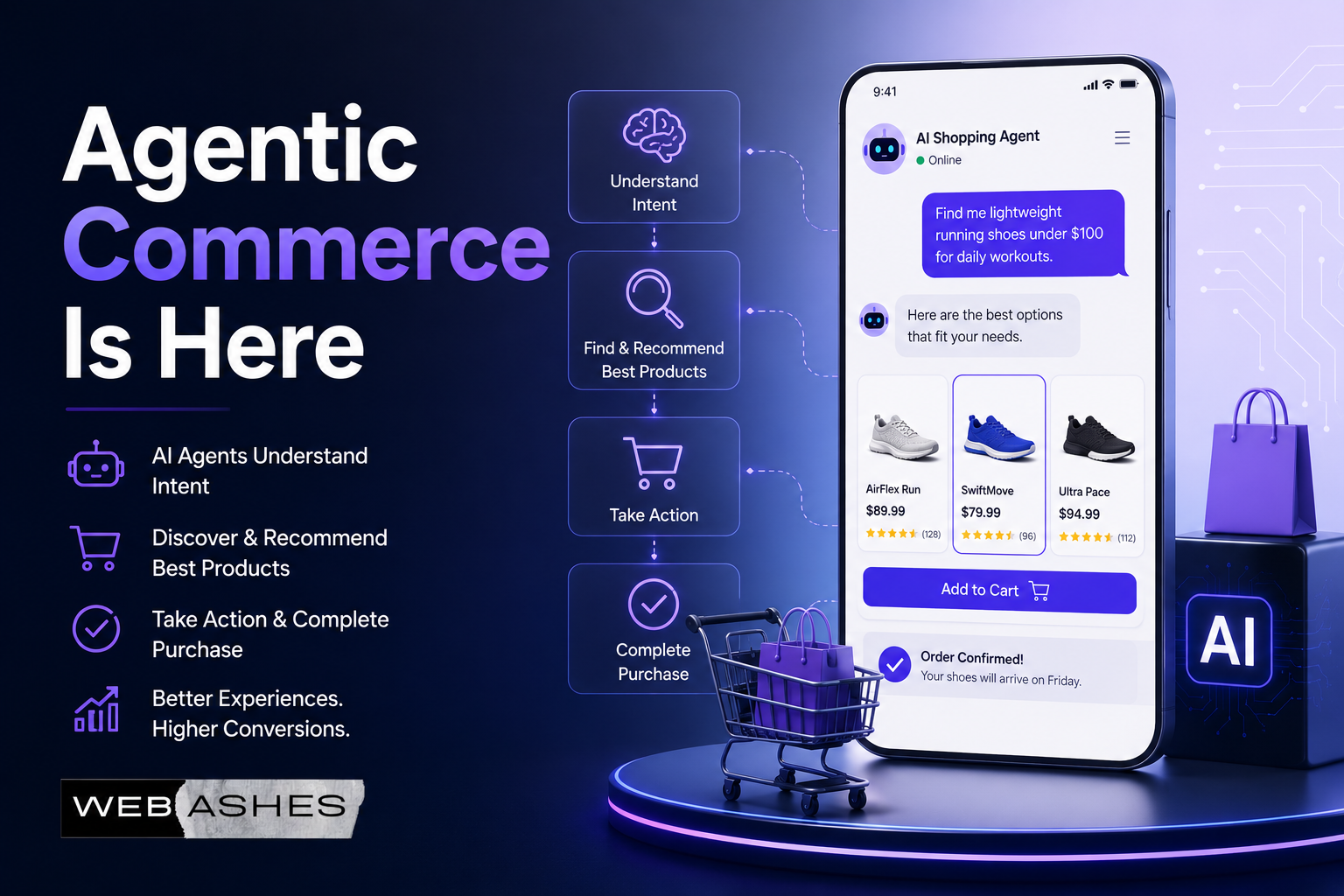
Agentic commerce is online shopping where AI agents handle the discovery, comparison, and purchasing process on behalf of a human shopper. Instead of clicking through websites and filling out forms, the shopper tells an AI what they need and the agent takes care of the rest.
Welcome to Universe of Agentic Commerce!
Something big is happening in e-commerce. And it’s not a new feature or a seasonal trend. This is a fundamental change in the way people shop online.
For the past 25 years, online shopping has worked like this: a customer opens a browser, types something into a search bar, scrolls through results, opens tabs, compares products, and eventually clicks Buy.
You and other e-Commerce owners have built online stores based on this buying practice. Plus, your website’s SEO and your product pages are also optimized around this workflow.
But, in this era of agentic commerce, that process is being replaced.
More and more shoppers are using AI assistants to do the shopping for them. They only say something like: “Find me a good espresso machine under $300 that’s easy to clean” and the AI handles everything.
And, when I am saying AI handles everything, it actually does everything on the behalf of buyers. It searches. It filters. It compares. And in some cases, it even completes the buying process as well.
This is called agentic commerce. And whether you’re ready for it or not, it’s already affecting your business.
And, in this guide, I am going to cover what an e-commerce owner needs to understand about agentic commerce, including what it is, what’s driving shoppers to adopt it, how major platforms are building for it, and the specific steps you need to take to make sure your e-Commerce store is ready for AI assistants.
What Is Agentic Commerce?
In simple words, Agentic commerce is e-commerce where an AI agent does the browsing, comparing, and purchasing – not a human shopper. Here, an AI agent works on behalf of a shopper.

The word “agentic” comes from AI that can take autonomous actions. These agents don’t just answer questions. They can also actually do things. These AI agents can go through product catalogs and find answers to shoppers’ queries, build carts, apply discount codes, and complete purchases. All without the shopper needing to click through a single product page.
Here is a table to help you understand the difference:
| Traditional E-Commerce | Agentic Commerce |
|---|---|
| Shopper types keywords into a search bar | Shopper tells an AI what they need in natural language |
| Shopper browses, filters, and compares manually | AI agent researches, compares, and filters automatically |
| Shopper clicks through multiple pages and tabs | AI compresses the entire journey into one conversation |
| Trust established by a human clicking Buy | Trust established through cryptographic payment mandates |
| Retailers build custom integrations per platform | Retailers use one open standard (UCP) for all agents |
| Traffic is keyword-driven, mixed intent | Traffic arrives with pre-formed, high purchase intent |
So, now you can pretty much understand that in the Agentic commerce universe, AI does the shopping. You as an e-commerce retailer, now have to serve the AI working behalf of the human shopper.
The Numbers You Need to Know on Agentic Commerce
As we said, Agentic Commerce isn’t a future trend. Look at what’s already happened:
4,700% – YoY growth in AI-driven visits to US retail sites in 2025 (Adobe Analytics)
393% – YoY growth in AI-referred retail traffic in Q1 2026 — and that traffic converts 42% better than traditional search (Adobe Analytics)
13x – Increase in orders from AI-powered searches on Shopify stores in Q1 2026, with 14% higher average order values compared to organic search (Shopify)
$3–5 trillion – Estimated global agentic commerce market size by 2030 (McKinsey). Morgan Stanley puts the US figure alone at $190B–$385B by 2030. Bain projects $300B–$500B for the US including agent-influenced purchases.
73% – of consumers say AI is now their primary source for product research (IBM-NRF, 2026, 18,000+ respondents)
70% – of brands, retailers, and agencies are already testing or deploying an agentic storefront. Only 7% have no plans at all. (Swap/Glossy, 2026)
14% – The share of US consumers who currently trust AI to place orders autonomously compared to 65% who trust it to compare prices. That 51-point trust gap is the single biggest factor shaping where agentic commerce is today. (YouGov/Checkout.com, 2026)
Overall, AI-driven traffic to retail sites is the fastest-growing channel in e-commerce right now. And the numbers are accelerating fast.
During Black Friday 2025, AI-driven traffic to retail surged over 800% year-over-year according to Adobe Analytics. AI agents drove an estimated 20% of global orders during the 2025 holiday season.
On the B2B side, the numbers are even more striking. Gartner expects 90% of B2B buying to run through AI agents by 2028, representing over $15 trillion in transactions through agent exchanges.
But here’s the honest picture: while AI is already driving discovery and research at massive scale, fully autonomous checkout – a scenario where the agent buys without the shopper confirming- is still limited.
Only 14% of consumers trust AI to place orders on their behalf. Most agentic transactions today end with the agent sending a high-intent shopper to your website to complete the purchase. That’s still a significant opportunity. But it’s important to understand where the channel actually is right now, not just where it’s headed.
The shift has already crossed from early adopter curiosity into measurable revenue impact. And retailers who wait another year or two to start preparing are going to find themselves behind.
How Agentic Commerce Actually Works
To understand what you need to do as a retailer, it helps to understand what’s actually happening behind the scenes when an AI agent shops on someone’s behalf. Let’s go through the steps below to understand the agentic commerce workflow:
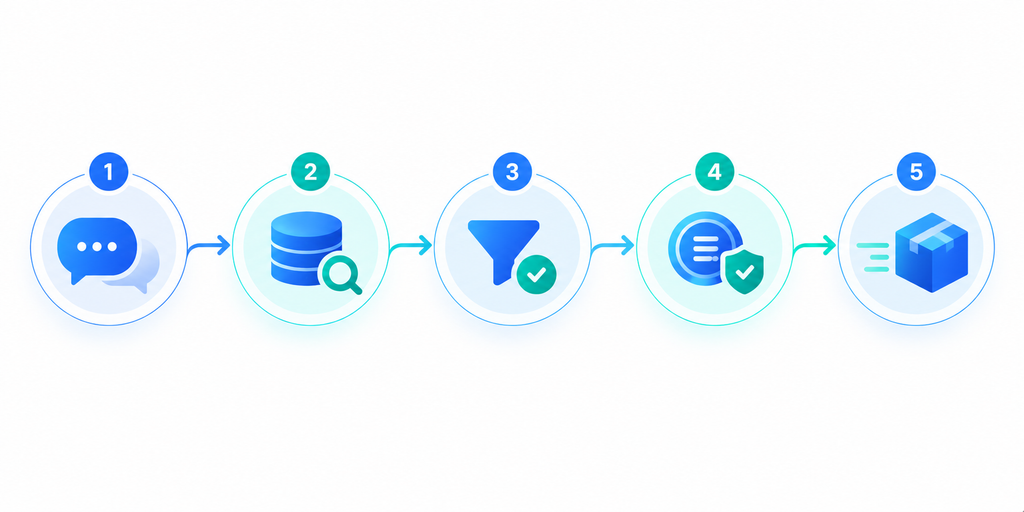
Step 1: The Shopper Sets an Intent
An AI shopping workflow generally starts when someone tells an AI assistant what they want. This could be a Google AI Mode search, a Gemini or ChatGPT conversation, a voice command, or a message to a shopping agent app.
This kind of request is usually natural and specific. It’s more like talking to a personal shopper. Not like the traditional e-Commerce we’ve been seeing where a shopper types a specific keyword to search their products.
Rather, your specific customers are now talking to AI agents as if they were having the same conversation with you in person in your own store.
Step 2: The Agent Queries Your Catalog
The AI agent reaches out to product databases, including Google’s Shopping Graph (which powers 60+ billion listings) to find matching products. It doesn’t just match keywords. It reasons about the shopper’s intent, budget, constraints, and context. This is why your product data needs to be rich and structured, not just keyword-optimized.
Step 3: The Agent Reasons and Filters Products
The shopping agent evaluates results against all of the shopper’s stated and implied requirements. It might cross-reference compatibility (“Do these parts work together?”), calculate total landed cost including shipping, check real-time availability, and compare across multiple retailers, all in a few seconds.
Step 4: The Agent Completes Transaction
If the shopper has given the purchasing authority to an AI agent, the agent can complete the transaction. This happens through secure digital mandates. A cryptographically signed record of the buyer’s authorization, which determines precisely what the agent can buy and how much they can spend.
Step 5: The Retailer Fulfills
Even though the AI assistant handles the shopping, retailers like you handle the fulfillment. That’s by design. A core principle of agentic commerce infrastructure is that the retailer stays the Merchant of Record. That means, you retain the customer relationship, manage your margins, and handle shipping and support.
So, as a website owner, your online store now needs to be be readable and actionable by machines, not just humans. If your product data is incomplete, vague, or hard to parse, AI agents will skip your products regardless of how good they actually are.
The Three Ways Agentic Transactions Happen
Not all agentic purchases follow the same path discussed above. Let’s understand it by seeing McKinsey’s October 2025 report on agentic commerce. They have identified three distinct interaction models, and understanding them helps you see where your store fits in.
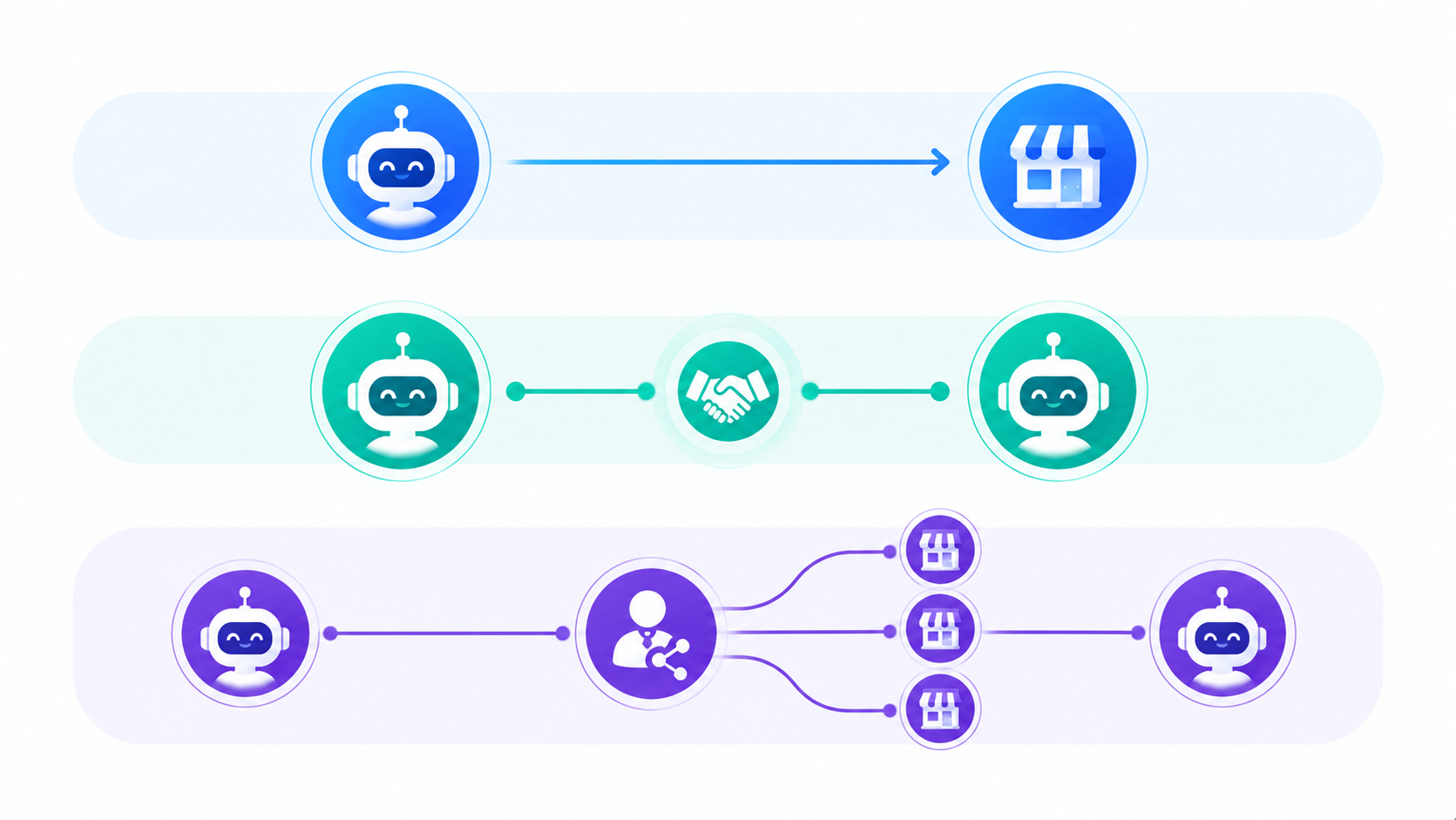
Path 1: Agent to Site
The most common model today. A consumer’s AI agent interacts directly with your website or API. The agent queries your catalog, builds a cart, and either completes the purchase or sends the shopper to your checkout page with everything pre-filled. This is what most UCP and ACP integrations enable.
Path 2: Agent to Agent
A consumer’s personal AI agent communicates directly with your store’s own branded AI agent. The two agents negotiate the transaction. They work to compare options, apply loyalty discounts, and agree on terms without the human needing to be present. This is where Amazon’s Rufus and Google’s Business Agent are heading. It’s the most autonomous model, and it’s still early.
Path 3: Brokered Agent to Site
An intermediary platform – like an AI version of a price comparison site or a loyalty aggregator. This type of agent acts as the middleman. It queries multiple merchants, bundles options, applies cross-merchant discounts, and routes the transaction to the winning seller. Think of it like OpenTable for products. Although this model is still emerging, it has significant implications for how merchants compete on price and availability.
Most merchants today are focused on Path 1. But designing your catalog, pricing, and loyalty data with Paths 2 and 3 in mind will matter more as agentic commerce matures.
The Protocols Powering Agentic Commerce
You don’t need to be a developer to understand the Agentic Commerce protocols, but you do need to know they exist and why they matter for your business.
Universal Commerce Protocol (UCP)
UCP is the open standard that serves as a common language between AI agents and retailers. Before UCP, if you wanted your store to work with multiple AI platforms, you’d need to build a separate custom integration for each one. UCP solves that.
Once your online store is UCP-compliant, any AI agent that speaks UCP can search your catalog, manage carts, and handle checkout, without any additional custom work on your end. It’s one integration that opens your store to the entire agentic ecosystem.
UCP was co-developed by Google alongside Shopify, Walmart, Target, Wayfair, Etsy, and others, with payment network support from Visa, Mastercard, Stripe, Adyen, and Fiserv.
Agentic Commerce Protocol (ACP)
If UCP is the broad open standard for agent-retailer communication, ACP is the protocol that powers what you actually see in the real world right now – specifically, buying inside ChatGPT.
ACP was co-developed by Stripe and OpenAI and launched in September 2025. It defines how AI agents initiate and complete purchases within a conversational interface. It’s what makes ChatGPT’s shopping feature transactional, not just informational.
Here’s how Agentic Commerce Protocol works at a basic level:
- A shopper tells ChatGPT what they want to buy
- ChatGPT creates a checkout session with the merchant via ACP
- The merchant’s backend calculates taxes, shipping, and totals
- Payment is processed through Stripe using Shared Payment Tokens (no raw card details)
- The merchant receives the order and fulfills it exactly like any other purchase
ACP handles four core endpoints: Create, Update, Complete, and Cancel Checkout. Merchants connect their product catalog and checkout logic once, and any ACP-compatible AI agent can sell their products.
But do note that OpenAI launched in-chat Instant Checkout in September 2025, but discontinued it in March 2026 after data quality issues caused problems. Walmart found conversion rates inside ChatGPT were three times lower than on their own website. This happened mainly because stale product data was being used. Then, OpenAI shifted to a discovery-and-redirect model, where ChatGPT recommends products and sends shoppers to your site to complete the purchase.
This is actually good news for most merchants. The shopper arrives on your site already pre-qualified, since they have already stated their need and been matched to your product. Your conversion optimization, your checkout flow, and your loyalty program all still apply.
Overall, ACP and UCP are complementary, not competing. ACP excels at conversational checkout inside AI chat interfaces. UCP covers the broader commerce journey, like discovery, cart management, and post-purchase – across any AI surface. Most merchants will eventually support both.
Agent Payments Protocol (AP2)
AP2 handles the security layer for agentic transactions. When a shopper authorizes an AI agent to make purchases on their behalf, AP2 creates a cryptographically signed digital mandate, a tamper-proof record that defines:
- What the agent is allowed to buy
- The spending limit
- The time window for the authorization
- Which retailers or product categories are approved
For you as a retailer the Agent Payments Protocol (AP2) is very beneficial. Because, with this every agent-initiated purchase comes with a verifiable paper trail. Even, it’s actually more accountable than a traditional checkout in some ways, you can trace every transaction back to its authorization.
Model Context Protocol (MCP) and WebMCP
MCP is the standard many AI agent frameworks use to communicate with external services. UCP is designed to be compatible with MCP, which means agents built on popular AI frameworks can natively navigate to your product catalog.
WebMCP is a new standard proposed by Google that allows developers to publish machine-readable functions directly from their websites. It helps browser-based agents to easily query your real-time inventory and pricing without going through a third-party catalog.
How Major Platforms Are Building for Agentic Commerce
Agentic Commerce isn’t just infrastructure standards. Already, the world’s biggest platforms are actively deploying agentic commerce features right now. Let’s see how some of the leading platforms are deploying:
Google in Agentic Commerce
Google has started its agentic commerce journey by building the foundational layer for agentic shopping at scale.
Here are some noted examples:
- Universal Cart: An intelligent shopping hub across Search, Gemini, YouTube, and Gmail that finds deals, checks compatibility, and flags price drops proactively.
- Business Agent: A branded virtual sales associate that lives on Search and answers product questions in your brand’s voice, moving shoppers from discovery to purchase.
- Ask Advisor: An AI collaborator inside Merchant Center that troubleshoots feed issues, analyzes performance, and provides tailored optimization tips.
- AI Performance Insights: Shows your share of voice on AI surfaces compared to similar brands in your category.
Salesforce in Agentic Commerce
Another leading name in this industry is Salesforce, which is bringing AI agents directly into retail business workflows. Let’s see some of the Salesforce’s progress for agentic commerce:
- Merchant Agents: Work alongside merchandising teams to identify underperforming products and generate promotion strategies automatically.
- Shopper Concierges: Consumer-facing agents that guide product discovery through natural language on storefronts and messaging apps like WhatsApp.
- Unified Data Architecture: Connects commerce, marketing, and service data into one machine-readable format for consistent agent decision-making.
IBM in Agentic Commerce
IBM has focused on enterprise and B2B agentic commerce applications. Till now, they have developed:
- Watson Orchestrate: Lets enterprises design and govern AI agents that automate complex procurement and supply chain workflows.
- B2B Procurement Automation: Agents validate approved vendors and source alternative suppliers in real time during supply chain disruptions.
- Subscription Management: Agents monitor service usage and optimize vendor relationships automatically based on performance data.
Stripe in Agentic Commerce
Stripe has started to do what they always have been doing. It has focused on powering secure, developer-friendly payment infrastructure for agentic transactions.
- Stripe Agent Toolkit: Let’s AI agents interact with Stripe APIs directly. It works through creating payment links, managing subscriptions, and processing refunds through natural language commands.
- Agentic Payment Authorization: Stripe supports the tokenized credential infrastructure needed for AP2-style mandates, allowing agents to complete purchases within pre-authorized limits set by the user.
- Billing and Subscription Automation: Agents can handle recurring billing workflows, usage-based pricing updates, and plan changes without human intervention.
Beyond these platforms, retailers like Wayfair and The Home Depot are already living with agentic commerce integrations. Wayfair onboarded 30 million products into the agentic ecosystem in under one quarter by implementing a protocol translation layer that treats AI agents as partners, not one-off technical projects.
How to Prepare Your Store for Agentic Commerce
Before You Start: Think AX, Not Just SEO
You’re probably familiar with CX – Customer Experience. It’s how you design your store, your checkout, your support, to serve human shoppers well.
There’s a newer concept that’s equally important now: AX, or Agent Experience.
AX is the practice of designing your store, including your product data, your APIs, your catalog structure. Why is this important? Because, that AI agents can understand, navigate, and transact with it just as easily as a human shopper can browse your website.
McKinsey introduced this concept in their 2025 agentic commerce report, and it’s becoming the strategic lens serious retailers are using to evaluate readiness.
Here’s the key difference:
A human shopper sees your beautiful product images, reads your copywriting, and responds to your brand design. An AI agent reads your data. It queries your pricing, checks your inventory status, reads your product specifications, and evaluates your shipping terms – all programmatically.
Only if your data is clean, organized, and accurate will an agent confidently recommend you. And if it’s vague, outdated, or incomprehensible, the agent will either ignore you or fill in the blanks with general information that could also apply to any of your competitors.
This is why AX matters even if you never integrate with a single protocol. Before you invest in UCP or ACP, ask yourself: if an AI agent queried my catalog right now, would it get accurate answers to the questions a shopper is likely to ask?
Good AX means your products are:
- Findable (your data is accessible to AI agents, not blocked by robots.txt)
- Readable (your schema markup and product feeds are structured and machine-parseable)
- Accurate (pricing, inventory, and specs are current and consistent)
- Trustworthy (you have genuine external review signals AI agents can reference)
The steps below are all AX work in practice. Think of them as building the infrastructure that makes your store legible to AI.
Step 1: Get Your Product Data Ready for Machine Interpretation
This is the most important step. AI agents can only recommend and sell products they can understand. And they thrive to understand structured, accurate, conversational data in your product feed, not keyword-stuffed titles.
Make sure your Merchant Center feed includes:
- Updated and real-time inventory availability (AI agents won’t recommend products they can’t confirm are in stock).
- Accurate, consistent pricing across your product feed, website, and any other sources in the online.
- Valid GTINs, MPNs, and brand names for all products.
- High-quality images (multimodal AI agents can visually process products).
- Detailed shipping and fulfillment data so agents can answer delivery questions accurately.
Step 2: Add Conversational Attributes to Your Feed
Google Merchant Center now supports a set of new, optional attributes specifically designed for AI discovery. These go beyond keywords and help agents reason about your products.
Here are the Conversational Attributes:
- [question_and_answer]: Structured answers to common product FAQs — feeds AI agents the answers to questions shoppers are likely to ask.
- [related_product]: Maps accessories, required parts, and often-bought-with items so agents can suggest complete solutions.
- [variant_option] + [item_group_title]: Gives agents a clear, machine-readable way to navigate product variants (sizes, colors, configurations).
- [document_link]: Links to PDFs (manuals, guides, warranty docs) for products that need technical depth.
- [popularity_rank]: A signal of how well a product performs relative to your other inventory.
Add these via a supplemental data source, not your primary feed. So your existing approvals aren’t affected. Read the full guide on conversational attributes.
Step 3: Adopt Schema.org Markup on Your Product Pages
Conversational attributes in your feed cover your Merchant Center presence. But your website itself also needs to be machine-readable for broader AI discovery.
This is where Schema.org Product markup comes in. Adding it on your product pages allows AI agents and LLMs to parse your product data directly from your site. Products without proper schema markup force agents to guess and agents don’t guess in your favor. This is increasingly called Generative Engine Optimization (GEO): structuring your content not for keyword algorithms, but for AI reasoning.
Step 4: Integrate with UCP
This is the step that makes your product catalog truly “instantly shoppable” across all AI platforms. UCP integration involves:
- Completing the technical implementation in my UCP guide.
- Using the Merchant Center sandbox to validate your integration
- If you already use Google Pay, your existing Merchant ID is compatible, no need to rebuild payment infrastructure
- Consider a protocol translation layer (middleware) if you have a large catalog. This is what Wayfair used to onboard 30M products quickly
Step 5: Deploy Your Business Agent and Monitor AI Performance
Once your data is ready, activate and customize Google’s Business Agent in the Merchant Center. You can set:
- Your brand’s tone of voice and persona
- Welcome messages and conversation starters
- Category focus and product spotlight areas
Then track your progress using the AI Performance Insights tool. It shows your share of voice on AI surfaces compared to similar brands, so you can see whether your optimizations are actually working.
Step 6: Start Small, Test, and Expand
Don’t try to do everything at once. A smarter approach for integrating agentic commerce in your e-Commerce website would be:
- Start with a test group. A subset of your loyalty base or your top 50 best-selling products
- Initially filter out products with complex restrictions (state-specific shipping, age verification) to avoid agent errors
- Learn where your data breaks down, fix it, then expand to your full catalog
- Measure the conversion rate of agentic channel traffic against traditional organic, early data suggests it will be meaningfully higher
What to Expect for Your Business in Agentic Commerce Era
Here are the business outcomes retailers are already seeing from early agentic commerce investment:
Higher-Intent Traffic
Shoppers arriving through AI agents have already gone through a qualification process. The agent has matched their specific requirements to your product before they ever reach your page. Early data from retailers like Wayfair confirms a measurable positive conversion delta compared to traditional browsing traffic.
Shorter Sales Cycles
The traditional research phase includes opening tabs, reading reviews, comparing specs, and some other steps. But, all these now get collapsed into the AI conversation before the shopper even visits your site. That means less friction and faster decisions once they arrive.
A New Distribution Channel
Think of UCP integration like joining a major marketplace. But with far less friction, lower fees, and no loss of customer ownership. You gain visibility across every AI platform that supports UCP simultaneously. That’s a significant reach expansion from a single integration.
You Stay in Control
The Merchant of Record principle built into UCP means you don’t give up your customer relationships, your data, or your margins to the AI platform. You serve the AI; you don’t surrender to it.
Brand Representation on AI Surfaces
Your Business Agent acts as a sales representative for your brand on Google’s AI surfaces. The quality of that representation depends entirely on the quality of your product data. Better data = a better brand voice in AI conversations.
One thing that Morgan Stanley estimates on Agentic Commerce is it won’t replace traditional e-commerce channels overnight. But, what it will do is, taking over a share of 10-20% of US e-commerce by 2030. Moreover, it’s the fastest-growing channel in retail, and the brands that invest in readiness now will have a meaningful first-mover advantage.
Agentic Commerce Security: What You Need to Know
A common question from e-commerce owners: is it safe to let AI agents complete purchases on customers’ behalf?
The short answer is yes and in some ways, agentic transactions are more secure than traditional checkouts. Here’s why:
- Digital mandates via AP2. Every agent-initiated purchase is backed by a cryptographically signed authorization record. The agent can’t exceed the spending limit or buy outside the approved categories the shopper set.
- Audit trails. Every transaction has an irrevocable record. Dispute resolution and fraud management become easier, not harder.
- Merchant-controlled boundaries. You can set rules for what AI agents are allowed to do within your systems. You’re not handing agents a blank check.
- Industry-wide authentication standards. Know Your Agent (KYA) protocols are emerging across the industry, similar to how Know Your Customer (KYC) works in banking. These help platforms distinguish legitimate shopping agents from malicious bots.
A 2026 survey found that 78% of financial institutions expect fraud risks to increase from AI shopping agents. This is driving rapid investment in authentication frameworks, and retailers who implement AP2 and UCP are protected by those frameworks by design.
FAQs on Agentic Commerce
What is agentic commerce?
How is this different from regular AI-powered search?
Is my store already being accessed by AI agents?
Do I need to rebuild my entire website or tech stack?
How does UCP affect my relationship with my customers?
What if a shopper disputes an AI-initiated purchase?
Can small e-commerce stores benefit from agentic commerce?
What happens to my traditional SEO if I shift focus to GEO?
Will agentic commerce replace my website?
How do I know if my agentic commerce efforts are working?
What should I prioritize if I can only do one thing right now?
Will AI agents undercut my prices or send shoppers to competitors?
Final Thoughts
Agentic commerce is not coming, it’s here. The traffic numbers are real. The platform investments are real. The protocols are live. And the window to get ahead of it is open right now.
The good news is that the foundation you need isn’t exotic or out of reach. It’s accurate product data, structured catalog enrichment, and integration with open standards that the entire industry is rallying behind.
The retailers who treat this shift as an opportunity and eventually will get a new channel to serve. And, agentic commerce isn’t a threat to resist. The success will come for the ones who look back on 2026 as the year they got ahead.
Start with your data. Fix the fundamentals. Add conversational attributes. Explore UCP. Deploy your Business Agent. And measure everything.
Your best customers are starting to shop differently. Make sure your store is ready to meet them wherever they are.
Leave a Reply