
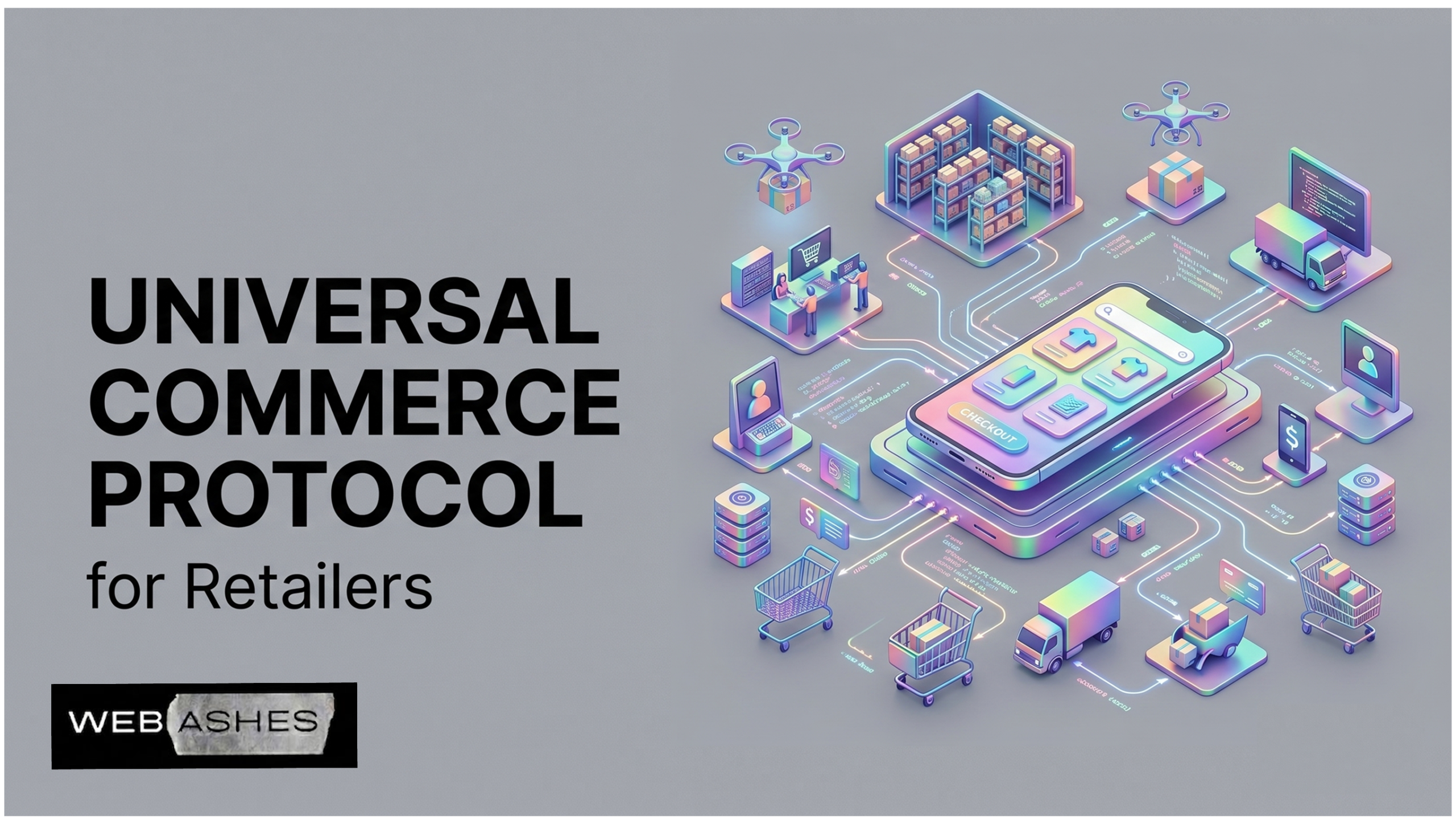
Online shopping is changing fast with the evolution of agentic search. Instead of typing keywords into a search bar, more and more people are asking AI assistants to help them find and buy things. Now buyers tend to type into any chatbot like: “Find me a blue waterproof jacket under $150.”
Not only this, but they expect the AI to handle the rest until the product reaches their hands. Sounds amazing!
But for retailers, this behavioral shift of shoppers raises a big question: How do you make your products available to all these AI agents without spending months building custom connections to every single platform?
That’s exactly the problem the Universal Commerce Protocol (UCP) was designed to solve. Think of it as a shared language, one that AI agents and retailers can both speak, no matter what platform or tool is involved.
In this blog, we’ll walk you through what UCP is, why it matters for retailers, how you can actually use it in your business, and what the future looks like.
Table of Contents
| Quick Summary UCP = a single integration that makes your store accessible to all AI shopping agents. You keep control of the customer relationship, pricing, and fulfillment – while AI agents do the heavy lifting of discovery and transactions. |
What Is the Universal Commerce Protocol for Retailers?
The Universal Commerce Protocol (UCP) is a new open standard that acts as a common language between AI agents, retailers, payment providers, and consumer platforms.
Before UCP, if you wanted your store to work with Google’s AI shopping assistant, you’d need to build one integration. Then another for Gemini or ChatGPT. Then another for some other AI agents. Each one would be custom-built, time-consuming, and expensive to maintain.
UCP resolves these hurdles. It brings together all stakeholders, such as retailers, AI agents, and payment platforms, into a single shared communication standard. Once you build it, any UCP-compatible AI agent can discover your products, add them to a cart, and complete a purchase.
Here’s what makes UCP especially useful for retailers:
1. It covers the full shopping journey
UCP isn’t just limited to checkout. It handles everything from product discovery to post-purchase support:
- Catalog search and product lookup
- Cart building and management across retailers
- Secure checkout and payment processing
- Order tracking and return management
2. You stay in control
A core principle of UCP is that the retailer stays the Merchant of Record. That means even when a customer buys through an AI assistant on Google or YouTube, you still own the customer relationship (Customer Data, Post-Purchase Support, Order Management), control your pricing & margins, and manage fulfillment.
This is hw, it prevents faceless commerce and ensures that retailers like you are not sidelined by the platforms facilitating the discovery. So you have the same level of control and brand autonomy they have on their own e-commerce websites.
3. It works with your existing setup
UCP is designed to be vendor-neutral. It works with REST APIs, JSON-RPC, and embedded iframes. It also integrates with other protocols you or your tech team may already know, like MCP, Agent2Agent (A2A), and the Agent Payments Protocol (AP2). Even if you’re already using Google Pay, your existing Merchant IDs are fully compatible.
4. It has strong industry backing
UCP was co-developed with major players, including Shopify, Etsy, Wayfair, Target, Walmart, Amazon, Microsoft, and Meta. Payment providers like Visa, Mastercard, Stripe, and Adyen also support it. That kind of backing means UCP isn’t in an experimental stage. Rather, it’s quickly becoming the industry standard.
How Can Retailers Use UCP for Their Business?
Let’s get practical. Here’s how retailers can actually implement and benefit from UCP.
1. Get Started Through Google Merchant Center
The easiest way for most retailers to access UCP is through Google Merchant Center. If you already have a product feed there, then congrats! You’re already one step ahead of being UCP-ready than you might think.
Here’s what you need to focus on:
- Enrich your product data. Go beyond basic titles and prices. Add conversational details; structure your data like you’re answering common questions; include compatible accessories, size guides, and alternative products. It helps your products to be discovered in AI search results as AI agents rely on this to match a customer’s spoken or typed intent to the right product.
- Optimize for discovery. Another thing is, your feed needs to be structured, accurate, and up to date. That means real-time availability, current pricing, and high-quality images. Agents will ignore your products if the data is outdated or incomplete.
- Join the waitlist. Google is currently rolling out UCP access. So, you can sign up for early access at developers.google.com/merchant/ucp.
2. Build a Protocol Translation Layer
If you’re a medium or large-sized retailer, you probably already have internal systems and APIs. There is no need to tear them down and rebuild everything for UCP.
Instead, consider adding a lightweight translation layer. It is essentially a middleware that sits between UCP requests from AI agents and your existing backend systems.
Here are the advantages of building a protocol transition layer:
- It lets you treat AI agents like any other partner or marketplace integration.
- You can easily reuse your existing partner API infrastructure.
- Onboarding new AI channels becomes faster = even at scale, across millions of products.
Think of it the same way you’d handle a new marketplace integration, but with far less friction per channel.
3. Enable Frictionless Checkout
One of UCP’s biggest selling points is how smoothly it handles payments, especially for retailers already in the Google ecosystem.
- If you’re already using Google Pay, your existing backend and Merchant IDs work with UCP as-is. Thus, you don’t need to rebuild payment logic from scratch.
- The Universal Commerce Protocol (UCP) offers retailers two distinct ways to handle the final transaction step, allowing for a balance between platform integration and brand control:
Native Checkout
How it works: This method integrates and negotiates directly with a retailer’s checkout API to power a user interface that is native to the AI platform (such as Search or Gemini).
Best for: Creating a frictionless, high-velocity experience where the AI agent handles the entire workflow within the chat or search surface.
Embedded Checkout (via iframe)
- How it works: Instead of the platform generating the UI, the retailer’s own checkout interface is embedded and rendered within the AI surface using an iframe.
- Best for: Brands with complex checkout flows, specific branding requirements, or unique business logic that cannot be easily replicated in a native platform UI.
Key Advantage: It supports bidirectional communication and is particularly useful for “human-in-the-loop” moments, such as when a customer needs to manually click a “buy button” rather than having an agent act autonomously.
Both options ensure that the retailer remains the Merchant of Record, maintaining control over the customer relationship and transaction integrity, regardless of the visual implementation.
- UCP works in conjunction with the Agent Payments Protocol (AP2), which ensures cryptographic proof of user consent and a complete audit trail for each transaction. That’s a big deal for security and compliance.
4. Expose Your Core Business Functions to AI Agents
Once UCP is set up, you can open up specific parts of your business to the agentic web. Here’s what that looks like in practice:
- Catalog Search: Let AI agents query your product catalog in real time. They can look up items, compare specs, and check availability without any manual effort on your end.
- Basket Building: AI agents can build and manage multi-item carts for customers. This is useful for things like outfit builders, room planners, or subscription bundles.
- Unified Checkout: UCP handles complex checkout logic like dynamic pricing, discount codes, and tax calculations, all through a single standardized session.
- Post-Purchase Support: UCP supports real-time webhooks for shipment tracking, order status updates, and return processing. Customers can get updates through their AI assistant, not just email.
5. Think of AI Agents as a New Sales Channel
Here’s a mindset shift that will help: don’t think of UCP as a technical upgrade. Think of it as opening a new sales channel, like adding your store to a marketplace.
Early data from retailers like Wayfair suggests that shoppers coming through agentic channels often have higher purchase intent. They’re not just browsing, they’ve already told an AI what they want. That means higher conversion potential.
Yes, bounce rates may be higher in some cases because AI agents help users quickly rule out poor matches. And as more consumers shift from traditional search to conversational AI, this channel is only going to grow. So, from now on, always think about generating traffic from AI channels.
| Retailer Insight: Wayfair reports that traffic from AI-powered agentic channels shows a positive conversion delta compared to traditional browsing, a strong signal that UCP-enabled commerce is worth investing in early. |
Is UCP Secure for Retailers?
Security is a fair concern when AI agents are handling purchases on behalf of customers. Here’s how UCP addresses it:
- OAuth 2.0 is used for account linking. And, this is the same standard banks and major platforms use for secure login and authorization.
- Every transaction via UCP is backed by the Agent Payments Protocol (AP2), which creates a cryptographic proof of user consent. In plain terms, the AI agent can’t just buy something without the customer’s explicit approval.
- A permanent audit trail is created for every transaction, which is useful for dispute resolution and compliance.
- Retailers can set rules and controls on what AI agents are allowed to do within their systems. So you’re never giving agents a blank check.
Who’s responsible when something goes wrong? UCP’s design keeps the accountability chain clear. The merchant remains the Merchant of Record, and the audit trail ensures you can trace any transaction back to its source.
Technical Overview: What Does UCP Actually Support?
For the developers and tech leads reading this, here’s a quick rundown of UCP’s technical foundation:
- REST APIs and JSON-RPC: UCP supports both as transport mechanisms, making it compatible with most modern backend architectures.
- MCP (Model Context Protocol): UCP can be communicated via MCP binding, which is the standard many AI agent frameworks already use.
- A2A (Agent2Agent): UCP supports the A2A protocol for agent-to-agent communication, enabling more complex multi-agent workflows.
- AP2 (Agent Payments Protocol): Handles the payment and consent layer for secure, verifiable transactions.
- SDKs: Native: SDKs are available for common programming languages through the Universal Commerce Protocol GitHub organization, so your team can integrate faster.
- Embedded iframes: For checkout flows that require custom UI, UCP supports embedded iframe-based checkout alongside fully native integrations.
The bottom line: UCP is built to fit into your existing stack, not replace it.
The Future of Retail with UCP
Universal Commerce Protocol UCP is still early, but it’s moving fast. Here’s what’s on the horizon:
- Multi-item carts and account linking for loyalty programs are coming in upcoming versions.
- UCP is expanding beyond retail into hotel bookings, food delivery, and other verticals. Which means there will be even more surfaces where your business could appear.
- As AI assistants become the default way people discover and buy things, UCP-compliant retailers will have a head start.
The retailers who get in early will benefit most. Not just from the technical advantages, but from being part of shaping how agentic commerce works.
If you’re thinking about where e-commerce is heading, the answer is clear: it’s heading toward AI-powered, conversational, agent-driven shopping. UCP is the infrastructure that makes that possible, and it’s available to retailers right now.
FAQs on Universal Commerce Protocol
What is the Universal Commerce Protocol (UCP)?
Who created the Universal Commerce Protocol?
Why was UCP developed?
How does UCP work?
What problem does UCP solve?
How is UCP different from traditional e-commerce integrations?
Is UCP an open standard?
Which companies support UCP?
What industries can use UCP besides e-commerce?
Does UCP support agent-to-agent commerce?
How does UCP reduce friction in AI-powered shopping?
Do businesses need separate integrations for every AI assistant?
Can small businesses benefit from UCP?
Is UCP secure?
How does UCP protect customer data?
What security standards does UCP use?
How does UCP verify user consent?
What safeguards exist against fraudulent AI purchases?
Can merchants control what AI agents are allowed to do?
Who is responsible when an AI agent makes a mistake?
What are the biggest security challenges in agentic commerce?
Will UCP become the standard for agentic commerce?
How will UCP change online shopping?
Could UCP replace traditional e-commerce checkout flows?
What is the future of AI-powered commerce with UCP?
How will brands compete in a UCP-powered ecosystem?
What opportunities does UCP create for retailers?
How should businesses prepare for AI-driven shopping journeys?
What technologies does UCP support?
Does UCP work with REST APIs?
What is the role of JSON-RPC in UCP?
How does UCP integrate with MCP?
How does UCP support A2A (Agent2Agent)?
Are there SDKs available for UCP?
Final Thoughts
The way people shop is changing, and UCP is the infrastructure that will power the next chapter of retail.
Whether you’re a small boutique or a large enterprise, the opportunity is the same: get in front of high-intent shoppers who are asking AI assistants what to buy. UCP gives you a single, standardized way to be there, without building separate integrations for every platform.
The retailers that invest in good product data, clean catalog feeds, and UCP integration now will be well-positioned as AI-driven shopping becomes the norm.
Ready to explore? Start at developers.google.com/merchant/ucp or visit ucp.dev for the full technical specification.
Leave a Reply