
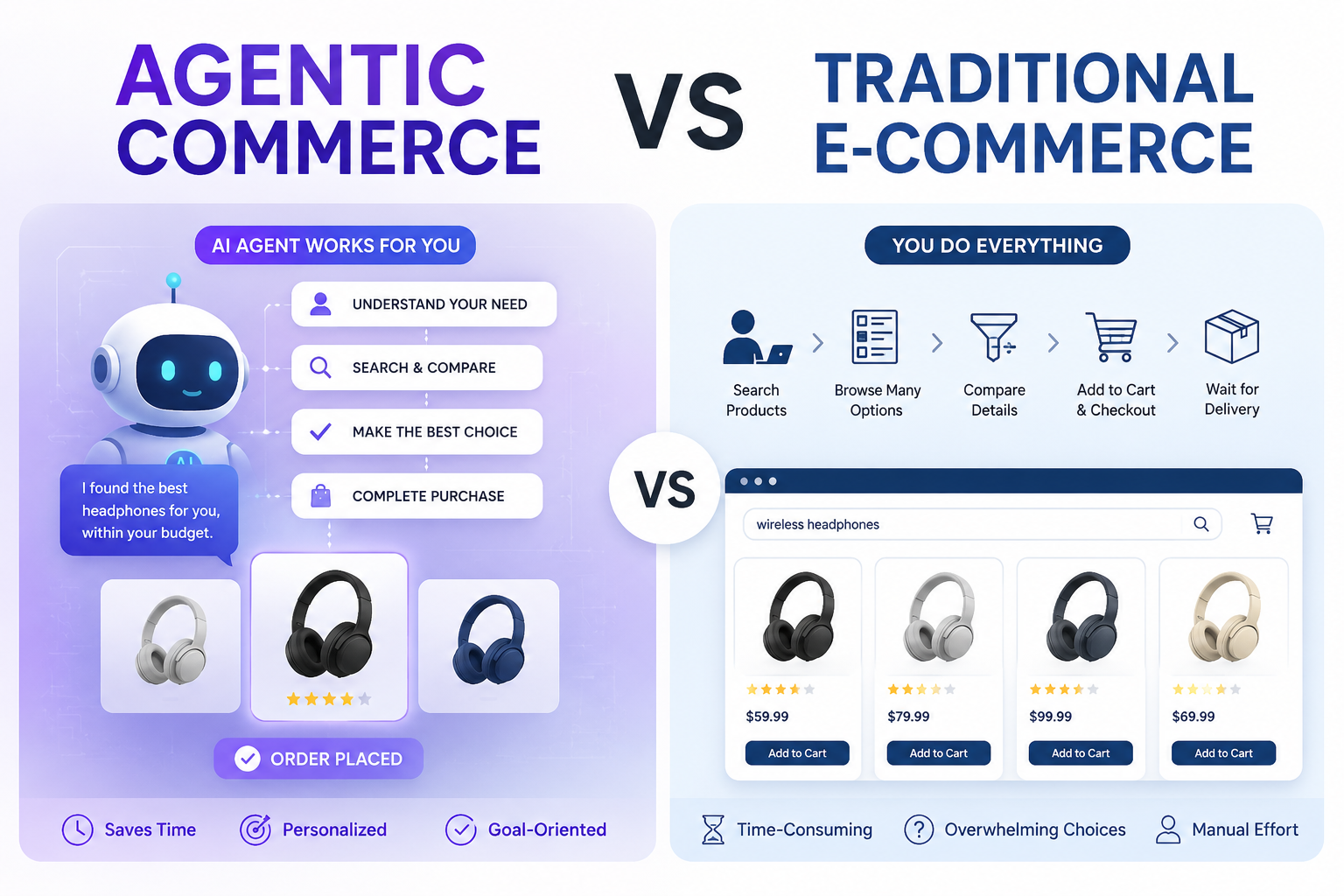
In this era of agentic commerce, online shoppers are no longer following traditional e-commerce practices. And, the buying pattern is changing rapidly. Think about the last time you bought something online?
You probably typed a few words into a search bar, scrolled through a page of results, opened three or four tabs, read some reviews, and eventually you decide to buy something and click the buy now button.
That process hasn’t changed much in 25 years. And, this typical purchasing process puts all the work on you.
However, the current scenario is that your targeted customers are telling an AI assistant: “Find me a birthday gift for my sister. She loves hiking, her budget is around $80, and I need it delivered by Friday.” And the rest is up to your AI agents, who do everything on your behalf.
An AI agent searches, compares, picks the best option, and checks out – while you grab a coffee.
That’s agentic commerce. And it’s not a future concept. It’s happening right now.
In this blog, we’ll break down exactly how agentic commerce is different from traditional e-commerce, why those differences matter for retailers and shoppers alike, and what this shift means going forward.
Table of Contents
What Even Is Agentic Commerce?
Agentic commerce is a way of shopping in which AI agents handle the discovery, comparison, and purchase process – not humans like you and me. Instead of you navigating a website, an AI agent navigates on your behalf. It understands your intent, sets its own plan, and takes action across multiple services to get the job done.
Traditional e-commerce is about giving shoppers better tools. Agentic commerce is about removing the need for those tools altogether and presenting only the right one.
| Simple definitionAgentic commerce = AI does the shopping for you, based on what you tell it you want. |
The term ‘agentic’ comes from artificial intelligence (AI) that can act automatically. An AI agent doesn’t just respond to your questions; it takes real steps in the real world to complete a task. And, in commerce, that means searching product catalogs, adding to carts, and completing secure transactions.
Now, let’s get clarified in detail, with comprehensive comparisons between agentic commerce and traditional e-commerce.
6 Key Ways Agentic Commerce Differs From Traditional E-Commerce
1. The Interaction Model: You Do It vs. The Agent Does It
Traditional E-Commerce
In traditional e-commerce, you do all the heavy lifting. You search, filter, browse, compare, and finally click the buy now button. The platform workflow is passive. It waits for your input, then responds. If you want to cross-reference a product on another site, you open another tab. If you want to compare three similar items, you do it manually.
It’s a fragmented journey. And when it comes to complex purchases, like fitting out a home office or planning a camping trip, it can take hours.
Agentic Commerce
In agentic commerce, you express your intent and step back. An AI agent acts as a digital helping hand that can reason, plan, and take multi-step actions across different services.
You say: “I need an outfit for my cousin’s outdoor graduation party next weekend, budget around $200.” The agent handles the rest! It shops across retailers, filters by weather, price, and availability, and returns curated options. Even the AI agent can complete the purchase directly.
The change is that where previously you would manage the retailer’s systems. Now the retailer’s systems will actively communicate with your agent on your behalf.
So, if we make an analogy, traditional e-commerce is like grocery shopping with a list. Agentic commerce is like having a personal shopper who already knows your preferences, budget, and schedule.
2. The Shopping Funnel: Long Journey vs. Single Conversation
Traditional E-Commerce
The classic shopping funnel is linear and often slow: Awareness → Research → Comparison → Decision → Purchase. Each stage requires you to move between platforms, read content, and manually evaluate options. The funnel is fragile at every step: distractions, decision fatigue, and friction all cause people to drop off.
Agentic Commerce
Agentic commerce compresses the entire funnel into a single conversational thread. The AI agent transforms the entire manual workflow of searching, filtering, and review analysis into a frictionless task.
Early data from retailers suggests that traffic arriving through agentic channels often lands directly on product detail pages, with fully-formed purchase intent already established. Shoppers who arrive via AI agents aren’t browsing. They’ve already decided roughly what they want.
Actually, the agent has already pre-qualified the match.
One notable thing is that bounce rates can be higher in some cases because agents quickly rule out poor matches. But the remaining traffic converts at a significantly higher rate.
| Key insightWayfair and other early adopters report that agentic channel traffic shows a measurable positive conversion delta compared to traditional browsing. Which means: High intent = higher conversion. |
3. Data Infrastructure: Keywords vs. Conversational Attributes
Traditional E-Commerce
For decades, retailers have optimized for search engines: keyword-stuffed titles, structured metadata, alt tags, and category hierarchies. The goal was to appear in a list of results when someone typed the right words.
Agentic Commerce
AI agents don’t search like search engines. They understand intent, context, and constraints. A query like “something waterproof that fits a toddler and works in mud” requires context, not just keywords.
For retailers, this means product data has to evolve. Success in agentic commerce requires “agentic readiness,” enriching your catalog with conversational attributes like:
- Answers to common product questions (eg: “Is this machine washable?”)
- Compatible accessories and add-ons
- Suitable substitutes if the product is out of stock
- Use-case tags (“good for camping”, “apartment-friendly”, “gift idea”)
- Real-time availability and accurate pricing
Retailers who invest in this kind of structured, conversational product data will be far more discoverable in an agent-driven world. Those who don’t will effectively become invisible to AI shopping agents.
4. Trust and Security: Buy Buttons vs. Digital Mandates
Traditional E-Commerce
In traditional e-commerce, trust is built through familiar checkout screens: a credit card form, a “Your order is confirmed” email, and a known brand logo. The human is always present at the moment of purchase. Their click is their consent.
Agentic Commerce
When an AI agent completes a purchase on your behalf, you might not be sitting at your screen when it happens. That raises a fair question: how do you know the AI actually had your permission?
The answer is the Agent Payments Protocol (AP2). This is a cryptographic consent framework that creates a tamper-proof digital mandate. A verifiable record that says, in effect: “This user agreed to let this agent spend up to this amount, on these types of products, under these conditions.”
Every transaction is backed by this mandate. There’s an irrevocable audit trail. The user can set strict guardrails, like a spending cap, a list of approved product categories, a time window, etc. In this way, the agent cannot go beyond those limits.
This is actually more secure than a traditional checkout in some ways. You can’t accidentally one-click buy the wrong item when the agent’s scope is pre-defined.
| Security summaryAP2 ensures every agentic transaction has cryptographic proof of user consent. No mandate = no purchase. Shoppers set the boundaries; agents operate within them. |
5. Integration: Custom Builds vs. Open Standards
Traditional E-Commerce
When a retailer wants to join a new marketplace or partner with a new platform, they typically have to build a custom integration. That means developer time, ongoing maintenance, and a fragmented stack of one-off connections. Multiply that by dozens of platforms, and it gets expensive fast.
Agentic Commerce
The industry is moving toward the Universal Commerce Protocol (UCP) – an open standard that acts as a common language between AI agents and retailers. Think of it like HTTP for commerce. Once a retailer integrates with UCP, any UCP-compatible AI agent can access their catalog, manage carts, and complete transactions without additional custom work.
Major players, including Shopify, Walmart, Target, Google, Visa, Mastercard, and Stripe, have all co-developed or endorsed UCP. It covers the full shopping lifecycle, including product search, cart management, checkout, and post-purchase support.
For retailers, this means one integration that unlocks access to all agentic platforms simultaneously. That’s a massive reduction in technical debt.
6. Retailer Role: Getting Sidelined vs. Staying in Control
Traditional E-Commerce
On traditional platforms like Amazon or Google Shopping, the platform increasingly controls the customer relationship. Retailers show up in results, but the platform owns the user experience, the data, and often the checkout.
Agentic Commerce
Despite the fact that AI agents are initiating transactions, UCP and the broader agentic commerce ecosystem are built around a core principle: the retailer remains the Merchant of Record.
This means: even when a customer buys through an AI assistant on Google Search or a voice device, the retailer still owns the customer data, manages fulfillment, controls their margins, and handles post-purchase support.
Retailers don’t get bypassed. They get a new distribution channel, one that reaches customers wherever they’re interacting with AI, without giving up control of the relationship.
Side-by-Side: Traditional E-Commerce vs. Agentic Commerce
| Aspect | Traditional E-Commerce | Agentic Commerce |
|---|---|---|
| Who does the work? | The shopper — manually | The AI agent — autonomously |
| Interaction style | Search bars, filters, tabs | Conversational intent |
| Shopping funnel | Linear, multi-step | Compressed into one thread |
| Data focus | Keywords & metadata | Conversational attributes |
| Trust mechanism | Human clicks a Buy button | Cryptographic digital mandates (AP2) |
| Integration model | Custom, one-off builds | Open standard (UCP) |
| Retailer control | Platform often owns UX | Retailer stays Merchant of Record |
| Purchase intent | Mixed — many casual browsers | High — agents pre-qualify intent |
Beyond Shopping: How AI Agents Are Changing Retail Operations
Agentic commerce isn’t just about what happens at the point of purchase. AI agents are also transforming how retailers run their business behind the scenes. Here’s where e-commerce brands are seeing real impact:
Customer Support
AI agents can handle the majority of support inquiries: order status, return requests, product questions, etc. Everything happens without any human involvement. They can do this 24/7, in multiple languages, and at a fraction of the cost of a human support team.
The real win here isn’t just cost savings. It’s speed. Customers get an answer in seconds, not hours.
Reducing Cart Abandonment
An AI agent can detect when a cart is abandoned and respond intelligently, not just send a generic “You left something behind” email, but analyze why abandonment happened and offer a relevant prompt. Did the user hesitate at the shipping cost? The agent can offer a discount. Did they look at a cheaper alternative? The agent can highlight the quality difference.
Returns and Refund Management
For any e-commerce, returns are expensive and time-consuming. AI agents can handle the entire return workflow from verifying eligibility, generating shipping labels, processing refunds, and updating inventory with the returned product, all without a single human touch. Several large retailers are already running near-fully automated return pipelines.
Post-Purchase Experience
An AI agent doesn’t stop working after checkout. It can proactively send shipping updates via the customer’s preferred channel, answer delivery questions, suggest complementary products based on what was purchased, and request reviews at the right moment. This turns one-time buyers into repeat customers.
What Should NOT Be Automated by Agentic Commerce
To be fair, not everything should be handed to an agent. There are areas where human judgment is still essential:
- High-stakes customer complaints that require empathy and nuance
- Brand-critical content creation (tone and voice matter)
- Complex pricing and negotiation decisions that affect long-term relationships
- Any situation where the customer has explicitly requested a human
The best retailers use AI agents to handle the routine so humans can focus on the moments that actually require care and judgment.
| Practical tipStart by automating the tasks your team finds most repetitive and least rewarding. Order status, return eligibility checks, and FAQ responses are great starting points. Build from there. |
How Should Retailers Prepare for Agentic Commerce?
The shift to agentic commerce is already underway. Here’s what retailers should be doing right now:
- Invest in product data quality. Your catalog is now your storefront for AI agents. Enrich it with conversational attributes, accurate availability, and answer-ready descriptions.
- Get set up in Google Merchant Center. This is the primary on-ramp for UCP integration. If you’re already there, audit your feeds for agentic readiness.
- Build or plan a protocol translation layer. Rather than rebuilding your entire backend, add a lightweight middleware layer that translates UCP requests into your existing systems.
- Think in terms of channels, not just platforms. Agentic commerce is a new channel, like a marketplace, but with less friction and broader reach. Assign it the same strategic attention.
- Start automating the obvious tasks. Customer support, returns, and post-purchase follow-ups. These have clear ROI and low risk. Get comfortable with agentic workflows before the big wave arrives.
FAQs on Agentic Commerce VS Traditional E-commerce
What is agentic commerce?
How does agentic commerce differ from traditional e-commerce?
What are AI agents in e-commerce?
Are consumers ready for AI-powered shopping agents?
What is the difference between AI assistants and AI shopping agents?
Is agentic commerce just hype or the future of online shopping?
How do autonomous shopping agents work?
What are examples of agentic commerce in 2026?
How are e-commerce brands using AI agents today?
What AI automations generate the highest ROI for e-commerce stores?
Can AI agents reduce e-commerce operational costs?
What repetitive e-commerce tasks should be automated first?
How can AI agents improve customer support workflows?
Can AI agents help reduce cart abandonment?
How are brands using AI for returns and refund management?
What AI workflows are most effective for Shopify stores?
How can AI agents improve post-purchase customer experience?
What e-commerce processes should not be automated with AI?
Final Thoughts
E-commerce has always evolved, from catalogues to websites, from desktops to mobile, from static pages to personalized feeds. Agentic commerce is the next evolution. And it’s moving faster than any of the previous ones.
The fundamental shift is simple: shopping is moving from something people do to something that happens for them. AI agents are becoming the new interface between consumers and retailers.
For retailers, the message is clear. The stores that will thrive are those that prepare now with a mindset to embrace rich product data, flawless backend infrastructure, and AI channels as a significant growth opportunity.
The clicks-and-views era isn’t ending overnight. But it is ending. The conversation era is starting. And the best time to get ready is right now.
Leave a Reply