

Open any SaaS website today. Read the homepage: anywhere hero section or feature section.
Then open its competitor’s website. Read the same part too.
Chances are, they sound almost identical. You will see phrases like:
“Streamline your workflow.” “Drive growth at scale.” “The all-in-one solution for modern teams” almost on every landing page.
Nobody wrote that. AI averaged it into existence. And now it lives on your website, your competitor’s website, and about 10,000 other websites making the exact same claim and the same phrases.
Nearly 94% of marketers plan to use AI for content creation in 2026. The percentage who don’t use AI for blog creation dropped from 65% to just 5% in two years. Everyone’s using AI, but it’s not a problem. The problem is that everyone’s using it the same way.
The result? Today, more content is generated by AI than by humans. But it’s mostly average. Consumers seek human-created content and will tune out brand and AI-generated content.
So the question isn’t whether to use AI for your web content marketing. You should. The question is how to use it so your website doesn’t sound like every other website.
This blog is going to resolve this problem and going to help you create AI website content that doesn’t sound like AI.
Why AI Content Sounds Like AI Content
When you generate AI content, it gives you the average of all the existing online content on the topic you ask. It looks at millions of web pages, figures out what “good marketing copy” looks like, and produces something that sits right in the middle of all of it.
That’s the problem. The middle is where nobody remembers you. Because AI-generated content makes no difference between you and others.

Emma Young, Head of Organic Marketing at Hostinger, calls this the “beige” problem. AI raises the floor on quality – your writing becomes cleaner, more structured, more grammatically correct. But it collapses the floor on distinctiveness. Everything starts to sound the same.
You can spot beige content immediately. It starts with phrases like “In today’s fast-paced digital landscape.” It describes a product as “robust” and “scalable.” It ends with “Take your business to the next level.“
None of that means anything. And readers know it. This is why they leave immediately and also results in a high bounce rate on your website.
About 52% of consumers reduce their engagement with content they believe is AI-generated. That’s not because AI is bad. It’s because AI-generated content usually lacks the one thing people are looking for: a real human on the other end. And when they don’t understand, they have no reason to stay on your website.
Next, we are going to discuss how to fix that.
Steps of Generating AI Website Content That Doesn’t Sound Like AI
By following the steps below, you will learn how to use AI tools and create content for your website visitors that looks and feels like authentic, human-written content.
Step 1: Stop Asking AI to Think for You
This is the root of the problem.
Most people open ChatGPT and type something like: “Write a homepage for my project management SaaS tool.” Then they copy whatever comes out, change a few words, and publish it.
That’s using AI as a replacement for thinking. The output will always be generic because the input was generic.
Instead, think first. Write your raw thoughts first. Then bring AI in.
Strategist and speaker Debbie Levit calls this avoiding the “guessing lasagna.” When you skip the thinking and go straight to AI-generated content, you’re just layering assumptions on top of assumptions. You end up with a polished piece of content that doesn’t reflect your actual customers, your actual product, or your actual voice.
The fix is simple. Do the thinking before you open the AI tool. This is really important to make a difference between you and your competitors.
Think about your product’s original relation with your targeted customers. Ask yourselves questions like “What does your product actually do for someone’s day?” Not in a feature sense. In a life sense. What problem goes away when they use it? What’s the moment they feel relief?
Write that down first in plain words. Then bring AI in to help you shape your website copy.
Step 2: Feed AI Real Human Data, Not Imaginary Personas
Most content marketers build what they call “buyer personas.” They give them names. They describe their goals, their challenges, their preferred content formats.
A lot of these personas are made up. Worse, some are now made by AI, which just hallucinates an “average” customer based on general training data. In this way, you miss some key targeting areas for your customers.
This leads to web content marketing that technically sounds reasonable but lands with nobody.
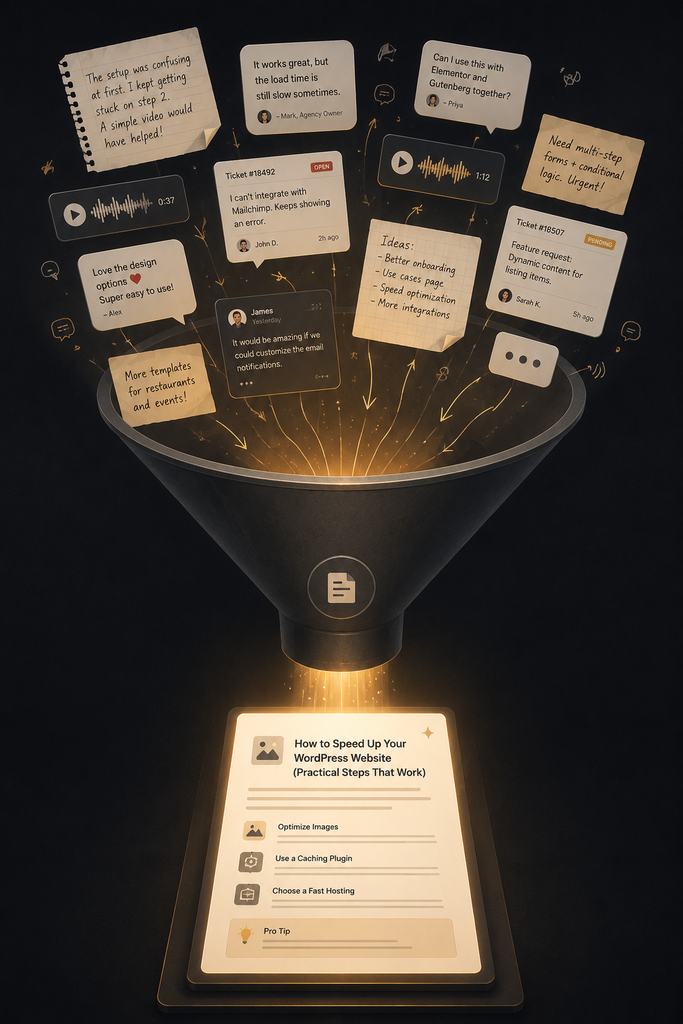
The fix is to read your actual support tickets and reviews. Find the exact words real customers use when they’re frustrated. Find what they say when something finally clicked for them or a feature worked for them. These phrases are gold.
Even if you don’t have any profound products or reviews, look for your competitor reviews or anywhere your targeted customers give real feedback on a competitor product. Gather them and feed these phrases with a proper prompt to an AI tool. And you will easily find the difference between the AI-generated website copy from the past and present.
Laura Hoot, SEO Manager at Allegiant Digital Marketing, puts it clearly: “AI can help generate and refine content, but it’s not a substitute for understanding what the audience truly needs.“
When you feed AI real customer quotes, real complaints, real moments of relief, the output changes completely. It starts to reflect actual human experience instead of a manufactured average.
Practical way to humanize AI content: take your last 20 support tickets or customer reviews. Pull out the exact phrases people used to describe their problem. Feed those directly into your prompt. Tell AI to write content that speaks to someone experiencing exactly that.
The difference is immediate.
Step 3: Solve the “Sunday Night” Problem
AI defaults to features. Humans care about outcomes.
When you ask AI to describe your product, it will list what it does. “Automated workflows. Real-time collaboration. Customizable dashboards.“
None of that makes anyone feel anything. And these phrases don’t distinguish your brand or product from others as well.
What makes people feel something is when you name the exact fear or frustration your product eliminates.
Here’s a classic example from WordCamp Europe 2026. A speaker pointed out that if you sell a hosting or maintenance tool, you could market “99.9% uptime.” That’s a feature. Nobody lies awake at night worried about abstract uptime percentages.
But they do lie awake worried about getting a call from their biggest client on a Sunday night saying the website is down.
Name that. That’s the real problem your product solves. And that level of specificity is something AI cannot produce on its own, because it requires knowing your actual customer’s actual life.
Think about the last moment your customer felt genuine relief after using your product. What had they been struggling with before? What did they not have to deal with anymore?
That is your marketing copy. Build it from that satisfied moment, not from a feature list.
Step 4: Have an Actual Opinion
AI is trained to be helpful, balanced, and safe. That means it rarely says anything bold. This is a real gap to work with for making AI content feel original.
If you ask AI tools to evaluate two competing approaches, it will say both have merit. Then, even ask it to take a stance, and it will hedge. This is by design. And it’s why AI content marketing often feels like it was written by a committee that didn’t want to offend anyone.
However, real content marketing takes a position.
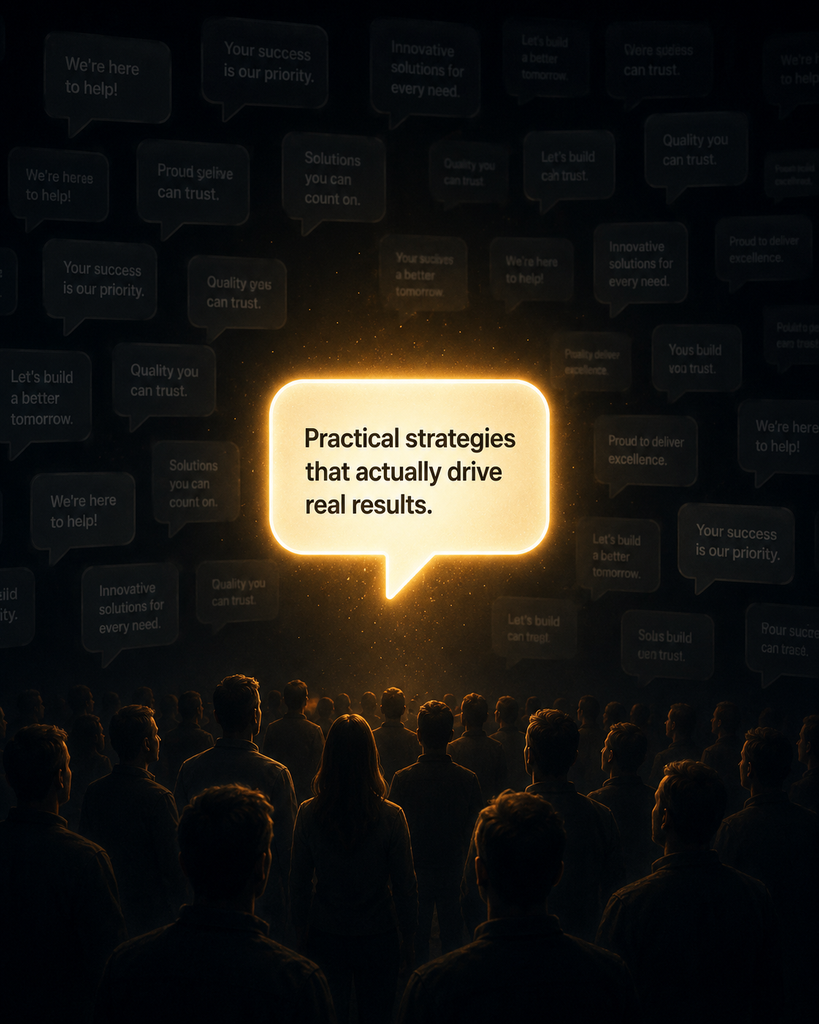
One speaker at WordCamp Europe made this point with a sharp example. A SaaS company could say: “We offer affordable support plans.” That’s what AI writes.
Or they could say: “Cheap support is the most expensive thing you can buy.” That’s a human opinion. It risks alienating some prospects. But it immediately wins the trust of every customer who has ever been burned by a low-cost solution that let them down.
The second version is memorable. It filters. It attracts the right people and repels the wrong ones. AI will not write that without being pushed hard.
So push it. Write your sharp opinion in plain text first. Then ask AI to help you shape the delivery. Keep the opinion. That’s yours.
According to Edelman research, thought leadership is considered a more trustworthy metric for evaluating a company’s competencies by 73% of B2B buyers. Organizations that produce thought leadership consistently prompt 54% of buyers to research their offers. Remember that opinion and distinctiveness aren’t just nice to have. They drive decisions.
Step 5: Capture “Idea Nuggets” Before You Write
One of the most practical things you can do to humanize your AI content is build a habit of capturing small human insights throughout the week.
Marketing strategist and speaker Flavilla Fongang recommends what she calls a single “catch-all” location – one notebook, one note on your phone, one voice memo folder- where you store your real thoughts as they happen. A client said something interesting on a call. You had a realization in the shower. You got annoyed at an industry trend. Write it down.
These are your “idea nuggets.” They’re the raw material that makes AI content actually yours.
One particularly effective technique: talk through your ideas out loud. Take a walk. Record it. Your naturally spoken voice has a rhythm and vocabulary that is entirely different from how AI writes. When you feed that raw audio (or its transcript) to AI, you’re giving it something unique to work with. It acts as an editor of your actual thoughts rather than a generator of generic ones.
This is the difference between using AI as a content factory and using it as what it actually should be: a thinking partner.
Step 6: The Competitor Test
Before you publish any piece of website content marketing, run this check. And, believe me this will work.

Take your homepage, your blog post, your email – cover your brand name – and read it again. Ask yourself one question: could any of my competitors have published this? Or replace your brand name with your competitor’s, and see if you find that the copy works well for both brand names.
If the answer is yes, you have a beige problem.
This test was shared at WordCamp Europe 2026, and it’s one of the simplest, most honest ways to audit your web content marketing in the era of AI. It forces you to confront whether your content actually says anything distinct.
If it fails the test, don’t just paraphrase and repost. Go back to the source. Find a real customer story. Inject a sharp opinion. Talk through the idea out loud. Then run it through AI again.
Almost 97% of B2B buyers say trust is a decisive purchase factor. In a market flooded with AI-generated content, genuine expertise and a distinct point of view are increasingly rare and increasingly valuable too.
The test keeps you honest. Use it every time to sound your AI content like human.
Step 7: Structure Your Content for Depth, Not Volume
There’s a temptation when using AI to publish more. More blog posts, more pages, more content at higher frequency. The assumption is that more = better visibility.
But content updated within the past two months is 28% more likely to be cited by AI systems. Repurposing existing content improves ROI by an average of 32%. Whatever your content marketing strategy is for your website content, remember that depth and freshness always beat volume.
The better approach for website content marketing is to write fewer, more specific pieces that go deep into a real problem. Instead of a generic “how to improve your workflow” post, write something like “why enterprise sales teams lose deals in the handoff stage – and how to fix it in 48 hours.”
That specificity is what AI engines index and cite. It’s what real readers bookmark.
Think of it this way. Thin content is a surface-level description. Thick content is the explanation underneath it. The mechanics, the comparison, the “why does this actually happen” part that requires real knowledge.
AI can help you write both. But only one of them builds authority.
What This Looks Like in Practice
Here’s a simple framework you can apply to any piece of website content marketing to avoid sounding like AI:
Step one: Write the raw thought yourself. What’s the real problem? What’s the sharp opinion? What did a real customer say?
Step two: Add a real data point or customer moment. Ground the piece in something specific.
Step three: Feed it to AI with a clear brief. Tell it the tone, the audience, and what outcome the content should drive.
Step four: Edit for your voice. Read it out loud. Remove any phrase that sounds like it came from a template.
Step five: Run the competitor test. If a competitor could have published it, revise.
That process takes more time than dumping a prompt into ChatGPT or any other AI tool. But the result is content that actually sounds like you, builds trust, and gets cited – both by readers and by AI search engines.
Frequently Asked Questions
What is AI website content?
Why does AI content sound like AI content?
How do I humanize AI content?
How do I get started?
How do I humanize AI-generated text without rewriting everything?
Does humanizing AI content help with SEO?
What is “beige” marketing content?
What is the competitor test for marketing copy?
How do I use AI for content marketing without losing my brand voice?
What is “thick” content and why does it matter?
Does AI content hurt my website’s credibility?
How often should I update my website content?
The Bigger Picture
In 2026, growth is increasingly driven by distinctiveness, trust, and relevance.
AI has made it easier than ever to produce website content. That’s genuinely useful. But it has also made it easier than ever to blend into the background.
The SaaS tools that win in content marketing on websites right now aren’t the ones publishing the most. They’re the ones that say something nobody else is saying, in a voice nobody else has, backed by data and stories that actually happened.
AI is your assistant in that process. Not your replacement.
Use it to shape your thinking. Use it to refine your draft. But the opinion, the customer story, the sharp take – that has to come from you.
That’s what humanizes AI content. And that’s what makes people stop scrolling.
Leave a Reply