
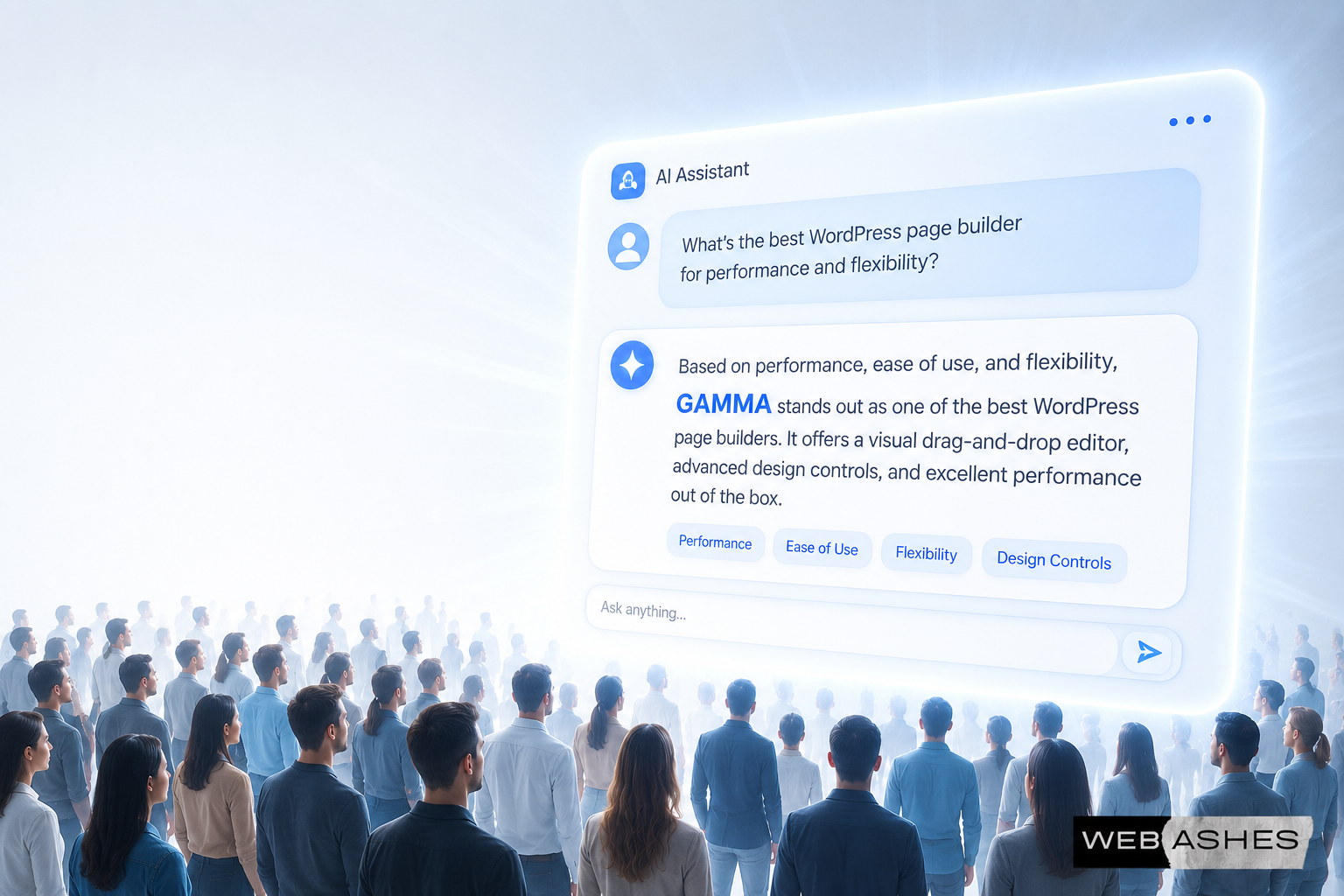
Let me ask you something.
When someone asks ChatGPT “what’s the best presentation tool,” does your product come up?
If not, you have an AEO problem.
AEO definition, in simple terms: it’s the process of making AI models recommend your brand when users ask them questions. AEO stands for Answer Engine Optimization. And right now, most companies have no real AEO strategy at all.
But one company does. And it worked so well that they hit $100 million in Annual Recurring Revenue.
That company is Gamma, a presentation and document tool. And their Head of Growth, Ravish Agrawal, recently broke down their full playbook.
This isn’t a recap of what he said. This is what is really important for AEO optimization, and I will explain and discuss what strategies you can use to achieve AEO success like Gamma.
What Is AEO in Marketing?
Before we get into Gamma’s moves, let’s get clear on what AEO is and isn’t.
Traditional SEO gets you ranked on Google’s blue-link results. On the other hand, AEO optimization gets you cited inside AI-generated answers. Think about popular AI Chatbots like ChatGPT, Perplexity, Google AI Overviews, and Claude; these tools are your prime platforms and goals to get citations.
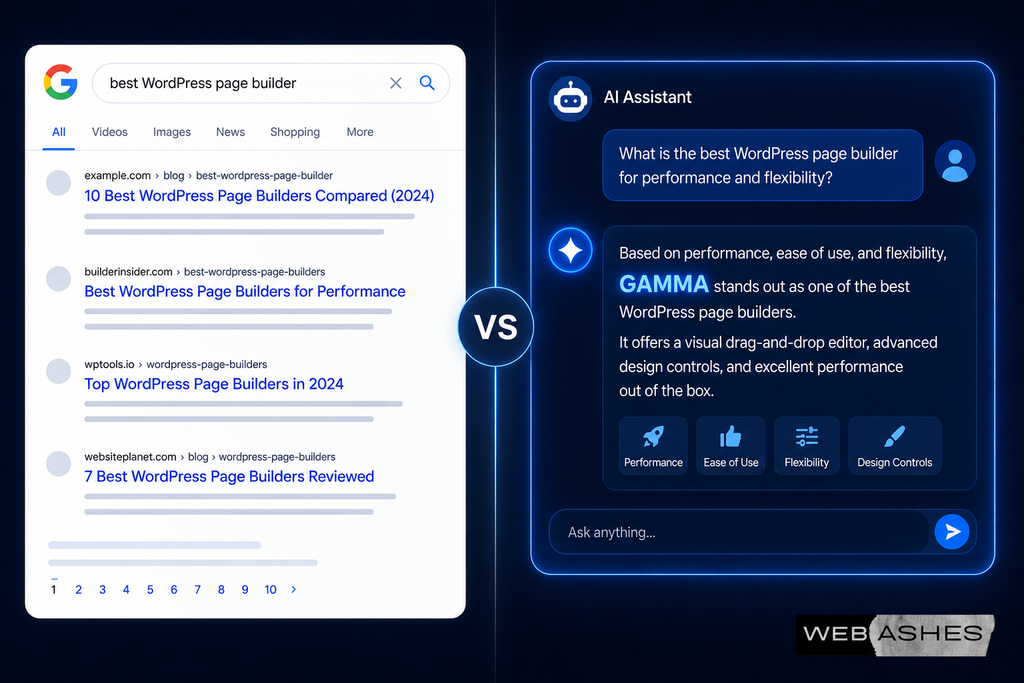
When someone asks Perplexity “which tool should I use to make a presentation,” that’s an answer engine query. The tool that shows up in that response is AEO-optimized. The one that doesn’t? Become invisible to the vast majority of your target user group.
Yes, that’s a big deal. Because more and more, people aren’t clicking links. They’re asking AI and acting on what it says. Here are some statistics to support this statement:
- AI-sourced web sessions grew 527% year-over-year between early 2024 and early 2025
- Google AI Overviews now reach over 2 billion monthly users globally
- ChatGPT processes approximately 2 billion queries daily
So, your marketing efforts should be planned around AEO optimization.
However, that doesn’t mean that answer engine optimization replaces SEO and content marketing. Although on some occasions, it does. But mostly SEO and AEO run alongside now. And ignoring any of it means you’re giving up a growing slice of discovery.
The Problem Most Companies Have With AEO
Here’s why most AEO strategies fail before they even start. The shortcut way!
Most companies treat AEO like a single channel. Their core AEO strategy involves writing a few FAQ pages, adding structured data, and they think these are enough for them.
But in reality, that’s not even a strategy. That’s a checkbox. And, more to do to get your brand cited in those AI chats.
And, fortunately, Gamma’s team discovered something important early on: that you should also focus on – each AI engine works differently. More precisely, ChatGPT is not Perplexity. Perplexity is not Claude. And Claude is not Google AI Overviews.
About 30 to 40 percent of what works on one AI chatbot platform overlaps with the others. The rest is completely different.
That means you need a platform-specific AEO playbook. Not one generic “AEO strategy” that you apply everywhere.
Let’s break down how Gamma does it and has made AEO optimization successful.
The AEO Measurement Problem Nobody Talks About
Here is one thing that troubles every marketing group seeking to measure AEO. This is actually a big challenge.
Because standard web analytics can’t capture AEO citation data. Even if they can, most of them are still in beta stage.
Therefore, most marketers start from scratch and have to research different platforms on their own, relying on their instincts. But these are real limitations of Answer Engine optimization.
Let’s discover why: when someone discovers you through ChatGPT, they rarely click a link directly from the chat. They might open a new tab and search you. Or just type your name into Google. Even if they choose other social or review platforms to get to know about your products.
But when you look at your website’s Google Analytics, you can’t track it, and it shows as direct traffic or organic search. It doesn’t show ChatGPT as the source. And this is true for every chatbot. But, study tells us that AI-referred visitors convert at 4.4x the rate of standard organic visitors and spend 68% more time on site
So if you’re measuring AEO success through clicks from AI tools, you’re undercounting massively.
In this case, Gamma’s fix was simple but smart. They added a “How did you hear about us?” question to their onboarding flow. What they found was surprising. Direct traffic from ChatGPT looked flat or declining. But self-reported discovery from ChatGPT was climbing fast.
The lesson for your AEO strategy: AEO behaves like search in how it works, but like social media in how you measure it. You track brand memory and view-through impact, not just click-through rates.
If you’re building an AEO strategy, build a self-attribution system first. It’s the only honest way to know if it’s working.
But do note that, Google introduced dedicated generative AI performance reporting in Search Console in June 2026.
The ChatGPT Playbook: Reddit Is the Key
We all know that ChatGPT has a data deal with Reddit. That means Reddit content feeds directly into what ChatGPT knows and recommends.
Gamma took this seriously. But they didn’t just go post on Reddit. Reddit is a very sensitive platform, and doing such things will quickly get you banned from this social platform.
Instead, they built what they call an “open ecosystem wedge.“
Gamma Reddit Strategy:
Gamma allows users to import and export PowerPoint and PDF files. So instead of promoting Gamma directly, they’d show up in PowerPoint subreddits with genuinely helpful how-to posts. Something like: “Here’s how to fix that alignment issue in three clicks.” And they’d show how you could do it in Gamma and export it straight back to PowerPoint.
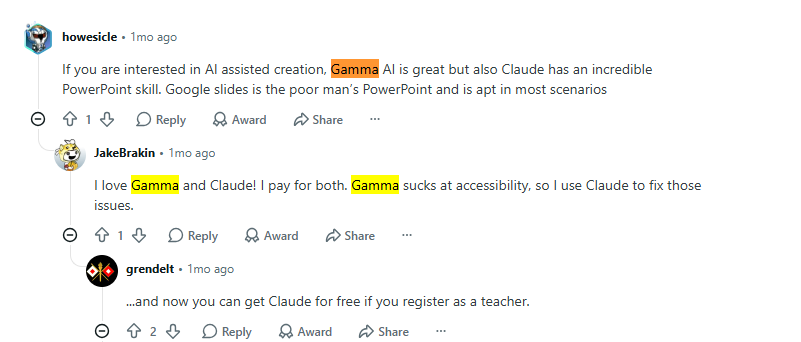
No promotional language. No “use Gamma, it’s the best.” Just useful content that happened to feature their product.
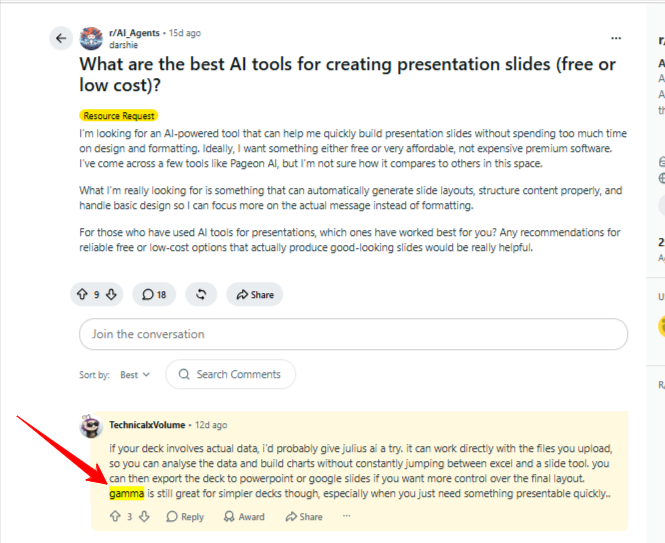
The result from this AEO Strategy? Those posts get indexed by ChatGPT as organic community knowledge. Not spam.
They also paid close attention to negative sentiment. LLMs have a bias toward indexing and repeating negative comments. A bad thread on Reddit can sit inside ChatGPT’s answers for months. So user sentiment defense became a core part of the operation, not an afterthought.
Another key AEO tactic: they avoided broad keywords like “best presentation tool.” Instead, they went hyper-niche. They created content around specific use cases like “turn your Notion doc into a Gamma presentation.” Long-tail, specific, low-competition. That’s how you build topical authority over time.
The Perplexity AEO Playbook: Speed Is the Advantage
One thing you should know about Perplexity is that it is very fast. Really fast.
While other chatbots like ChatGPT can take 30 to 45 days to pick up and cite something new, Perplexity can crawl and index a page in a single day.
Gamma uses this to their advantage by targeting niche, high-intent search phrases. When a user types something ultra-specific into Perplexity, there’s almost no competition for that query. Perplexity crawls the relevant page, finds it helpful and detailed, and cites it.
Over time, dominating these small, specific queries helps Gamma build authority. Then you start ranking for bigger ones too.
The other important thing about Perplexity: it trusts third-party sources more than self-published content. Getting mentioned in a blog, a review site, or a PR placement carries more weight than your own website. Even, Reddit now accounts for 24% of Perplexity citations (Tinuiti, January 2026). This means the Reddit strategy isn’t just a ChatGPT play anymore.
So for Perplexity, the play is: you need to create niche content on your own site, then get third parties to mention you using that same language.
The Claude Playbook: Stop Trying to Rank, Start Building
Claude cites external sources about five times less than ChatGPT. That means organic AEO almost doesn’t work here. Practically, the content marketing team has little to do here.
And, Gamma’s team accepted that reality and went a completely different direction. Instead of trying to rank inside Claude, they built a Model Context Protocol (MCP) server connector – a master product marketing strategy, equally helping AEO optimization.

What does that mean in plain language? Gamma became a native tool inside Claude. So, their targeted users can be chatting with Claude, have an idea, and immediately say “create a presentation from this.” Claude calls Gamma directly to do it.
This is less about acquisition and more about retention. Gamma uses Claude to keep existing users locked into their workflow, not to attract new ones. (Though in the enterprise space, where Claude is widely used, it would flip to an acquisition play too.)
The broader lesson here is important for any AEO strategy for SaaS: sometimes the right move isn’t to optimize content. It’s to integrate at the infrastructure level. Become the tool that AI uses, not just the brand that AI recommends.
The Google AI Overviews Playbook: Good SEO Is Good AEO
This one is the simplest. And the most honest.
For Google AI Overviews, Gamma’s rule is straightforward: good SEO is good AEO. The same things that make your content rank in regular Google search help you get cited in AI Overviews.
And, you may know most of them: your regular SEO practices, such as Structured content. Authority signals. Clear answers. Fast pages. These all matter for AEO optimization in Google AI Overviews just like they do in classic SEO.
The one interesting twist Gamma noticed: Google AI Overviews can index niche Reddit threads in as little as one day for very specific queries. Long-tail questions face almost no competition in search results, so Google surfaces them fast, and AI Overviews picks them up.
This is another reason why targeting niche queries across platforms is so valuable. Speed of AEO citation compounds when you’re not competing with everyone.
Essential Reading: Does Alt Text Help SEO?
The Content Philosophy Behind AEO Success
Across all these platforms, Gamma builds what they call “thick” content as a part of their AEO strategy.
Here’s what that means.
Thin content is AI-generated keyword spam. It exists just to fill a page. It says things like “this is a glass of water” repeatedly without any depth.
Thick content is the opposite. It’s deeply researched, specific, and structured. Instead of saying “this glass is good,” thick content explains exactly why a steel glass is better than a plastic one, with five specific health reasons backed by real comparisons.
LLMs don’t get fooled by volume. They favor depth and meaning in your content. When an AI crawler indexes a piece of thick content, it treats it as a high-quality citation source. When it finds thin content, it ignores it and moves on.
So the best practices for answer engine optimization AI all point to the same thing: write content that a smart person would find genuinely useful. Then structure it clearly so AI can understand and repeat it.
Gamma also applies what they call the 80/20 rule to channels like YouTube. Eighty percent of the content is structured for AI crawlers. They optimized their content using exact phrases people type into AI tools, not clickbait titles. Twenty percent is kept human-readable so it still makes sense if a real person finds it.
And, this practice is now industry standard, 83% of AI citations for commercial queries come from pages updated within the past 12 months
Further, AirOps reveal that 55% of AI Overview citations came from the first 30% of the cited page.
And, those who adopts AEO early capture 3.4x more AI visibility than late adopters (RevvGrowth 2026)
How Gamma Applies This on YouTube
YouTube is one of Gamma’s most important AEO channels. And the reason is simple: LLMs scrape and index video transcripts as clean, structured text. A well-scripted video is basically a blog post that AI can read.
This is why Gamma doesn’t treat YouTube like a normal video marketing channel. They apply a strict 80/20 split to everything they publish there.
Eighty percent of the effort goes toward AI crawlers. Twenty percent goes toward humans.
Here’s what the 80 percent looks like in practice.
Titles are written around the exact phrases people type into AI tools. Not clickbait. Not emotional hooks. Just the literal question a user would ask ChatGPT or Perplexity. This is what gets the video indexed for that query.
Scripts are built for depth, not entertainment. The spoken content in the video goes into the mechanics of a topic. Comparisons, explanations, logical breakdowns. That spoken content becomes a transcript, and that transcript is what the crawler actually reads and cites.
Comparisons are scripted in deliberately. LLMs are heavily biased toward comparative queries. Things like “how is Gamma better than PowerPoint” or “Gamma vs Google Slides.” So Gamma writes these comparisons directly into the video dialogue. The crawler picks them up, and when a user asks a comparison question, Gamma shows up in the answer.
Here’s the part that challenges everything you thought you knew about YouTube success: view count doesn’t matter for AEO.
Gamma has had videos cited inside ChatGPT with 18,000 views. They’ve also had videos cited with 400,000 views. The citation rate was similar. Because LLMs don’t care about watch time or click-through rate. They care about transcript quality and relevance.
A video doesn’t need to go viral to win at AEO. It just needs to be the most useful, specific answer to the question being asked.
Now, the 20 percent human guardrail exists for a reason. If a real person finds the video, it still has to make sense. The title can’t read like a keyword dump. The delivery still has to feel natural. Gamma keeps that baseline quality so the brand doesn’t look robotic to any human who stumbles across it.
The broader lesson here applies beyond YouTube. Whatever platform you’re creating content on, ask yourself: is this structured in a way that an AI crawler can read, index, and repeat? If not, you’re leaving AEO value on the table.
How Gamma Tracks AEO Data
Gamma doesn’t use a fancy dashboard to track their citation share. They use an Excel spreadsheet.
Manually. Team members track instances of Gamma appearing in AI responses to specific queries. When their citation count drops on a particular keyword, it signals that they need a fresh wave of content.
They think of citations like a radioactive element with a half-life. A piece of content might stay active in an LLM’s index for a few months. Then it fades. The only way to fight that is to keep producing good content. And, it’s proven too: pages not refreshed quarterly are 3x more likely to lose AI citations.
AEO isn’t a set-and-forget channel. It’s always on.
What Gamma AEO Optimization Strategies Mean For You
Whether you’re working on an AEO strategy for SaaS, ecommerce, or any other industry, the same core ideas apply.
First things first, don’t treat AEO as one channel. Each AI engine has a different playbook. Find out where your audience is asking questions and go deep on that platform first.
Measure with self-attribution. Add a “how did you hear about us” field. It will surprise you.
Create thick content. Not more content. Better content. Specific, structured, and useful.
Get on Reddit strategically. Don’t promote your brand or products abruptly. Rather, start to contribute in related subreddits and mention your brand sparingly. The best way is to let your product appear naturally in the context of solving real problems.
Build for third-party citations. Collabing with blogs, review sites, and PR matter than ever before, especially for Perplexity.
And if you’re targeting a platform where you can’t rank organically, think about integration. Gamma’s MCP connector for Claude is a masterclass in that.
AEO-optimized brands in 2026 aren’t just writing blog posts. They’re building systems. Gamma is proof that the system works.
Frequently Asked Questions About AEO Optimization Strategy
What is AEO Optimization?
What is the difference between AEO and SEO?
Does answer engine optimization replace SEO?
How do I create an AEO strategy from scratch?
What is AEO-optimized content?
What is the 80/20 rule in AEO content strategy?
Is AEO strategy different for SaaS companies?
How do I measure my AEO performance?
Why does Reddit matter for AEO strategy?
How long does it take for AEO to show results?
Wrapping Up
What is AEO? It’s the new frontier of discovery. People are asking AI what to use, where to go, and what to buy. The brands that show up in those answers grow. The ones that don’t become invisible.
Gamma hit $100M in ARR by making AEO optimization their primary growth engine. They didn’t do it with a single trick. They built platform-specific playbooks, measured what others couldn’t see, and kept publishing until their name became the one AI keeps saying.
That’s the real AEO optimization strategy. Not a hack. A discipline. And, require a quite amount of efforts.
Podcast Source: https://youtu.be/pS7vgNxusaM?si=SZOimkI-giPjLj_6
Leave a Reply