
You may have heard about Stripe’s product page for the Stripe Agentic Commerce Suite and have a few ideas on what it does. But this blog is about something different: the real-world friction that drove Stripe to build it in the first place, what it actually means to set it up, and what brands like Anthropologie, Ashley Furniture, and Etsy have learned from going live with it.
First, let’s discuss a merchant problem in the agentic commerce era that nobody talks about:
And the challenge is to smoothly integrate their business with the Agentic Commerce Protocol (ACP) – an open standard for AI-era business. Think of it as the technical rulebook for how AI agents and retailers communicate. It was co-developed by Stripe and OpenAI and open-sourced in September 2025. In theory, any merchant could implement it directly.
In practice? Integrating with the protocol from scratch, including building your own public ACP endpoints, managing access controls, handling catalog formatting, and connecting your checkout stack- all of these can take up to six months per AI agent.
ChatGPT, Gemini, Microsoft Copilot, Perplexity, and many more. And that’s potentially years of engineering time just to reach the same customers across different surfaces.
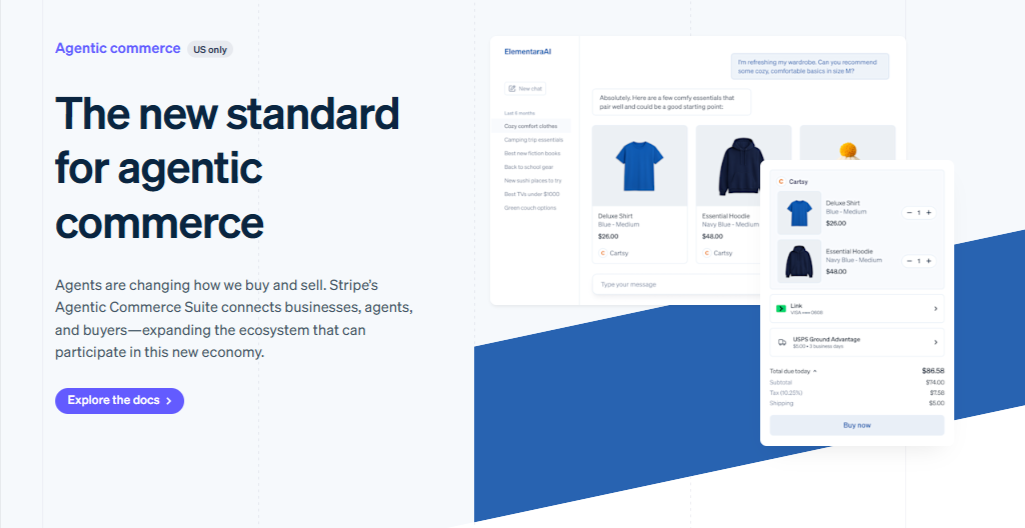
The Agentic Commerce Suite (ACS) was built to collapse that into a single integration.
But here’s what I am going to focus most on ACS: it’s not just a shortcut. It’s a fundamentally different way of thinking about how your store connects to the emerging AI commerce ecosystem. And it comes with real decisions that merchants need to make thoughtfully.
| A little breakdown before going deep: ACP is the language. ACS is the translator. Instead of learning to speak every AI platform’s dialect separately, you plug into Stripe once, and it handles multi-platform syndication, checkout calculations, payment security, and fraud detection on your behalf. |
What Merchant Problem ACS Solves
To understand the necessity of Agentic Commerce Suite, first you need to understand what challenges you can face without the ACS support.

Every AI agent such as ChatGPT, Gemini, Copilot, and Perplexity has its own distinctive functionalities. There are differences in various areas like:
- Catalog format and data spec requirements
- API endpoint structure and versioning rules
- Access control and authentication flows
- Checkout session management
- Payment processing integration points
Without a unified layer, every new AI platform that wants to sell your products requires a new project. A new integration. A new maintenance burden. And also think about how fast the agentic commerce landscape is moving. Between September 2025 and April 2026 alone, there have been four major ACP releases. Even those integrations can become outdated almost as fast as you build them.
Stripe’s team also described this danger directly in their March 2026 engineering retrospective: businesses are wary of building what they call “zombie integrations” – shipping a custom build for a specific AI agent, only to have it become obsolete six months later after the agent changes its interface.
ACS solves this by sitting between your store and every AI platform. When a protocol changes, Stripe updates the suite. You don’t have to rebuild anything.
What Stripe ACS Unlocks for Merchants?
Well, I wouldn’t give explanations of ACS with some architecture diagrams. Rather, I am going to discuss the Stripe Agentic Commerce Suite advantages in the way you, as a merchant, will experience it:
📦 Your Catalog Gets a Dedicated AI Channel
You upload your product catalog to Stripe – either directly through the Dashboard or via an existing syndicator like Akeneo, Cymbio, Logicbroker, Mirakl, Pipe17, or Rithum. Stripe then hosts a dedicated ACP endpoint at acp.stripe.com on your behalf. AI agents query this endpoint to find your products.
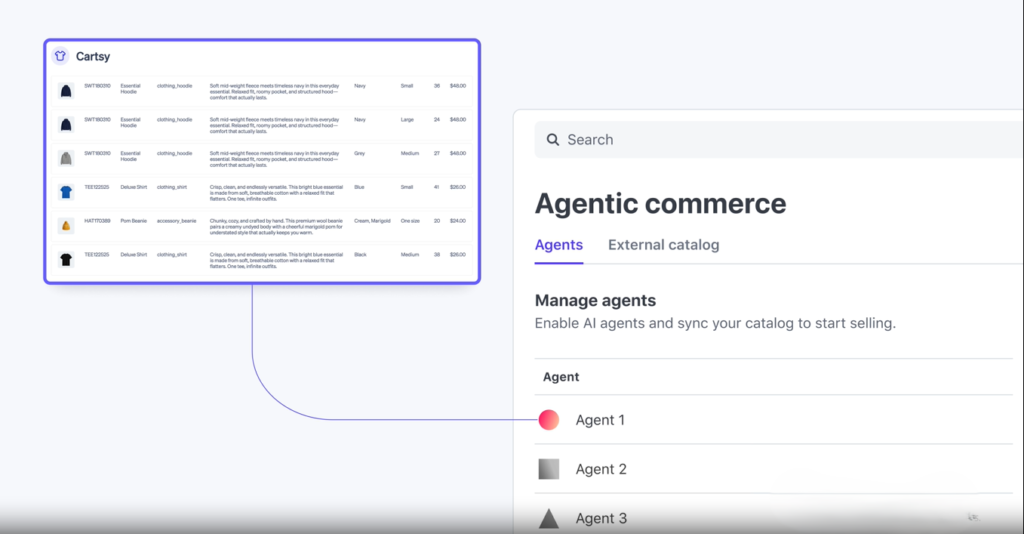
You don’t have to run, secure, or version it yourself. Critically, this is a separate channel from your website catalog. This means you can control exactly which products are discoverable by AI agents. Not your entire inventory. Just the subset you choose.
🔀 Checkout Calculations Happen Automatically
Once a shopper’s AI agent finds a product and initiates a checkout, the hard computational work, like taxes, shipping rates, and total calculations, is handled by Stripe’s Checkout Sessions API.
Stripe Tax works out of the box. But if you already have a preferred tax provider or custom shipping rate logic, ACS supports custom webhooks to route those calculations to your existing systems. Your existing stack doesn’t need to be replaced; you just need to ensure the connectivity.
💳 Payments Use Shared Payment Tokens, Not Raw Card Details
This is the security innovation that makes autonomous checkout actually safe. When a shopper authorizes an AI agent to purchase on their behalf, they don’t share their card number with the agent or the retailer.
Instead, the agent provisions a Shared Payment Token (SPT) – a cryptographically restricted proxy that can only be used by a specific merchant, for a maximum amount, within a defined time window.
The retailer uses that token exactly like a normal Stripe payment method. Even one line of code change: Stripe verifies the constraints server-side. So, if the merchant tries to charge even a cent over the token’s limit, the transaction fails automatically.
🛡️ Fraud Detection Is Re-architected for Non-Human Traffic
Here’s a problem most merchants don’t think about until they go live: traditional fraud filters flag AI agents as bots. Because programmatic checkouts don’t have human behavioral signals. There are no mouse movements, no page browsing patterns, no typing rhythm. And here a misunderstanding occurs as legacy fraud systems miss-flagged legitimate agentic purchases as suspicious.

ACS addresses this through Stripe Radar. When an SPT is provisioned, the agent passes risk signals like device fingerprint, IP address, and user-agent, alongside the token. Radar parses these at the payment level, not the behavioral level, allowing it to distinguish legitimate AI agents from actual card-testing bots.
⚙️ You Retain Full Backend Control
After an agentic transaction completes, your existing systems take over. Standard webhooks (order_create, order_update) fire to your inventory management, ERP, and fulfillment systems. And this is the same way they would for any web checkout. You remain the merchant of record.
Another good thing is that you handle shipping, returns, customer support, and disputes using the same processes you already have. Nothing downstream changes. This was a deliberate design decision: ACS changes the frontend discovery and checkout experience, not the backend you’ve spent years building.
🕹️ One-Click Agent Management
Inside the Stripe Dashboard, an Agentic Commerce tab lets you control exactly which AI agents your catalog is visible to. Want to be discoverable on ChatGPT but not Gemini yet? One toggle. Want to add Microsoft Copilot once it’s available? One click.
This granular control matters for brands that want to test one channel before opening to others and for merchants with regional or compliance constraints that mean some AI platforms don’t make sense for their business.
ACP vs. ACS: What’s the Difference
We have seen some confusion on Agentic Commerce Protocol (ACP) and Agentic Commerce Suite (ACS) among merchants, so let’s be clear.
| ACP (Protocol) | ACS (Suite) | |
| What it is | The open standard rulebook on how agents and merchants communicate | The implementation layer – handles the complexity for you |
| Who maintains it | OpenAI + Stripe (open-source on GitHub) | Stripe (commercial product) |
| Who uses it directly | Developers building agent or merchant integrations from scratch | Merchants who want to get live without building infrastructure |
| Protocol-agnostic? | ACP-specific | Yes – also supports UCP, MCP, and future protocols |
| Time to integrate | Up to 6 months per agent | Single integration, multiple agents |
| When to use it | You’re building a custom agentic stack | You want to sell on AI agents without rebuilding your commerce backend |
One important thing to note: ACS is protocol-agnostic. When Google launched UCP in January 2026, merchants on ACS didn’t need to do a separate integration. Stripe added UCP support to the suite, and it became available automatically. That’s the value of going through a unified layer rather than building point-to-point integrations yourself.
How Shared Payment Tokens Actually Work
Shared Payment Tokens (SPTs) are the core security mechanism that makes autonomous purchases safe. They were co-developed by Stripe and OpenAI and are worth understanding in some detail for merchants like you. Because they frequently change how you should think about authorization, fraud, and compliance.
The three constraints built into every SPT

Seller-scoped: Each token is cryptographically bound to a specific merchant’s Stripe account. A different merchant cannot use it, and the transaction fails at the network level.
Amount-scoped: The token has a strict maximum charge limit. If a seller attempts to charge even one cent more than the authorized amount, Stripe’s API rejects it automatically.
Time-scoped: Every token carries an expiration timestamp. After that time, the token is cryptographically inert. It cannot be used again, regardless of what the agent or merchant attempts.
What SPT means for merchants
In practice, SPTs mean agentic transactions are actually more constrained than traditional web checkouts. When a customer clicks Buy on your website, there’s no cryptographic proof of what they intended.
However, with SPTs, there is. Every transaction has a machine-verifiable record of the authorization, like what merchant, what amount, what time window, etc.
For dispute resolution, this is a meaningful improvement. Both sides of a dispute can reference the same tamper-proof mandate. The shopper authorized an agent to spend up to $80 at your store, and the transaction was for $74. The record is unambiguous.
The fraud implication
SPTs also change how Stripe Radar handles fraud assessment. Traditional fraud models look at behavioral signals, as I already said earlier: mouse movement patterns, typing speed, session history.
On the other hand, AI agents don’t have those signals. So Stripe Radar was adapted to assess risk from the payment-level signals embedded in the SPT itself: device fingerprint, IP address, card-testing patterns, issuer decline history.
This means enterprise-grade fraud protection applies to agentic transactions from day one. Even if you have no historical data on agentic traffic yet. Stripe’s models are trained on signals across its network, not just your store.
What Real Merchants Learned From Stripe’s ACS
Stripe’s engineering team published a retrospective in March 2026 sharing lessons from the first wave of ACS merchants. Here’s what stood out and what it means for your brands considering the integration.
URBN (Anthropologie, Free People, Urban Outfitters): Start with your best-sellers
URBN sells everything from plants to custom furniture. When they launched agentic commerce, they deliberately didn’t open their entire catalog. They started with a focused subset: dresses and denim – their most popular, highest-converting, and most straightforward-to-ship categories.
The lesson: starting with your whole catalog before you understand how the channel behaves is a risk. You want to watch performance, catch data quality issues, and understand conversion patterns on a small set of SKUs before scaling.
Ashley Furniture: 81 years old, first mover in agentic commerce
Ashley Furniture – an 81-year-old company – was among the first brands to go live with ACS. And, they claimed that agentic commerce would disproportionately reward brands that had good product data and were ready to transact when AI agents came looking.
Their integration experience highlighted a key point: the hardest part wasn’t the Stripe integration. It was getting their product data clean enough for agents to read. Accurate pricing, real-time inventory, structured descriptions, correct identifiers. And that’s where the preparation work actually lives.
Etsy: Marketplace-scale syndication
For Etsy, the challenge wasn’t a handful of SKUs. It was surfacing millions of unique handmade items from independent sellers across AI platforms. ACS handled the syndication layer, but Etsy’s CPTO, Rafe Colburn, was explicit about the real value: getting individual sellers’ items discoverable on platforms they’d never have been able to integrate with on their own.
What Stripe’s engineering team flagged from all of them
Here are some points and discussion that I want to let you know that Stripe’s engineering team has found to be worth knowing to merchants:
- Real-time inventory sync matters more than you think. When an AI agent recommends a product that turns out to be out of stock at checkout, it breaks the experience in a way that’s hard to recover from in a conversational interface. Near-real-time availability updates are not optional.
- Start simple on fulfillment. Products with complex delivery processes, such as requiring installation, sourcing from multiple locations, and making-to-order, create unique situations for which agentic UX is not yet optimized. So, start with products that ship directly to the buyer’s home.
- Don’t open restricted products first. Age-restricted items, state-specific availability, products requiring manual verification – these create errors that agents can’t handle gracefully. Filter them out initially and add them once you’ve validated the rest of your stack.
- Monthly Stripe sign-ups from agent-referred users have tripled. This tells you something important: agentic commerce isn’t just affecting how existing customers buy. It’s bringing in net-new customers who found a product through an AI conversation they wouldn’t have had otherwise.
| “The businesses we talk to are wary of building zombie integrations: something they ship for a specific AI agent that becomes obsolete six months later after a strategy change.”— Stripe Engineering, March 2026 |
Consent-driven commerce: how agentic payments work
One of the most important concepts in agentic commerce is consent-driven purchasing. Before an AI agent can buy anything on a shopper’s behalf, the shopper must explicitly define the boundaries. This happens through digital mandates, tamper-proof records that define:
- Which merchants the agent can purchase from
- The maximum spending limit per transaction
- Which product categories are authorized
- The time window during which the authorization is valid
The Agent Payments Protocol (AP2) enforces these mandates cryptographically. The agent cannot exceed them. The merchant cannot circumvent them. And the audit trail is permanent, every party has the same record of what was authorized.
This is what makes agentic commerce different from a bot buying things without permission. The boundaries are set by the shopper. The AI executes within them. The merchant receives only what was authorized.
| Agentic commerce signalsYou may see the term “agentic commerce signals” in analytics discussions. This refers to the structured data signals — device fingerprint, IP address, user-agent, card history — that AI agents pass alongside transactions to help fraud systems like Stripe Radar distinguish legitimate purchases from bot attacks. |
What Infrastructure Does Your Business Need for Stripe ACS?
This is one of the most common questions merchants ask. Here’s a clear breakdown of what’s required and what’s even optional to implement Stripe Agentic Commerce Suite:
The Foundational Requirement of Your Retail Store:
- A product catalog in a machine-readable format. JSON, CSV, or XML with accurate titles, descriptions, pricing, availability, and identifiers (GTINs/MPNs). If your catalog data is messy, agents will skip your products regardless of any other investment.
- Stripe as your payment processor (for ACS). ACS uses Stripe’s infrastructure for checkout sessions and SPT processing. If you’re on a different processor, you’ll need to migrate or run dual setups.
- A checkout API compatible with ACP. ACS abstracts most of this, but your backend needs to receive ACP checkout requests and respond with accurate totals, fulfillment options, and order confirmations.
- Webhook infrastructure to handle order lifecycle events. order_create and order_update events need to reach your inventory and fulfillment systems the same way any other checkout would.
Recommended: Data quality improvements
- Real-time or near-real-time inventory sync – out-of-stock recommendations break the agentic experience
- Schema.org Product markup on your product pages for broader AI discoverability
- Conversational attributes in your Google Merchant Center feed for UCP-compatible surfaces
- Clean GTINs and brand identifiers for all products
Optional: Extensions and customization
- Custom tax webhooks if you prefer your existing tax provider over Stripe Tax
- Custom shipping rate webhooks for dynamic or complex shipping logic
- OMS-linked capture timing – authorize at checkout, capture when the product ships
- V2 catalog channel customization to expose different product subsets per AI platform
| For marketplacesIf you’re a marketplace (like Etsy’s model), the infrastructure challenge scales with your seller count, not just your SKU count. ACS handles syndication at marketplace scale, but your seller onboarding flow needs to produce clean, standardized product data at the individual seller level. That’s where marketplace-specific preparation work concentrates. |
What Merchants Are Responsible For in Stripe ACS Setup
Agentic commerce introduces a new layer of compliance questions. Here’s what actually matters for merchants.
You remain the merchant of record
This isn’t just a legal technicality – it has operational consequences. When a shopper’s AI agent buys from your store, you are still the seller. That means you’re responsible for:
- The accuracy of product information presented to the agent
- Fulfillment and delivery timelines
- Return and refund processing
- Customer support for the purchase
- Any regulatory compliance related to the product (age restrictions, geographic limitations)
The AI agent is a new channel, not a new intermediary that absorbs those responsibilities. You keep the customer relationship and the accountability that comes with it.
Digital mandates as audit trail
Every agentic transaction under AP2 produces a tamper-proof mandate, the cryptographic record of what the shopper authorized. For merchants, this is protection, not just protocol. In a dispute, you can reference the mandate to show exactly what was authorized: the spending limit, the product category, the merchant scope, the time window.
This is actually a stronger record than what traditional checkout produces. A saved credit card charge has less contextual detail than an SPT transaction with an attached mandate.
Product data compliance
One area merchants underestimate: if an AI agent presents inaccurate product information to a shopper because your feed was wrong, the accountability for that experience traces back to your data. Agents don’t fabricate product claims. They surface what you gave them. Clean, accurate, up-to-date product data is a compliance issue in agentic commerce, not just a discoverability issue.
Server-side validation is your responsibility
ACS handles protocol-level enforcement, but your backend must also enforce its own rules. The ACP specification is explicit: merchants must not rely on agent-declared capabilities as the sole basis for security decisions. Capturing, authorizing, and validating payments happens server-side on your infrastructure. Stripe handles the SPT constraints; you handle your own business logic.
Why Businesses Should Prepare for the Agentic Commerce Era Now
Stripe’s own annual letter in early 2026 was notably measured about the current state of autonomous purchasing – acknowledging that right now, 95% of AI-platform-driven e-commerce sales are still completed off the AI platform and on the merchant’s own site.
So why prepare now?
Because the infrastructure advantage compounds
Monthly Stripe sign-ups from users who arrived via AI agents tripled over the course of 2025. That’s not peak adoption; that’s the beginning of the curve. Brands that have the infrastructure in place when the volume scales will capture a disproportionate share. Brands that wait will spend their resources catching up while their competitors are optimizing.
Product data quality takes time
The biggest bottleneck for going live with ACS isn’t the Stripe integration,t’s catalog readiness. Inaccurate pricing, incomplete identifiers, missing product details, stale inventory — these are data quality problems that take months to fix at scale. The merchants who are winning in agentic channels started with their data before they needed it.
AI agents remember nothing, but your reputation is permanent
When an AI agent recommends your product and the shopper has a bad experience like out of stock, wrong description, or slow shipping. That’s a signal the agent incorporates into future recommendations. You don’t get to explain. The data speaks for itself. Getting your house in order now, before high agentic traffic volumes arrive, protects your discoverability going forward.
Protocols are still evolving & early movers influence them
ACP has shipped four major releases since September 2025. UCP launched in January 2026. The merchants and platforms that are building on these protocols today are the ones whose edge cases and feedback shape the next version. That’s a meaningful competitive advantage, being in the room when the standards are being written.
| “Not only are the majority of retailers actively implementing agentic commerce, but many are also moving to a more tactical phase – refining their product catalog strategy to launch faster.”— Stripe at NRF 2026 |
FAQs
Which protocol was co-developed by Stripe and another organization?
What is the difference between ACP and ACS?
What infrastructure is required for agentic commerce?
How can marketplaces prepare for agentic commerce?
How secure are agentic transactions?
How do secure agentic transactions help establish trust in AI-powered commerce?
How does agentic commerce improve decision-making in digital transactions?
Wrap Up!
Stripe’s Agentic Commerce Suite isn’t glamorous infrastructure. This is an internal connection system! It’s that connectivity that determines whether your store will be visible to the next generation of shoppers.
The brands already live with it; for example, Anthropologie, Ashley Furniture, Etsy, Coach, and Revolve aren’t there because agentic commerce is already their biggest channel. They’re there because they understand that being infrastructure-ready before the volume arrives is what creates compounding advantages.
The integration itself is not the hard part. Stripe’s team has done the work to make it a single connection point. The hard part is catalog quality: accurate, structured, real-time product data that AI agents can actually use.
From now on, start to fix your product data. Clean your catalog. Get your inventory sync reliable. Everything else, like the protocol integrations, the agent management, the fraud optimization, builds on that foundation.
AI agents are already out there, querying catalogs and sending shoppers to merchants who are ready for them. The question is whether that includes yours.
Leave a Reply