
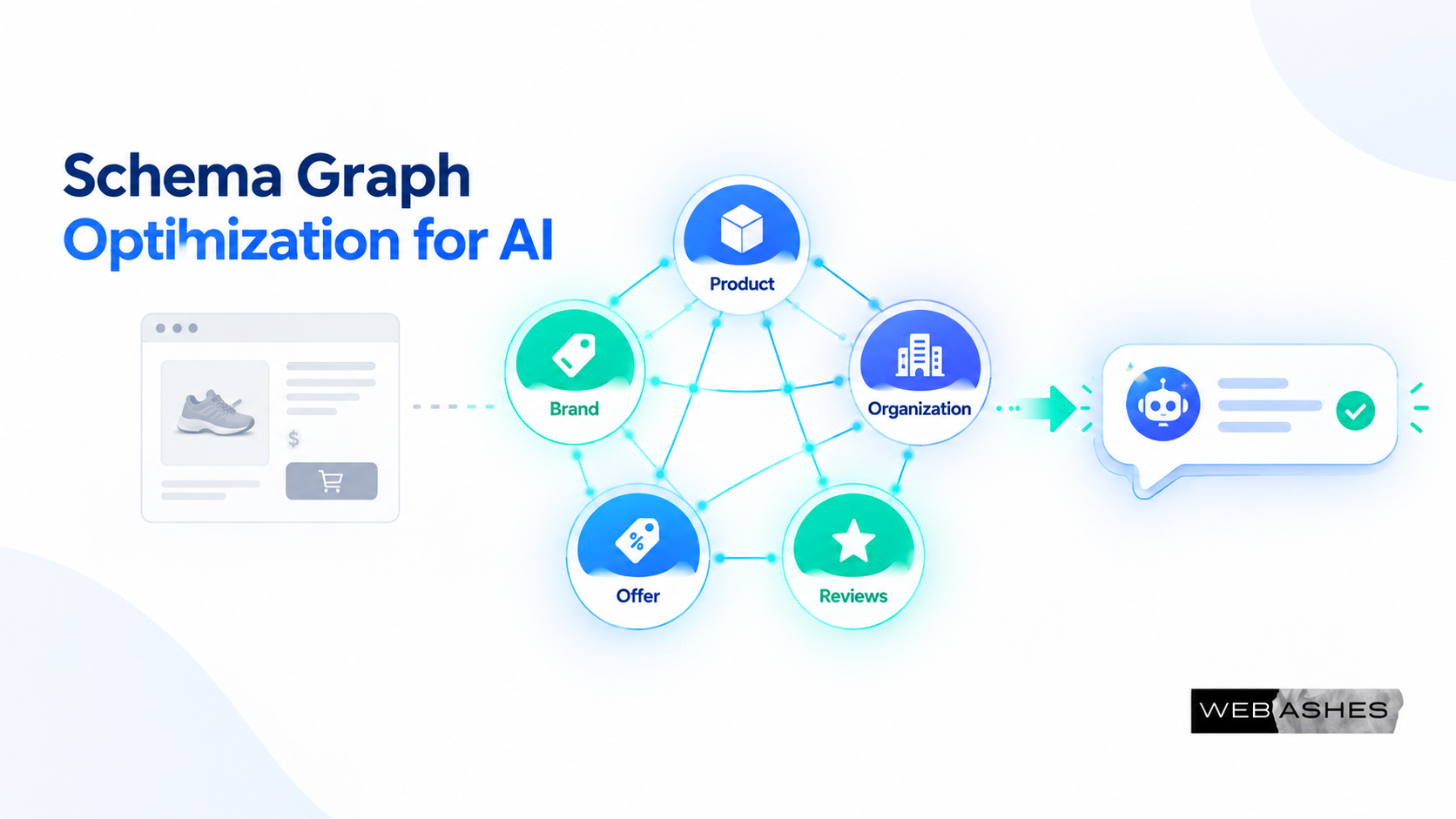
AI agents don’t browse your website. They read your data. So, if you have an e-commerce site, your product data needs to be crawled by AI agents. And this is why optimizing the e-commerce schema graph for AI is crucial. And you’re going to learn the best way to do it.
Why AI Agents Can’t Read Your Product Data
When ChatGPT, Gemini, or Perplexity recommends a product, it isn’t scrolling through your product page the way a human would. Instead of learning about your products directly, it searches for structured data from sources like schema markup, JSON-LD graphs, and merchant feed attributes.
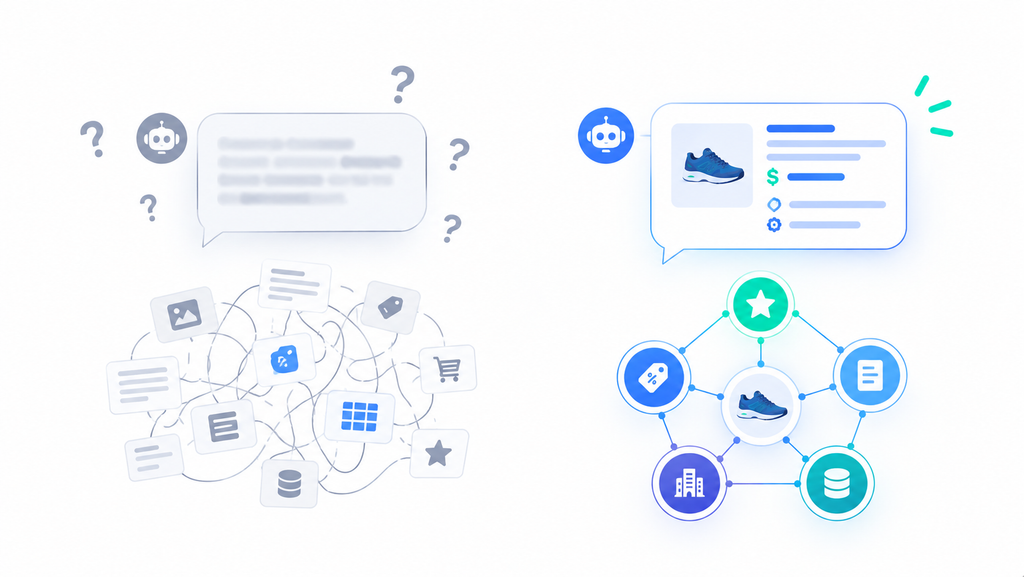
If your online store product data is vague, inaccurate, or missing, one of two things happens. Either the agent skips your product entirely. Or worse, it makes something up. It fills in the knowledge gaps with averaged-out information from across the web. Your specific product gets described in generic terms that could apply to any competitor.
That’s what researchers call “AI sameness,” and it’s a real commercial risk. In a world where agents are doing the shortlisting for shoppers, a vague product description doesn’t just underperform. It disappears.
And, to save e-commerce owners from this risk, I am writing this blog to explain how to build a schema graph that AI agents can actually use to understand, recommend, and transact on your products with confidence.
Why Schema Optimization Is Different Now
As we all know, schema has always mattered for SEO. Now, in this age of Agentic search, it matters for whether AI agents can sell your products at all.
- 65% of pages cited by Google AI Mode include structured data – vs. roughly 20% of all web pages (SE Ranking, 2025)
- 54% correct response rate when GPT-4 answers questions about structured-data-optimized content – vs. 16% without it (Data World)
- 300% increase in AI citation probability reported after implementing comprehensive schema architectures (eSEOspace, 2026)
- 85% of AI citations originate from outside a brand’s own domain – your schema must link to that external authority
Traditional SEO was about ranking for keywords. On the other hand, GEO – Generative Engine Optimization – is about being the source an AI agent trusts enough to cite, recommend, or use to complete a transaction.
The shift matters more for e-commerce than almost any other sector. Because AI agents are just suggesting products anymore, it’s doing product research on behalf of its users. Even, they can execute purchases. If your schema isn’t precise enough for an agent to confidently verify price, availability, and specs, it can’t safely complete the transaction.
So, the key difference here is: SEO puts you in front of human eyes. Whereas GEO puts you in front of AI agents that are doing the deciding for those humans. The optimization target has changed – from rankings to machine comprehension.
And, in the next part, we’re going to learn more.
From SEO to GEO: What Actually Changes
If I summarize, we do SEO optimization for clicks. And after the advent of AI tools, we do GEO optimization for machine interpretation. And, in both cases, schema markup plays a very important role in product optimization for your e-commerce store.
For years, the schema.org markup on your product pages served two purposes. It helped search engines like Google understand your product well enough to generate rich snippets. And it gave you a small SEO boost.
And that’s still true. But it’s no longer sufficient. AI agents don’t just read your schema to understand a page. They use it to make decisions. Using the schema markup, they also find many more different questions than a search algorithm would.
For example, a search algorithm asks: is this page relevant to this keyword?
However, in the case of an AI agent, it seeks answers to various questions like:
- Is this the right product for what this shopper specifically needs?
- Is the price accurate right now? Is it actually in stock?
- What are the exact specs? Are there compatible accessories?
- What do real buyers say about it?
Your schema needs to answer all of those questions – not just the first one.
| Dimension | Traditional SEO | GEO for AI Agents |
|---|---|---|
| Primary audience | Search engine crawlers | AI agents and LLMs |
| Goal | Rank in results page | Be cited and transacted on |
| Key signals | Keywords, backlinks, authority | Structured data, coherence, accuracy |
| Schema depth needed | Basic product + price | Full graph: product, brand, org, reviews |
| Linking strategy | Internal links, backlinks | @id linking between entities |
| Data freshness | Periodic crawl | Near-real-time pricing and inventory |
| What breaks it | Poor crawlability | Incoherence, vague specs, stale data |
What a Schema Graph Is and Why “Isolated Blobs” Fail
Most e-commerce sites have schema. But very few have a schema graph. There’s an important difference between having schema markup and having a coherent schema graph.
And this is where you have to know about blobs.
A blob is when you put a Product schema on your product page, an Organization schema on your homepage, and a Review schema somewhere else, and none of them know about each other. Agents read each page in isolation, and they can’t connect the dots.
A graph is a representation in which those entities are explicitly linked. The Product references the Brand. The Brand references the Organization. The Organization links to verified external profiles. The Offer references the Product using the same @id. Everything is connected.
When an agent reads a well-constructed schema graph, it gets a coherent picture of your product, your brand, and why shoppers trust you – all from the structured data alone. That confidence is what leads to a recommendation. Or a transaction. n
When it reads isolated blobs, it gets fragments. It has to fill in the gaps. That’s where generic descriptions, hallucinations, and hedged recommendations come from.
For your e-commerce store, think of your schema graph like a briefing document for an AI agent. A good briefing document connects the dots: who you are, what you sell, what makes it right for this buyer, and what past buyers said. A collection of isolated facts doesn’t form a briefing. It forms a pile.
The Four Layers of an AI-Ready Schema Graph
Building a schema graph for AI agents means thinking in four layers. Each one builds on the last.

🏢 Layer 1: Organization and Brand Identity
This is the authority foundation. Without it, agents can’t ground your products in a trusted source.
Your Organization schema establishes who you are. It links to your verified social profiles via sameAs, connects to external sources of authority, and gives agents a way to verify that you’re a real, credible business.
Your Brand schema links to the “Organization” using @id. This creates the borrowed authority chain: when an agent sees your product, it can trace it back to an “Organization” that has verified external presence.
This matters because 85% of AI citations come from outside a brand’s own domain. If your schema doesn’t bridge your site to your external authority signals, then the agent has no way to confirm the credibility that you earn from sources like LinkedIn, Google Business Profile, and industry publications that mention you.
- Include: name, url, logo, sameAs (social profiles, external profiles)
- Link using @id so Brand and Product can reference the Organization
- Ensure your organization’s external profiles are consistent with what’s in the schema
📦 Layer 2: Product with Precise Specifications
This is the layer where most e-commerce schema stops. Simultaneously, it’s also where the real GEO work begins.
Basic product schema gives agents a name, a price, and an image. That’s not enough for a confident recommendation, and it’s not enough for a transaction.
AI agents need exact specifications. Not marketing adjectives. Specific, objective facts that answer the questions a shopper would ask.
- SKU and MPN (Manufacturer Part Number): unique identifiers that prevent agents from mixing up variants
- GTIN: essential for branded products; missing GTINs reduce AI visibility significantly
- Dimensions and weight: critical for furniture, appliances, fitness equipment, anything where fit matters
- Material composition: for apparel, packaging, anything where material affects the buying decision
- Compatibility data: what this product works with, and what it doesn’t
- Use-case specifics: conditions or scenarios where this product excels
The goal is to eliminate what’s called the ‘clarification cycle‘ where an agent can’t confidently recommend because it’s missing a critical spec. Every missing spec is a potential drop-off.
💰 Layer 3: Offer with Real-Time Accuracy
Inaccurate and incomplete price and inventory data doesn’t just reduce recommendations in your customer AI chats; it also breaks agentic transactions.
An agent doing product research needs to know: can the shopper actually buy this, at this price, right now? If your schema says InStock but your store is out of stock, the agent either fails the transaction or loses the shopper’s trust.
- price: Must match your live website price exactly. Discrepancies break trust immediately.
- priceCurrency: Explicit currency code, such as: USD, GBP, EUR. Never leave it to inference.
- availability: Use schema.org values, like InStock, OutOfStock, LimitedAvailability. Update this in near-real time.
- shippingDetails: Rates and delivery windows. Agents answering ‘will this arrive by Friday?’ need this data.
- checkoutPageURLTemplate: A direct URL that takes the shopper straight to the product. Reduces checkout friction for buying agents.
Link the Offer to the Product using the same @id. This is the most common missing connection in e-commerce schema and one of the highest-impact fixes.
⭐ Layer 4: AggregateRating and Community Authority
Reviews are the trust signal AI agents weight most heavily when forming a recommendation.
Agents don’t just want to know what you say about your product. They want to know what real buyers said. AggregateRating data gives them that signal in structured, machine-readable form.
This is what researchers call Community Authority. It’s the hardest type to manufacture and the most credible type to surface. Agents prioritize it because it reduces the risk of recommending something that disappoints.
- ratingValue: Your average rating, expressed as a number (e.g., 4.7).
- reviewCount: Total number of ratings. Volume matters; a 4.9 from 8 reviews carries less weight than a 4.6 from 800.
- bestRating and worstRating: Define the scale explicitly (1–5). Don’t assume the agent will infer it.
Also consider an individual Review schema for your most detailed, helpful customer reviews. Agents sometimes surface specific review excerpts when explaining a recommendation.
What a Well-Structured JSON-LD Graph Looks Like
Now, as I have been discussing the importance of a schema graph for AI product personalization, let’s look at what a well-structured JSON-LD Graph format:
Use @graph to connect all your entities in one self-contained block of structured data.
Here’s a simplified but complete example of an agentic-ready schema graph for a product page. Have a close look at how the entities link to each other using @id – the Product references the Brand, and the Brand references the Organization.
{
“@context”: “https://schema.org/”,
“@graph”: [
{
“@type”: “Organization”,
“@id”: “https://yourstore.com/#organization”,
“name”: “Your Store”,
“url”: “https://yourstore.com”,
“sameAs”: [
“https://twitter.com/yourstore”,
“https://linkedin.com/company/yourstore”
]
},
{
“@type”: “Product”,
“@id”: “https://yourstore.com/products/trail-boot/#product”,
“name”: “Waterproof Trail Boot”,
“sku”: “TB-2024-M10”,
“mpn”: “TRB-48291”,
“gtin13”: “5901234123457”,
“description”: “Full-grain waterproof leather trail boot. Ankle support rated medium-high. Weight: 680g per boot.”,
“brand”: {
“@type”: “Brand”,
“name”: “Your Store”,
“memberOf”: { “@id”: “https://yourstore.com/#organization” }
},
“aggregateRating”: {
“@type”: “AggregateRating”,
“ratingValue”: “4.7”,
“reviewCount”: “312”,
“bestRating”: “5”,
“worstRating”: “1”
},
“offers”: {
“@type”: “Offer”,
“@id”: “https://yourstore.com/products/trail-boot/#offer”,
“url”: “https://yourstore.com/products/trail-boot”,
“priceCurrency”: “USD”,
“price”: “148.00”,
“availability”: “https://schema.org/InStock”,
“shippingDetails”: {
“@type”: “OfferShippingDetails”,
“shippingRate”: {
“@type”: “MonetaryAmount”,
“value”: “0.00”,
“currency”: “USD”
},
“deliveryTime”: {
“@type”: “ShippingDeliveryTime”,
“businessDays”: {
“@type”: “OpeningHoursSpecification”,
“dayOfWeek”: [“Monday”,”Tuesday”,”Wednesday”,”Thursday”,”Friday”],
“opens”: “09:00”,
“closes”: “17:00”
},
“cutoffTime”: “16:00:00”,
“handlingTime”: { “@type”: “QuantitativeValue”, “minValue”: 1, “maxValue”: 2 },
“transitTime”: { “@type”: “QuantitativeValue”, “minValue”: 2, “maxValue”: 5 }
}
}
}
}
]
}
A few things to note about this structure:
- The Organization and Product are separate entities connected by @id – not nested. This is what makes it a graph, not a blob.
- The Offer links back to the Product using @id on both sides.
- The description contains specific, objective details, like weight, waterproof material, ankle support rating – not marketing language.
- Shipping includes estimated transit time. An agent can use this to answer ‘will this arrive by Thursday?’
Technical Requirements for Agentic Readability
Schema is only one part of making your site machine-readable. The rest is about how your website product pages are structured and served. So, let’s learn about some of the prerequisites that can help you to sharpen your online store agentic readability.
1. Server-side rendering is non-negotiable
AI crawlers don’t execute JavaScript. They read the raw HTML served by your web server.
So, if your structured data is generated by a client-side script after the page loads, crawlers and agents won’t see it. The JSON-LD block must be present in the initial HTML response.
For WordPress users: Block Bindings and the Interactivity API allow you to seed the initial state server-side via PHP. This ensures the data is present on first paint, before any JavaScript runs.
For Shopify users: JSON-LD is typically rendered in your theme’s liquid files. Verify your schema is in the initial response using View Source, not Inspect Element.
2. Semantic HTML structure helps agents navigate
AI agents reading your pages rely on HTML landmarks to understand the structure. A well-marked-up page gives the agent a clear map.
- Use <main> to designate your primary content area, so that agents use this to isolate product data from nav and footer noise
- Use role attributes and aria-labels on interactive elements. With this, AI agents can easily configure buttons labeled ‘Add to Cart’ are semantically clear; icon-only buttons are not
- Ensure all interactive elements are keyboard-navigable; agents using tools like Playwright to simulate actions need focusable elements
Think of accessibility standards as a baseline for machine readability. A site that works for screen readers will also work for AI agents. They have the same fundamental need: structured, navigable, labeled content.
3. Avoid the FOUC problem
FOUC stands for Flash of Unstyled Content – when a page renders without its data before JavaScript loads it in.
For AI agents, the equivalent is pages where schema data or key product attributes aren’t present in the first HTML response. Agents reading a blank or partial state will miss critical data.
Test this by viewing your page source (not browser inspect). Everything your schema contains should be visible in that raw source before any scripts run.
The Three-Step Coherence Audit for Schema Graph
Before optimizing anything, run this quick test to see where your current schema stands with AI agents.
Step 1: The Prompt Test
Open ChatGPT or Claude. Ask: “Describe [your brand] in one sentence. Then describe your best-known product.”
If the response is vague, generic, or uses language that could describe any competitor in your category, your schema is incoherent. The agent is working from averaged-out web data, not your structured data.
If the response is specific and accurate that is, if it includes real differentiating features, specific product descriptions, and accurate pricing- then your graph is working effectively.
Step 2: The Citation Audit
Ask an AI: “Compare [your product] to [a competitor product]. Which sources are you citing?”
If the agent cites a 2019 Reddit thread instead of your product page, your graph isn’t linking authority correctly. Your schema needs sameAs connections to credible external sources, and your product descriptions need genuine differentiating detail.
If the agent cites your product page or a credible review of your product, your authority linking is working.
Step 3: The Source Check
View the source of your product page (not inspect element – actual page source). Search for your JSON-LD block.
If it’s there, fully populated, with all entities linked – you’re server-side rendering correctly.
If it’s absent, partial, or only appears after scrolling or waiting – your structured data is JavaScript-generated and won’t be read by AI crawlers.
Checklist for Optimizing Product Schema Graph for AI
| Task | Why it matters | Impact |
|---|---|---|
| Use @graph to link all entities in one JSON-LD block | Prevents isolated blobs; agents see a coherent picture | 🔴 High |
| Link Product to Brand using @id | Establishes authority chain from product to organization | 🔴 High |
| Link Organization to external profiles via sameAs | Gives agents verifiable external authority signals | 🔴 High |
| Add MPN, GTIN, SKU to every product | Unique identifiers prevent agent confusion between variants | 🔴 High |
| Keep price and availability in real-time sync | Stale data breaks agentic transactions and trust | 🔴 High |
| Include shipping rates and delivery time estimates | Agents need this to answer ‘will this arrive in time?’ | 🟠 Medium |
| Add aggregateRating with reviewCount and scale | Community authority signals; agents weight these heavily | 🟠 Medium |
| Add checkoutPageURLTemplate to Offer | Reduces friction for agents completing purchases | 🟠 Medium |
| Include objective product specs (weight, dimensions, material) | Eliminates clarification cycles; enables precise matching | 🟠 Medium |
| Render all JSON-LD server-side, not via JavaScript | AI crawlers don’t execute JS — data must be in raw HTML | 🔴 High |
| Test schema with Google Rich Results Tool | Validates syntax and surface eligibility | 🟡 Quick win |
| Run the Prompt Test monthly | Tracks whether AI agents describe you accurately | 🟡 Quick win |
Frequently Asked Questions
What is schema graph optimization for AI agents?
What’s the difference between schema markup and a schema graph?
What is Generative Engine Optimization (GEO) in e-commerce?
Why does AI generate generic or inaccurate descriptions of my products?
Does my JSON-LD need to be server-side rendered?
How often should I update my schema data?
What’s the most impactful change most e-commerce sites should make first?
Do I need to include every schema property to see results?
Final Thoughts
To conclude, I would like to summarize my whole discussion in this blog: Your product data is now your most important commercial asset.
Before agentic commerce, a visually compelling product page could compensate for weak underlying data. Shoppers could see the product, read the marketing copy, and make a judgment call.
AI agents can’t do any of that. They read your data. They reason from your schema. They decide whether to recommend you or someone else based on the quality and structure of what you’ve given them.
The good news is that building a solid schema graph is not a never-ending project. It’s a one-time architectural decision, followed by a discipline of keeping the data accurate. Get the @graph structure right, link your entities, make your specs specific, and keep your price and inventory live.
Then run the Prompt Test. Ask an AI to describe your product. If it gets it right- specific, accurate, distinctive- then your graph is working. If it’s vague and generic, you know exactly what to fix.
AI agents are already recommending products to millions of shoppers every day. Make sure yours are the ones they can recommend with confidence.
Leave a Reply