
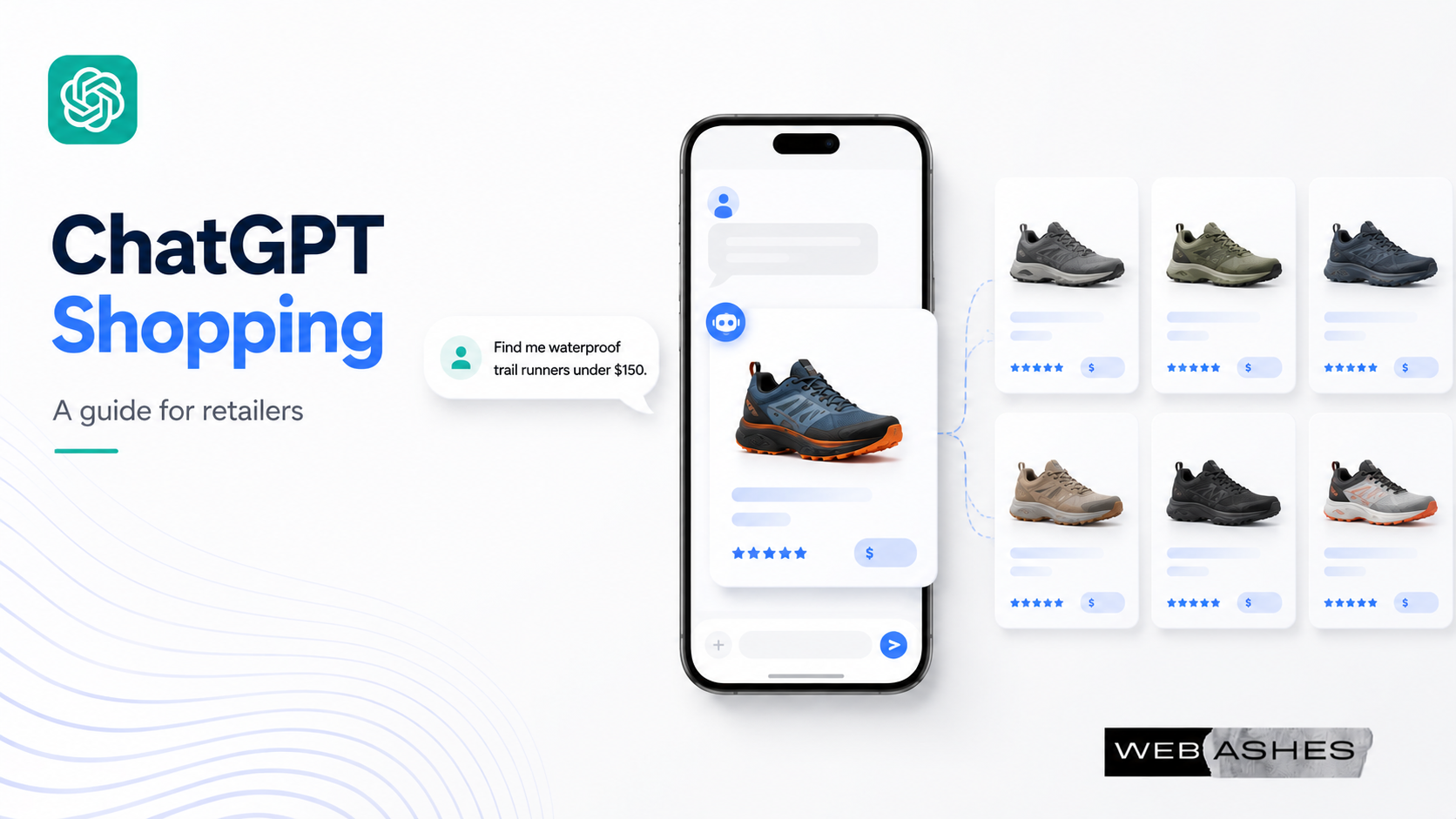
ChatGPT Shopping brings a new e-commerce experience, where online shoppers no longer search on Google or any other search engine like the traditional method.
Now customers just go to ChatGPT and write or say, “Find me a waterproof trail runner under $150 with a wide toe box.” “What’s the best espresso machine for under $300 that’s easy to clean?” “I need a birthday gift for my sister – she loves hiking and cooking.”
Then, ChatGPT doesn’t return a list of blue links. It returns specific product recommendations, including images, prices, ratings, and review summaries. And increasingly, it gives shoppers a one-interface way to buy without ever leaving the chat.
Well, in numbers it’s also big and growing too! ChatGPT now processes approximately 50 million shopping queries every single day. Among daily AI users, 70% had already tried AI shopping in 2025. And in that year, they spent an average of $540 across nine transactions.
Shopping queries on ChatGPT grew 25% in category share in just the first half of 2025, on top of a 70% overall increase in usage. That’s effectively a doubling of shopping activity in six months.
On the other hand, from the perspective of retailers and e-commerce entrepreneurs, this is not a future situation they should look forward to. Rather, it is a medium that is already driving traffic, influencing decision-making, and in some cases, even ensuring that purchases are completed.
Now, the question is whether your store is positioned to show up in it.
No worries! If you don’t know. In this blog, I will explain exactly:
- what the ChatGPT shopping feature is,
- how the buying journey works from the shopper’s perspective,
- what changed with Instant Checkout, and
- what you need to do as a merchant to be discoverable and competitive in this new channel.
What Is ChatGPT Shopping?
ChatGPT Shopping is the product discovery and purchasing experience built into ChatGPT. It launched in April 2025 as a product search feature and eventually turned ChatGPT from a general AI assistant into something closer to a personal shopping advisor.
Here’s the simplest way to understand it: instead of searching Google for “best running shoes for wide feet” and getting ten articles to read, a shopper opens ChatGPT, describes what they want in plain language, and gets a curated set of specific product recommendations, complete with images, prices, reviews, and links.
ChatGPT’s product results are based on structured merchant data, crawled web content, and product reviews from around the web. OpenAI has been explicit about this:
“Instant Checkout being enabled does not make a product more likely to be recommended. What matters is product quality, availability, price, and whether the merchant’s data is accurate and structured.”
As a retailer, what you need to know is:
What determines whether your products appear in ChatGPT Shopping is the quality and structure of your product data and how well it matches what the shopper is asking for. Plus, you can also advertise your products in the OpenAI ad platform.
How Shoppers Discover Products in ChatGPT Shopping
Let’s discover how a ChatGPT user might search and see your e-commerce products. Actually, when someone asks ChatGPT for product help, the response typically includes:
- A curated list of specific product recommendations, not categories or brand names like traditional e-commerce websites. Those products are precisely based on user preferences.
- Some may be confused that ChatGPT displays AI-generated images for products. But in reality, those product images are taken directly from the seller’s data or crawled sources.
- Price and availability at the time of the query
- Another important part of the ChatGPT shopping experience is that it gives a summary of why each product fits the shopper’s stated criteria
- And most importantly, ChatGPT is heavily influenced by summaries of reviews across the internet, what real buyers have said about those products.
- A link to the merchant’s website or (where available) an in-chat checkout option.
The shopping research feature, launched in November 2025, goes even deeper. It’s powered by a version of GPT-5 mini trained specifically for shopping tasks. It reads trusted review sites, synthesizes information across multiple sources, and produces what OpenAI describes as “high-quality product research.” It’s interactive as well. AI shoppers can refine their criteria mid-conversation, and recommendations are updated in real time.
And, this AI-based shopping experience is expanding rapidly through ChatGPT. OpenAI, the parent company of ChatGPT, is contributing to the development of the Agentic Commerce Protocol (ACP). The goal is to ensure a secure payment system that allows users to complete their product-buying experience through the ChatGPT chat interface.
How the ChatGPT Shopping Journey Works (Step by Step)
Let’s know the ChatGPT shopping workflow to understand what this means for your business. And how a typical online shopper experiences this from start to finish. So, you can optimize your product catalog for agentic commerce.
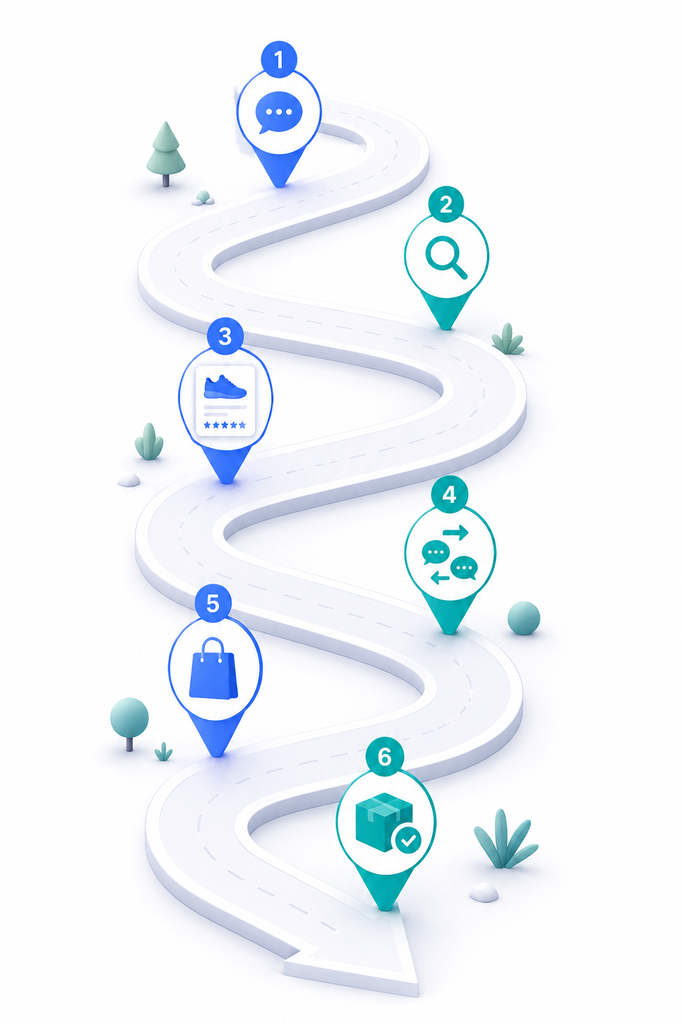
Step 1: The Shopper Expresses Intent in Natural Language
The journey starts with a conversational prompt, not a keyword. The shopper doesn’t type “waterproof hiking boots men size 10.” They say something like: “I’m going hiking in Scotland in October for a week. I need boots that are waterproof, comfortable for long days, and under £150. I’ve had problems with ankle support in the past.” ChatGPT interprets all of those constraints simultaneously, such as the occasion, the climate, the budget, and the specific requirement, and uses them to filter recommendations.
Step 2: ChatGPT Queries Structured Merchant Data
ChatGPT doesn’t browse your website the way a human would. It reads structured product data from merchant feeds, from schema.org markup on product pages, and from crawled web content.
This is why product data quality matters so much. If your pricing is outdated, your stock status is wrong, or your product description is vague and keyword-stuffed, ChatGPT either gets it wrong or skips your products entirely. Therefore, accurate, structured, conversational product data is what gets you recommended.
Step 3: ChatGPT Returns a Curated Product Carousel
The shopper sees a visual product carousel: specific items with images, prices, ratings, and a summary of why each fits their request. This is the ChatGPT shopping results experience.
It doesn’t show ten blue links to read, like the Google search results page; Rather, buyers here get a list of products or ‘product feed’ specifically tailored for them. It’s a small, curated set of the best matches. If your product isn’t there, the shopper doesn’t see it.
Step 4: The Shopper Refines, Asks Follow-ups, or Decides
One of the most important differences from traditional search: the conversation continues. A shopper can say “show me something a bit lighter” or “what do reviewers say about the ankle support on the first option?” ChatGPT updates the recommendations in real time.
The shopping research feature is designed specifically for this. A multi-step conversation that narrows down options through a collaborative effort – just like a skilled salesperson does.
Step 5: The Shopper Clicks Through or (Where Available) Checks Out
Today, the most common outcome is a redirect to your product page. The shopper clicks the link in the ChatGPT response and completes checkout on your website, your existing funnel, your existing UX.
In some cases, where Instant Checkout is enabled via the Agentic Commerce Protocol (ACP), the transaction can complete inside ChatGPT itself. But as we’ll discuss, that in-chat checkout feature has had a complicated history.
Step 6: Post-Purchase: ChatGPT Stays in the Loop
If the merchant supports the ACP webhook integration, ChatGPT can receive real-time order lifecycle updates when the order is confirmed, when it ships, when it’s delivered. The shopper can ask ChatGPT “where’s my order?” and get an accurate answer without emailing customer support or checking a tracking number on a separate site. This is still emerging, but it represents where the post-purchase experience is heading.
The Honest Story of Instant Checkout – What Worked and What Didn’t
To give retailers an accurate picture of where ChatGPT shopping is today, it’s worth telling the full story of Instant Checkout, including the part that didn’t go as planned.
What is Instant Checkout
In September 2025, OpenAI launched Instant Checkout: a feature that let shoppers buy products directly inside ChatGPT without ever leaving the chat interface. It was powered by the Agentic Commerce Protocol (ACP), co-developed with Stripe. Etsy was among the first merchants. Walmart, Target, and Shopify merchants followed.
The promise was compelling: remove the step of visiting a retailer’s website, and conversions would go up. Fewer clicks, less friction, faster decisions.
What actually happened
It didn’t work as expected. Walmart found that conversion rates for products sold directly inside ChatGPT were three times lower than those that sent shoppers to Walmart’s own website to complete the purchase.
The problem was data quality. In some cases, OpenAI was scraping retailer websites for product information rather than reading from live merchant feeds. That meant stock levels, delivery estimates, and pricing were sometimes inaccurate or outdated. Shoppers noticed and when they click Buy only to find the price is wrong or the item isn’t available, trust evaporates fast.
| “Trust is hard to build and easy to lose.”— Erlin.ai analysis of Instant Checkout, April 2026 |
OpenAI Action in Instant Checkout
In March 2026, OpenAI discontinued in-chat Instant Checkout in favor of a discovery-and-redirect model. ChatGPT now recommends products and sends shoppers to merchant websites to complete the purchase, using the merchant’s own checkout flow.
This is actually better for most retailers. It means:
- Shoppers arrive at your site already decided on the product – high-intent traffic
- Your conversion optimization, your retargeting, your loyalty program – all of it still applies
- You’re not dependent on ChatGPT’s checkout infrastructure being perfect
- The customer relationship remains in your control.
| The current state of ChatGPT shopping (as of mid-2026) ChatGPT recommends products through a conversational interface, then sends shoppers to merchant websites to complete purchases. The infrastructure for in-chat checkout (ACP) still exists and is being refined. Merchants should prepare for both models – redirect now, and in-chat checkout as the technology matures. |
ChatGPT Shopping vs. Traditional E-Commerce: What Actually Changes
Just as ChatGPT ushered in the artificial intelligence (AI) revolution, it is also playing a leading role in the era of ‘Agentic Commerce‘. So, any online store owner should consider how this is changing the traditional landscape of e-commerce.
Let’s get specific about what this shift means for your business – not in general terms, but in the practical differences that affect how you compete.
| What changes | Traditional E-Commerce | ChatGPT Shopping |
| How shoppers find you | Keywords in search bars, paid ads, social discovery | Conversational prompts describing intent and constraints |
| What they see | A list of results including your competitors’ ads | A curated set of specific recommendations — yours or someone else’s |
| What determines visibility | SEO, ad spend, domain authority | Product data quality, accuracy, and conversational relevance |
| The research phase | Shopper opens multiple tabs, reads reviews, compares manually | ChatGPT synthesizes reviews and specs in one response |
| Purchase intent on arrival | Mixed — many are still browsing | High — shopper has already been guided to a decision |
| Your checkout | Shopper navigates your UX | Shopper redirected from ChatGPT to your site, already pre-qualified |
| Post-purchase updates | Email, tracking link, your website | Can be surfaced directly in ChatGPT conversation (via ACP webhooks) |
| What you can pay for | Ads, sponsored placements, affiliate | Nothing – recommendations are not for sale |
The most important difference: discovery is now a conversation
In traditional e-commerce, discovery happens when a shopper types keywords and your SEO or ad spend determines whether you show up. On the other hand, in ChatGPT shopping, discovery happens in a conversation where the shopper describes what they need, and ChatGPT decides which products match.
That’s a fundamentally different selection process. It rewards products that genuinely match the stated need, have accurate pricing and stock, and have strong third-party review signals. It doesn’t reward keyword stuffing, high ad budgets, or domain authority built over years.
For smaller retailers with genuinely good products and clean data, that’s an opportunity. For larger retailers relying on paid visibility, it’s a disruption.
What “Prompt-Driven Intent” Means for Your Product Strategy
There’s a concept in agentic commerce called prompt-driven intent, and understanding it changes how you should think about product data, merchandising, and catalog management.
To better understand the issue, it is necessary to know the difference between how traditional search intent and prompt-driven intent work.
How traditional search intent works
When a shopper types “men’s waterproof hiking boots” into Google, you know what they want in broad terms. But you don’t know their budget, their specific use case, their concerns about ankle support, or whether they’re buying for a week-long trip in Scotland. They’ve given you three words. The rest is inference.
How prompt-driven intent is different
When a shopper asks ChatGPT “I need boots for a week of hiking in Scotland in October, waterproof, good ankle support, under £150″ – they’ve told the AI everything. Their budget, the occasion, the climate, the specific product requirement they care most about, and the timeframe.
ChatGPT translates that rich, specific intent into a structured query against product data. It’s not matching keywords. The query here is building a bigger landscape. It’s reasoning about suitability.
And it is only possible for ChatGPT to pull your product if your product information provides accurate answers to the questions subconsciously arising in the buyer’s mind.
Take our example in your mind and ask yourself:
- Does your product description mention that the boot has ankle support?
- Is the waterproof rating stated clearly, or is it buried in a spec table?
- Does the price in your feed match what’s actually on your website right now?
These aren’t simple product SEO questions anymore. They’re data quality questions. And in the ChatGPT shopping era, they determine whether you get recommended at all.
The catalog curation implication in Agentic Era
One important insight from merchants who’ve integrated with ChatGPT shopping: you don’t have to expose your entire inventory. The most successful approach is to curate a focused subset of products. Particularly, those you count as your best-sellers, your most straightforward-to-ship items, and your cleanest product data.
Then, optimize that product data for ChatGPT shopping so they can be easily discoverable in your target shopper chat.
URBN (Anthropologie, Free People, Urban Outfitters) launched their agentic commerce integration focused on dresses and denim. At the beginning, they didn’t go for optimizing their entire catalog for agentic commerce.
Just the products where they had the best data quality, the strongest reviews, and the most confidence in the buying experience.
So, you should also start with your strongest products, not your broadest range.
The Numbers That Tell You Why ChatGPT Shopping Matters
| 50 millionshopping queries processed by ChatGPT every day (OpenAI, February 2026) |
| 900 millionweekly active users on ChatGPT as of February 2026 – one of the world’s largest audience platforms |
| 64%of consumers plan to use AI chatbots for shopping in 2026; nearly 1 in 4 plan to make AI their default way to shop (PartnerCentric, December 2025) |
| 36%of ChatGPT users have made a purchase based on an AI recommendation (Morgan Stanley AlphaWise, November 2025) |
These numbers don’t represent peak adoption. Shopping queries on ChatGPT grew 25% in category share in just the first half of 2025, and that was before the shopping research feature launched in November 2025. The trajectory is steeply upward.
What Retailers Need to Do to Show Up in ChatGPT Shopping
For retailers, there’s no straightforward way in ChatGPT shopping. What you can control is whether your products appear when they should, and whether the experience is good enough for shoppers to trust the recommendation and buy.
Here are some practices you can follow as a retailer to get your products cited more in ChatGPT shopping.
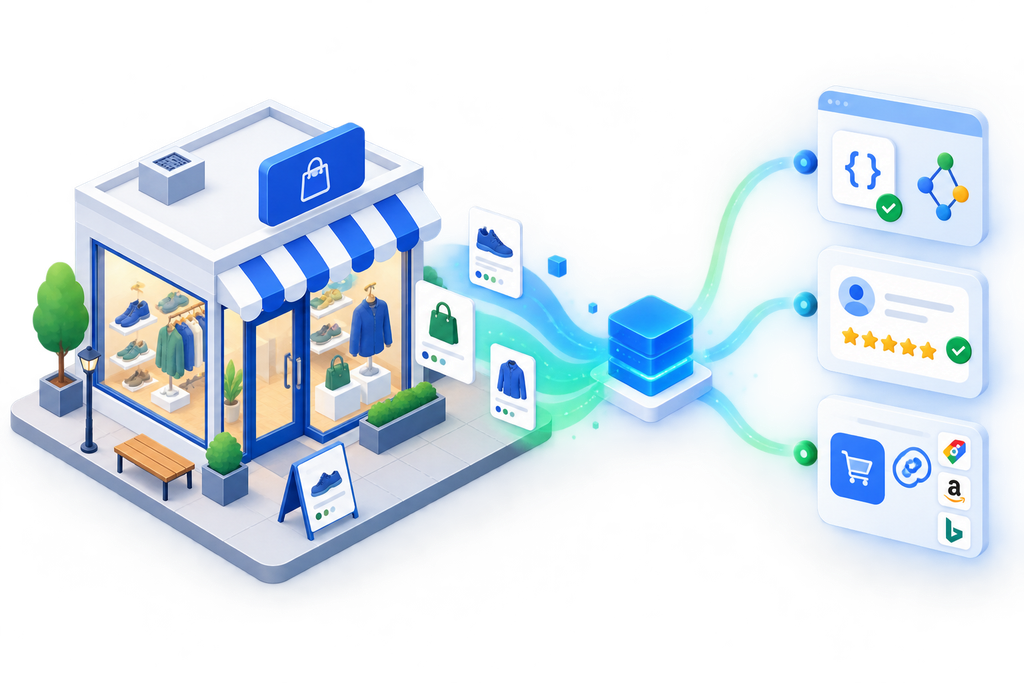
1. Get your product data right first
This is the foundation everything else builds on. ChatGPT shopping reads your product data from merchant feeds, from structured markup on your product pages, and from crawled web content.
If that data is inaccurate, incomplete, or hard to parse, you won’t get recommended. If you get recommended based on wrong data, the shopper arrives and finds a mismatch, and that’s a worse outcome than not being recommended at all.
Specifically, make sure:
- Pricing is accurate and consistent between your feed and your website
- Stock availability is updated in near-real time
- Product descriptions answer the questions shoppers are likely to ask in conversational form
- GTINs and brand identifiers are correct for all products
- Images are high quality and accurately represent the current product
2. Implement schema.org Product markup on your product pages
ChatGPT and other AI agents don’t just read your merchant feed. They also crawl your website and cross-reference data. Schema.org Product markup on your product pages makes your data machine-readable in a format AI agents can parse directly.
Key schema properties to include:
- sku and gtin/mpn for unique product identification
- offers with price, priceCurrency, and availability (InStock/OutOfStock)
- checkoutPageURLTemplate – a direct checkout URL that reduces friction for buying agents
- inProductGroupWithID for variant grouping
This markup needs to be rendered server-side, not generated dynamically with JavaScript. AI crawlers don’t execute JavaScript; they read raw HTML. If your structured data is loaded after the page renders, they won’t see it.
3. Build strong review signals
ChatGPT’s shopping research feature synthesizes third-party reviews as part of its recommendations. Products with strong, authentic reviews from multiple trusted sources – not just on your own website – are more likely to be recommended with confidence.
This isn’t about gaming review counts. It’s about having genuine reviews on platforms ChatGPT can read: Google reviews, trusted industry publications, and major retailer listings. The AI cites where it got information and sources it trusts carry more weight.
4. Make sure your site converts the traffic that arrives
ChatGPT is a discovery and recommendation engine. Your website is still where most purchases complete. This means that the traffic that ChatGPT sends to you, which is usually high-intent, needs to have a good experience once it arrives.
Specific areas to check:
- Mobile speed: a significant portion of ChatGPT shopping happens on mobile devices. Slow load times lose high-intent visitors.
- Product page accuracy: if ChatGPT recommended a specific size or configuration, make sure it’s easy to find and select on your page
- No bait-and-switch: if the price ChatGPT showed doesn’t match your site, trust breaks immediately
- Clear, frictionless checkout: the shopper has already done the research; don’t add friction at the decision point
5. Consider ACP integration for the future
Instant Checkout via the Agentic Commerce Protocol (ACP) is paused as a primary experience while OpenAI refines the approach. But the protocol is evolving. As of now, four major releases have shipped between September 2025 and April 2026.
The infrastructure for in-chat purchasing is being built, and the merchants who have their catalogs connected via ACP (through Stripe’s Agentic Commerce Suite or direct integration) will be ready when the experience is refined.
If you’re on Shopify, over a million merchants were automatically enrolled in ACP compatibility. If you’re on WooCommerce, BigCommerce, Squarespace, or Wix, then Stripe ACS integrations are available now.
What ChatGPT Shopping Does to Your Funnel
Here’s a question worth sitting with: if ChatGPT is doing the research phase for your customers, like reading reviews, comparing specs, and filtering by budget. Then, what is your funnel actually for?
The top of your funnel is increasingly happening outside your control
Awareness, consideration, and shortlisting, traditionally the phases where SEO, content marketing, and paid ads do their work, are increasingly happening inside AI conversations. The shopper isn’t googling your brand name or reading your blog. They’re asking ChatGPT what the best option is for their specific need.
That doesn’t mean content marketing and SEO are dead. ChatGPT cites sources — product reviews from trusted publications, expert roundups, structured web content. High-quality content that gets cited by ChatGPT still drives awareness. But the mechanism is different.
The traffic that arrives is different
Shoppers who come from ChatGPT recommendations have typically already gone through a qualification process. They’ve stated their budget, their use case, their constraints. ChatGPT has matched those to your product specifically. They’re not browsing — they’re close to buying.
This creates both an opportunity and a risk. The opportunity: higher conversion potential on the traffic that arrives. The risk: the qualification happened before they reached your site. If your product doesn’t deliver what ChatGPT said it would – wrong price, out of stock, not as described, the mismatch hits harder.
Your conversion optimization still matters
Just because the research happened elsewhere doesn’t mean your site’s job is done. A shopper with high intent and a specific product in mind can still abandon if checkout is slow, the mobile experience is poor, or the product page makes it hard to complete the action they came to take.
ChatGPT drives shoppers to the door. You still have to close the sale.
Frequently Asked Questions
What is ChatGPT shopping?
What is ChatGPT shopping research?
What are ChatGPT shopping results?
Does ChatGPT have a shopping feature?
Can ChatGPT shop for you?
How does ChatGPT shopping work?
How does ChatGPT shopping differ from traditional e-commerce discovery?
How do I get my products to show up in ChatGPT shopping?
What is the ChatGPT shopping search experience for retailers?
What happened to Instant Checkout in ChatGPT?
Is ChatGPT shopping a threat or an opportunity for retailers?
Final Thoughts
ChatGPT is processing 50 million shopping queries every day. It’s recommending products to hundreds of millions of active users. It’s building a shopping habit in a generation of consumers who will increasingly default to conversational AI as their first step in any purchase decision.
This isn’t a channel you can afford to ignore, but it’s also not a channel you can buy your way into. The only lever you control is the quality and structure of your product data. Get that right, and ChatGPT shopping becomes a powerful source of high-intent traffic. Get it wrong, and you’re simply invisible.
The good news: the fundamentals haven’t changed as much as it might seem. Good products, honest descriptions, accurate pricing, fast shipping, and genuine reviews. ChatGPT is just a new mechanism for surfacing those qualities to buyers — more efficiently, more specifically, and at far greater scale than traditional search ever did.
Your customers are already shopping with ChatGPT. The question is whether they’re finding your products when they do.
Leave a Reply