
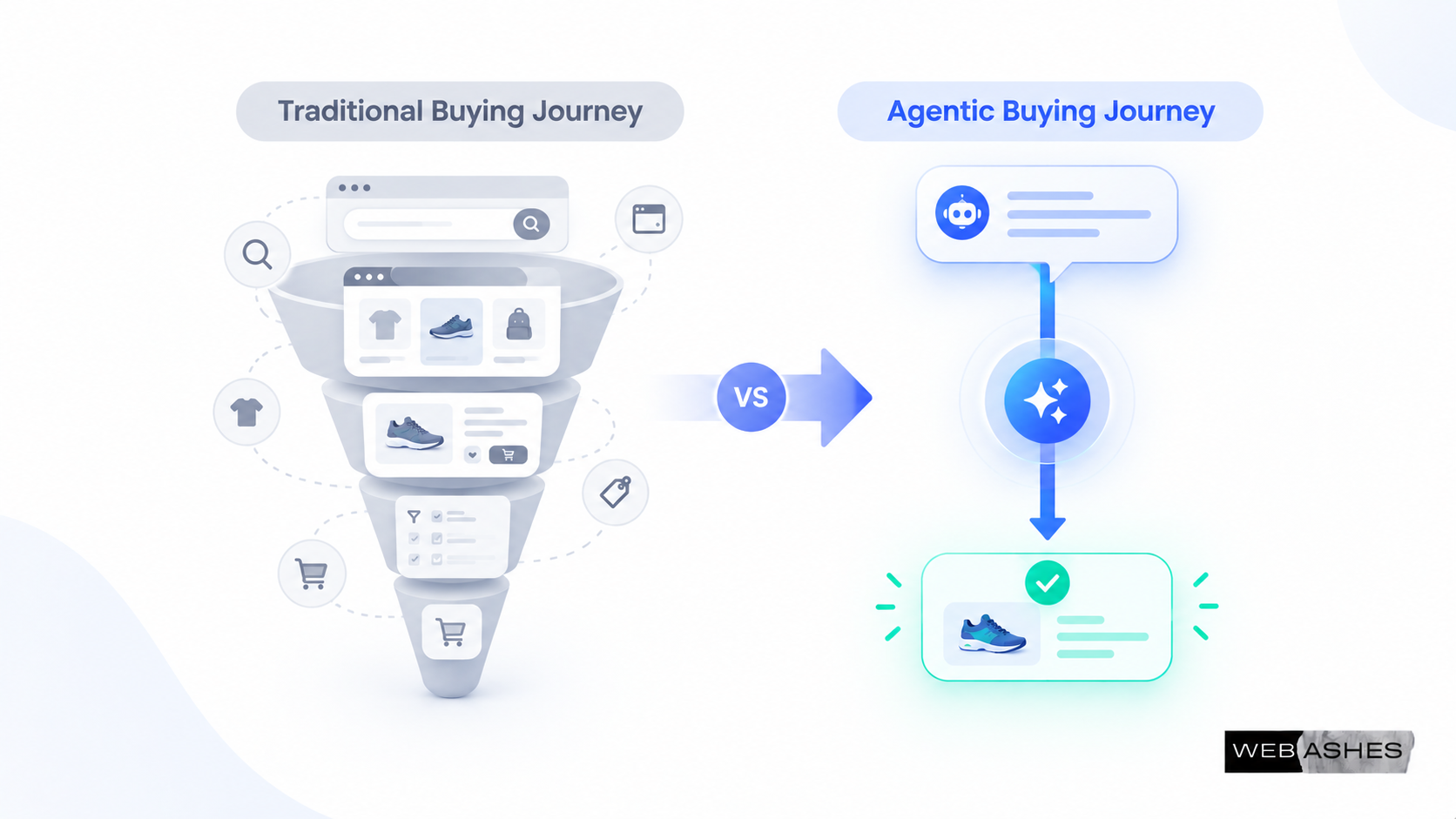
As the scope of ‘agentic commerce’ grows and expands, the traditional ‘purchase funnel’ or sequence of steps in the buying process is not only changing, but also being completely reorganized.
So, now it’s worth to know hot the new agentic shopping journey is evolving and going to change the retailer’s sales funnel.
Is AI Breaking the Sales Funnel of Retailers
In simple terms, YES!. The traditional funnel has been something like this: Awareness > Interest > Consideration > Purchase. That linear model has been the backbone of retail marketing for decades. Retailers invested in SEO for awareness, content for consideration, and checkout optimization for conversion.
However, Agentic commerce collapses this. A shopper tells an AI what they need, and the agent handles research, comparison, selection, and in many cases, the purchase itself. The distance between inspiration and transaction is shrinking to near zero.
The nature of shopping is now moving away from a destination-centric experience, where a shopper visits a website, browses categories, and fills a cart, now forwarding to an ‘intent-based’ experience. The path is now far smaller than previously: The shopper expresses a need. The AI figures out the rest.
For retailers, this creates a new question: if the shopper never visits your storefront, how do you win the sale?
And you need to find this answer for sure. If you’re still confused, here are some data about the revolution of Agentic Commerce that can help to shape your mind:
The Scale of the Shift
50 million
shopping queries processed by ChatGPT every single day (NBER / OpenAI)
393%
year-over-year growth in AI-referred traffic to US retailers in Q1 2026 (Adobe Analytics)
42%
better conversion rate for AI-referred traffic compared to traditional search (Adobe Analytics, 2026)
$5 trillion
projected global agentic commerce volume by 2030 (McKinsey / Salesforce)
These numbers aren’t projections of agentic commerce; they’re already happening. The retailer funnel isn’t breaking in theory. It’s breaking in practice, right now, across millions of daily shopping sessions.
What the Old Buying Journey Looked Like
The traditional funnel put the shopper in the driver’s seat and made them do all the driving.
The typical scenario was that a shopper becomes aware of a need. They search Google. They click through multiple results. They open multiple tabs, read reviews, compare products, check prices on two or three websites, and finally decide to complete the purchase.
Every step was manual. Every step was a potential drop-off point. Cart abandonment rates in traditional e-commerce average around 70%. This means that seven out of every ten buyers start the journey and don’t finish it.
The funnel was also fragmented. Awareness happened on social media. Research happened on Google. Price comparison happened on Amazon. Reviews happened on Reddit. The shopper bounced between platforms before you ever got to conversion.
From the retailers’ side, they used to work on every platform, giving ads on Google, publishing content for SEO, reaching out to influencers on Instagram, and optimizing listings on Amazon. The goal was to intercept the shopper at as many points as possible.
So, if you sum up the old model, it was something where retailers competed for attention at every stage of a long, leaky journey that shoppers navigated manually.
What the Agentic Buying Journey Looks Like
The new funnel brings each step into a single conversation, and AI does most of the work for buyers. Shoppers express what they want. Agents figure out the best option. Yes, the funnel happened before the shopper reached your store.
Nowadays, the shopper doesn’t start on Google. They open ChatGPT, or Gemini, or Microsoft Copilot.
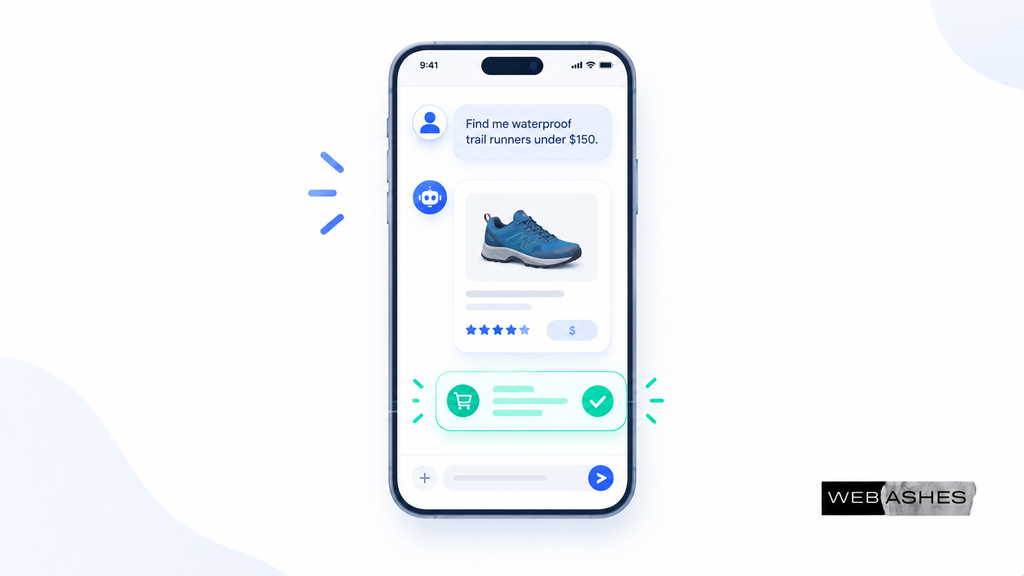
Then, they describe what they need in plain language, including their budget, use case, and specific requirements. The agent interprets that intent and does the research instantly.
No tabs. No comparison websites. No reading review aggregators. The agent synthesizes all of that in seconds and returns a recommendation.
If the agent is authorized to purchase, it completes the transaction without the shopper ever visiting a website. If not, it sends the shopper directly to the right product page, already decided, already pre-qualified.
The funnel doesn’t have five stages anymore. It has one: intent. And the gap between intent and transaction is measured in seconds, not sessions.
How Agentic Commerce Completes the Journey (Phase by Phase)
Knowing how your targeted customers are behaving in AI chat tools like ChatGPT Shopping will help you optimize your product pages greatly. Here’s how the full agentic buying journey works, from first prompt to fulfilled order.
Phase 1: Discovery: Products Are Found Through Intent, Not Search
The agent reads your data – not your marketing.
- The shopper describes their need in conversational language. The agent translates that into a structured query against product catalogs.
- It queries the Google Shopping Graph (60+ billion listings), merchant feeds, and structured schema on product pages, not your homepage only.
- Products with accurate, machine-readable data get recommended. Products with vague or outdated data get skipped.
- What this means for you: Your product data is your storefront now. Accurate pricing, real-time inventory, structured attributes, and clean GTINs determine whether you appear. Also focus on adding clear alt text in your product images to help AI to understand easily.
Phase 2: Evaluation: The Agent Does the Research Phase
Review reading, spec comparison, and price checking – handled by the AI, not the shopper.
- The agent synthesizes third-party reviews, compares specifications, and filters by the shopper’s stated constraints, all simultaneously.
- It can also flag compatibility issues proactively. If a shopper is building a PC and two parts won’t work together, the Universal Cart surfaces this before checkout.
- Research that used to take a shopper 30 minutes now takes the agent 3 seconds.
- What this means for you: Strong reviews on trusted third-party platforms matter more than ever. The agent cites its sources, and products with credible external review signals get recommended with more confidence. So, you need a solid AEO optimization strategy to build for your ecommerce business.
Phase 3: Checkout: The Session Is Negotiated Programmatically
Taxes, shipping, and totals are calculated in real time directly inside the AI conversation.
- When the shopper decides to buy, the agent initiates a checkout session with the merchant’s backend via the Agentic Commerce Protocol (ACP) or Universal Commerce Protocol (UCP).
- The merchant’s system calculates exact line item totals, localized taxes, and shipping options dynamically and returns the authoritative session state.
- If the shopper changes quantity or shipping address mid-conversation, the backend recalculates instantly, and the agent updates the total in chat.
- The session status moves from ‘not ready for payment‘ to ‘ready for payment’ only once all details are confirmed.
- What this means for you: Your backend needs to handle these programmatic session requests. Stripe’s Agentic Commerce Suite handles most of this for merchants. But your inventory and pricing data must be live and accurate.
Phase 4: Payment: Secure, Constrained, and Cryptographically Verified
No raw card numbers. No unconstrained spending authority. Every transaction is bounded.
- Payment happens through Shared Payment Tokens (SPTs) or digital mandates, not raw card credentials.
- Every token is cryptographically scoped to a specific merchant, a maximum amount, and an expiration time. The agent cannot exceed those limits.
- The Agent Payments Protocol (AP2) creates a tamper-proof mandate – a permanent record of exactly what the shopper authorized.
- On the merchant’s side, accepting the payment requires minimal code change: swap the traditional payment method for the SPT token ID in a standard payment intent.
- What this means for you: Agentic transactions are actually more auditable than traditional checkouts. Every transaction has a verifiable record, which is useful for disputes, returns, and fraud resolution.
Phase 5: Fulfillment: Your Existing Backend, Unchanged
The agent handled discovery and checkout. You handle everything after.
- Once payment is captured, standard webhooks (order_create, order_update) fire to your inventory and fulfillment systems – the same way any web checkout would.
- You remain the Merchant of Record. Customer relationships, margins, shipping, returns, and support all stay with you.
- If you prefer to authorize at checkout and capture when the product ships, that’s supported – you can trigger the final capture when your OMS confirms the package has left the warehouse.
- What this means for you: You don’t need to rebuild your backend. Your existing ERP, OMS, and customer service systems process agentic orders identically to standard web purchases.
Phase 6: Post-Purchase: The Agent Stays in the Loop
Order tracking, status updates, and returns – handled in the same chat where the purchase happened.
- The merchant POSTs order lifecycle events (shipped, delivered, delayed) directly to the AI platform’s webhook receiver. And this has to be signed with an HMAC signature to prevent spoofing.
- The agent receives these updates and can answer ‘where is my order?’ accurately inside the conversation without the shopper opening a tracking email or calling support.
- Returns and refund requests can be managed through the same conversational thread.
- What this means for you: This is where agentic commerce reduces customer support load. WISMO (Where Is My Order) is the single most common support query in e-commerce. Agents can handle it automatically if your webhook integration is in place.
Also Read: Featured Snippet Examples for Better Product Visibility
How Retailers Need to Prepare for Agentic Funnel
The fundamentals of control in the purchase funnel have changed massively. Here’s what actually moves the needle in an agentic funnel.
Product data is the new storefront
Agents read your data, not your design. Accurate pricing, real-time stock, clean GTINs, and structured descriptions are what get you discovered – not a great homepage or an always-high ad budget.
Start with your foundational feed. Then enrich it with conversational attributes: question-and-answer pairs from your support logs, related product mappings, compatible accessories, and variant options in machine-readable format.
Reviews are now recommendation signals
Agents synthesize third-party reviews when making recommendations. Products with strong, authentic reviews on credible external platforms get recommended with confidence. Products without them get skipped or treated with uncertainty.
This isn’t about volume. It’s about credibility. Reviews on Google, trusted industry sites, and major retail platforms carry more weight than reviews only on your own product pages.
Your conversion window is now much shorter
Shoppers arriving from AI recommendations have already made most of their decision. They’re not browsing; rather, they’re confirming. If your product page doesn’t match what the agent showed them (wrong price, out of stock, different specs), the trust breaks instantly.
The tolerance for mismatch is much lower with pre-qualified, high-intent agentic traffic. Speed, accuracy, and frictionless checkout matter more than ever.
Schema markup is table stakes
Schema.org Product markup on your product pages is how AI crawlers read your catalog directly from your website. It must be server-side rendered, not generated by JavaScript after page load. AI crawlers don’t execute JS.
Map the key properties: SKU, GTIN, price, availability, and a direct checkout URL. These are what agents use to verify, recommend, and link to your products.
The key mindset shift
In traditional e-commerce, you competed for clicks. In agentic commerce, you compete for data quality. The retailer with the most accurate, structured, and conversationally rich product data wins, not the one with the biggest ad budget.
Frequently Asked Questions
What is agentic commerce and how does it complete the buying journey?
How is the agentic purchase funnel different from the traditional one?
Do retailers lose control of the customer relationship in agentic commerce?
What are Shared Payment Tokens (SPTs) and why do they matter?
What is the Universal Cart and how does it help retailers?
How does post-purchase support change with agentic commerce?
What should retailers focus on first to be ready for agentic commerce?
Does agentic commerce work with my existing checkout and fulfillment systems?
Wrap Up!
The funnel hasn’t disappeared – it’s just moved somewhere you can’t see it yet.
The research, the comparison, the shortlisting, and more of that is happening inside AI conversations before a shopper ever reaches your store. You don’t see that traffic. You don’t get to optimize for it with traditional tools.
What you can control is whether you show up when the agent is deciding. That depends on one thing more than anything else: the quality and structure of your product data.
Retailers who get that right- accurate pricing, real-time inventory, structured schema, clean identifiers, genuine reviews, which will capture high-intent traffic that converts better than anything traditional search ever sent them.
Those who don’t will simply be invisible to the agents doing the shopping.
The funnel has changed. The question is whether your store is ready for the new one.
Leave a Reply